Full Text of the August Monetary Policy Decision Statement
The Bank of Korea's Monetary Policy Committee announced on the 28th that it would keep the base interest rate unchanged at 2.50% per annum. The committee stated, "Although the upward trend in housing prices in the Seoul metropolitan area and the growth in household debt have slowed, it is necessary to further monitor whether these trends will stabilize in the long term." They added, "We have determined that it is appropriate to maintain the current level while closely monitoring changes in both domestic and external conditions."
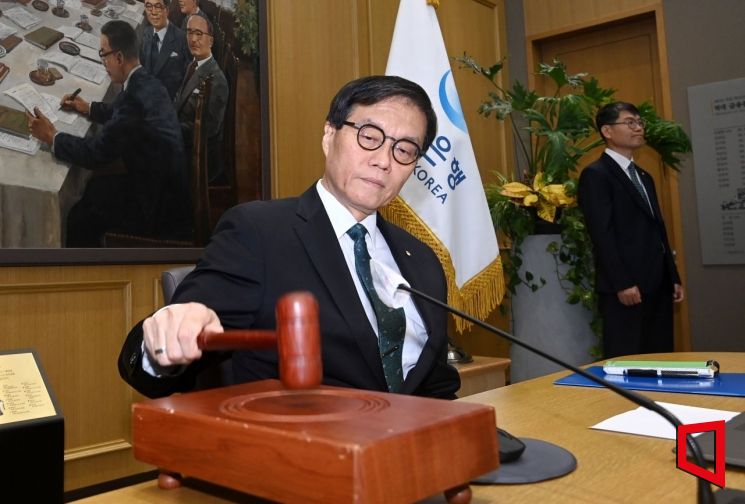 Lee Changyong, Governor of the Bank of Korea, is striking the gavel at the Monetary Policy Committee meeting held at the Bank of Korea in Jung-gu, Seoul on the morning of the 28th. Photo by Joint Press Corps
In the statement on the direction of monetary policy distributed that morning, the Monetary Policy Committee said, "Going forward, domestic demand is expected to continue its moderate recovery, supported by the supplementary budget and improved consumer sentiment. However, exports are expected to gradually slow as the impact of U.S. tariffs expands." The committee further assessed, "There is a high level of uncertainty regarding the future growth path, particularly related to U.S.-China trade negotiations, the imposition of tariffs on specific items, and the pace of domestic demand improvement." The Bank of Korea projected economic growth of 0.9% for this year and 1.6% for next year.
The domestic inflation forecast was revised upward by 0.1 percentage points compared to the May outlook, to 2.0% for this year and 1.9% for next year. The committee stated, "Despite rising prices of agricultural, livestock, and fisheries products, domestic inflation is expected to remain around 2%, supported by low demand pressure and stable international oil prices." They added, "Next year, both consumer price inflation and core inflation are expected to slightly exceed the previous forecast (1.8%), driven by continued recovery in consumption."
Regarding household loans and housing prices, the committee noted, "The scale of household debt growth has been significantly reduced due to government measures, and both the upward trend in prices and transaction volumes in the Seoul metropolitan housing market have slowed." However, they also pointed out, "Expectations for rising housing prices remain high."
The committee stated, "While inflation remains stable and growth has somewhat improved, uncertainty regarding the future growth path remains high due to factors such as U.S. tariff policy." They continued, "From a financial stability perspective, although the upward trend in metropolitan housing prices and household debt growth has slowed, it is necessary to further monitor whether these trends will stabilize. Additionally, continued attention should be paid to the potential for increased exchange rate volatility."
Below is the full text of the monetary policy decision statement.
The Monetary Policy Committee has decided to operate monetary policy by maintaining the Bank of Korea's base rate at the current level of 2.50% until the next decision on the direction of monetary policy. While inflation remains stable, the growth outlook is still highly uncertain, but there are signs of improvement centered on domestic demand. Given the need to further observe trends in metropolitan housing prices and household debt, the committee judged it appropriate to maintain the current base rate while monitoring changes in both domestic and external conditions.
Looking at the global economy, although trade negotiations between the United States and major countries have made progress, the impact of tariff increases has become more apparent, leading to a gradual slowdown in growth. The inflation trajectory is expected to differ by country. In international financial markets, U.S. long-term Treasury yields and the dollar index initially rose but later fell as expectations for a Federal Reserve rate cut increased. Major stock indices rose as uncertainties related to tariff negotiations eased. Going forward, the global economy and international financial markets are expected to be influenced by U.S.-China trade negotiations, the direction of tariffs on specific items, and changes in the monetary policies of major countries.
In the domestic economy, despite continued sluggishness in construction investment, consumption has recovered and exports, especially semiconductors, have increased more than expected, leading to improved growth momentum. Employment has continued to rise overall, although major industries such as manufacturing have seen declines. Going forward, domestic demand is expected to continue its moderate recovery, supported by the supplementary budget and improved consumer sentiment. However, exports are expected to remain favorable for the time being, but gradually slow as the impact of U.S. tariffs expands. As a result, this year's growth rate is projected to be 0.9%, slightly above the May forecast (0.8%), and next year's growth rate is expected to be in line with the previous forecast (1.6%). The committee assessed that there remains a high level of uncertainty regarding the future growth path, particularly related to U.S.-China trade negotiations, the imposition of tariffs on specific items, and the pace of domestic demand improvement.
As for domestic prices, the consumer price inflation rate in July slightly decreased to 2.1%, while core inflation (excluding food and energy) remained at 2.0%, maintaining a stable trend. Short-term inflation expectations among the general public rose slightly to 2.6% in August from 2.5% in the previous month. Going forward, domestic inflation is expected to remain around 2%, despite rising prices of agricultural, livestock, and fisheries products, due to low demand pressure and stable international oil prices. This year's consumer price inflation is projected at 2.0%, slightly above the May forecast (1.9%), and core inflation is expected to rise by 1.9%, in line with the previous forecast. Next year, both consumer price inflation and core inflation are projected to be 1.9%, slightly above the previous forecast (1.8%), driven by continued recovery in consumption. The future inflation path is expected to be influenced by domestic and global economic trends, exchange rates, international oil prices, and government measures to stabilize prices.
The financial and foreign exchange markets have remained generally stable. Long-term government bond yields fluctuated within a narrow range, and stock prices paused their upward trend due to adjustment pressures following previous gains and changing expectations regarding improvements in capital market regulations. The won/dollar exchange rate rose, reflecting continued demand for overseas investment by residents. Household loan growth has been significantly reduced due to government measures. In the Seoul metropolitan housing market, both the upward trend in prices and transaction volumes have slowed, but expectations for rising housing prices remain high.
The Monetary Policy Committee will continue to monitor the growth trend to ensure that inflation remains stable at the target level over the medium term, while also paying close attention to financial stability in its conduct of monetary policy. While the domestic economy has seen some improvement in growth amid stable inflation, uncertainty regarding the future growth path remains high due to the impact of U.S. tariff policy. From a financial stability perspective, although the upward trend in metropolitan housing prices and household debt growth has slowed, it is necessary to further monitor whether these trends will stabilize. Continued attention should also be paid to the potential for increased exchange rate volatility. Therefore, future monetary policy will maintain a rate-cutting stance to mitigate downside risks to growth. In this process, the committee will closely monitor changes in both domestic and external policy conditions, as well as the resulting trends in inflation and financial stability, in determining the timing and pace of any further base rate cuts.
© The Asia Business Daily(www.asiae.co.kr). All rights reserved.












