Lutnick, U.S. Commerce Secretary, in CNBC Interview
"Trading Partners Understand 'A Strong America Means Global Success'"
U.S. Moves to Formalize Investment Agreement with Japan
South Korea Likely to Follow Amid Growing Pressure
The Donald Trump administration in the United States has proposed creating a National Economic Security Fund using investment funds from South Korea and Japan. The plan is to use funds secured by leveraging high tariffs imposed on allied countries and invest them in rebuilding domestic infrastructure.
Although South Korea and the United States reached a broad trade agreement last month, significant differences remain on specific issues such as the method of investment in the United States. The U.S. is expected to continue raising additional demands and increase pressure during subsequent negotiations.
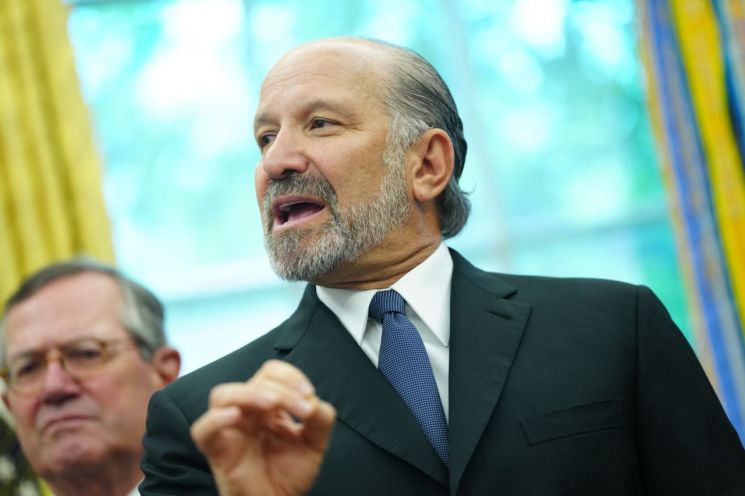
On the 26th (local time), U.S. Secretary of Commerce Howard Lutnick stated in an interview with CNBC, "We will establish a National Economic Security Fund with money from Japan, South Korea, and other countries," adding, "This is a deal President Trump achieved using tariffs, and these countries will provide us with funding to build America's social infrastructure."
Secretary Lutnick claimed that this fund is not derived from tariff revenue but from "the commitments of countries that fundamentally understand that a strong America is essential to global success." He also emphasized that the fund will be created with money from other countries, stating, "To be clear, there is currently no sovereign wealth fund. We are not spending U.S. taxpayers' money anywhere. We are not launching a sovereign wealth fund."
Previously, President Trump signed an executive order in February instructing the Treasury Department and the Department of Commerce to establish a sovereign wealth fund. However, since operating a sovereign wealth fund based on public funds would entail strict regulatory oversight, high transparency requirements, and accountability in the event of investment failures, the administration appears to have shifted toward creating a fund using investment money from South Korea, Japan, and others.
Last month, the United States agreed to lower tariffs on all South Korean imports, including automobiles and auto parts, from 25% to 15% in exchange for a total investment of 350 billion dollars (approximately 48.8 trillion won) from South Korea. Japan, which reached a trade agreement with the United States before South Korea, also pledged to invest 550 billion dollars (approximately 76.7 trillion won) in the United States in return for a reduction of tariffs on Japanese imports to 15%. However, while South Korea and Japan are advocating for a fund centered on guarantees and loans, the United States is insisting on a greater share of direct investment, and the parties have yet to bridge this gap.
Earlier, the European Union also agreed to invest 600 billion dollars (approximately 83.7 trillion won) in the United States and received a tariff reduction to 15%. However, Secretary Lutnick specifically mentioned only South Korea and Japan as countries providing funds to the National Economic Security Fund during his remarks.
After the South Korea-U.S. tariff negotiations were concluded, Secretary Lutnick revealed on his social networking service X (formerly Twitter) that the United States should retain 90% of the profits from South Korea's investment in the United States. This time, he has presented a clearer plan for utilizing investment funds from South Korea, Japan, and others, accelerating the process of implementing concrete measures.
Meanwhile, the United States is working to formalize the 550 billion dollar investment agreement with Japan in writing. Although Japan had previously been reluctant to document the agreement, it appears to have changed its stance under U.S. pressure. This reveals the U.S. intention to ensure that the investment pledge is not left as an empty promise. South Korea is also likely to enter the documentation process for its investment plans in the United States, continuing detailed negotiations under ongoing U.S. pressure. However, it seems unlikely that South Korea will be able to insist solely on a guarantee- and loan-based investment approach in the face of U.S. demands for a higher proportion of direct investment.
Meanwhile, Secretary Lutnick mentioned that the Trump administration is considering acquiring stakes in U.S. defense companies in the same way it acquired a 10% stake in Intel in exchange for subsidies. He said, "There is tremendous discussion regarding the issue of acquiring stakes in the defense industry," adding, "Lockheed Martin generates 97% of its revenue from the U.S. government. They are, in effect, a division of the U.S. government." He continued, "But what about the economics? I will leave that decision to the Secretary of Defense and the Deputy Secretary. They are handling that matter and are reviewing it."
© The Asia Business Daily(www.asiae.co.kr). All rights reserved.












