"Highest in Asia...
India's Export Competitiveness at Risk"
The Donald Trump administration in the United States implemented a 50% tariff on Indian products starting on the 27th (local time), citing reasons such as imports of Russian crude oil.
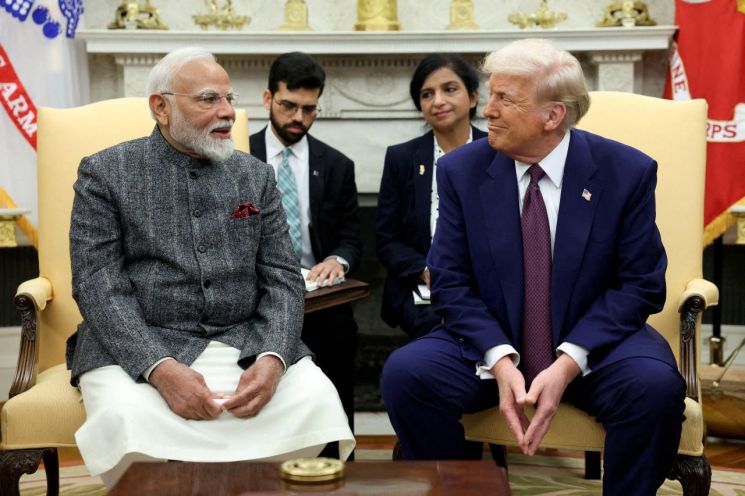
According to Bloomberg News and other sources, the Trump administration imposed a 50% tariff on Indian products starting at 12:01 a.m. Eastern Standard Time on this day. However, the 50% tariff does not apply to humanitarian aid goods or items covered under reciprocal trade programs.
In April, the United States imposed a 26% reciprocal tariff on India, and the two countries held five rounds of negotiations afterward. However, they failed to reach an agreement due to differences over reducing tariffs on U.S. agricultural products and India's continued purchases of Russian crude oil.
In response, President Trump strongly criticized oil transactions between India and Russia and announced that a total tariff of 50% would be imposed on Indian products, consisting of a 25% reciprocal tariff-1% lower than before-plus an additional 25%. Peter Navarro, the White House Trade and Manufacturing Policy Advisor known as Trump's "tariff strategist," and U.S. Treasury Secretary Scott Besant also criticized India for increasing purchases of Russian crude oil, thereby indirectly supporting the war in Ukraine.
Bloomberg News noted that the 50% tariff is the highest rate the U.S. has imposed on any Asian trading partner, and pointed out that India, a rapidly growing major economy, could face a downturn in trade with its largest export market, the United States. The report also highlighted that India's export competitiveness could be threatened compared to rival countries such as Vietnam.
Some experts argue that because the Indian economy relies more on domestic demand than exports, the economic impact of the 50% tariff could be mitigated. Last year, India's exports to the United States totaled $87.4 billion, which accounted for only 2% of India's total gross domestic product (GDP). Trinh Nguyen, chief economist at the French global financial firm Natixis, analyzed, "Because India's domestic market is so large, the short-term impact will be minimal."
© The Asia Business Daily(www.asiae.co.kr). All rights reserved.