Births Expected to Surpass 300,000 This Year
A Rare Bit of Good News for the Dairy Industry, Yet Concerns Remain
Imported Brands Like Aptamil Gain Ground in the Market
K-Formula Looks to Overseas Markets Like Cambodia
Regulatory Barriers Limit
Although the number of expected births this year is estimated to exceed 300,000, the dairy industry continues to face difficulties. This is because more parents are choosing imported infant formula despite higher prices, weakening the competitiveness of domestic formula brands. While the dairy industry is turning its attention overseas, there are concerns that regulations and other barriers are limiting their ability to enter new markets.
Birth Numbers Recovering... A Rare Bit of Good News for the Dairy Industry
According to the National Assembly Budget Office on August 30, the number of expected births this year is projected to reach 304,000, an increase of 21,000 from the previous year (283,000). If the number of births exceeds 300,000, it will mark the first time in six years, since 2019, that the figure has returned to the 300,000 range.
Experts analyze that the increase in the number of expected births is due to women born between 1991 and 1996, a large demographic group, reaching childbearing age. The number of births in South Korea peaked at 438,420 in 2015 and had been declining every year until it rebounded to 238,300 last year, marking the first increase in nine years. The total fertility rate also continued to decline after 2015 (1.239) but rose to 0.750 last year, reversing the trend for the first time in nine years.

While the increase in the main consumer base for infant formula is rare good news for the dairy industry, companies are not optimistic. This is because the market share of domestic infant formula brands continues to decline, while the preference for imported formula is rising.
‘Gangnam Formula’ Aptamil Gains Ground... K-Formula Sees Sales Drop
In reality, domestic infant formula brands are experiencing a severe decline in sales. Maeil Dairies’ ‘Absolute’ saw retail sales fall by 27.6%, from 3.221 billion won in the first half of 2023 to 2.402 billion won in the first half of last year. During the same period, Ildong Foodis’ ‘Goat Milk Formula’ dropped by 26.5%, from 2.091 billion won to 1.535 billion won. Namyang Dairy Products’ ‘Imperial’ and ‘I Am Mother’ decreased by 16.8%, from 3.097 billion won to 2.57 billion won. Lotte Wellfood’s ‘Pasteur’ fell by 18.7%, from 2.402 billion won to 1.95 billion won.
Meanwhile, Nutricia’s ‘Aptamil’ recorded a 10.7% increase in sales, rising from 85.4 billion won to 94.6 billion won during the same period. The German formula brand Aptamil, which officially launched in South Korea in 2017, gained popularity as the so-called ‘Gangnam Formula’ and, according to Nielsen, ranked first with a domestic market share of around 20% last year.
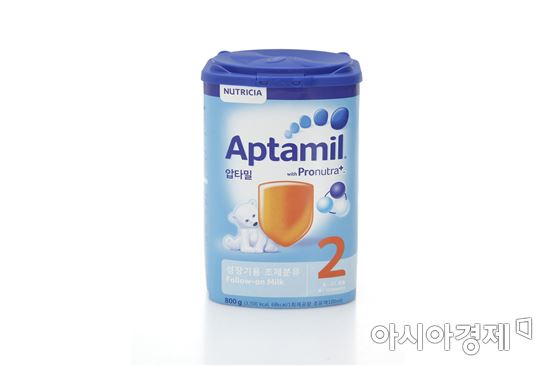 Aptamil Stage 2
Sales of infant formula through domestic retail distribution channels have also continued to decline. According to the Korea Agro-Fisheries & Food Trade Corporation (aT), sales dropped from 15.893 billion won in the first half of 2023 and have continued to fall, reaching 14.235 billion won in the second half of 2023 and 12.05 billion won in the first half of 2024.
In contrast, Korea Customs Service import and export statistics show that last year’s infant formula imports reached an all-time high of 4,912 tons. By country, the largest imports came from Germany (2,040 tons), followed by New Zealand (1,306 tons), Ireland (417 tons), and France (380 tons).
An industry insider explained, “Millennial & Gen Z parents are increasingly purchasing imported formula through direct overseas shopping, such as buying directly from German websites. As European and other foreign formula brands enter the Korean market with premium strategies, competition has become even fiercer.”
Looking Overseas Instead of Domestic... Regulatory Barriers Remain
The domestic dairy industry, facing difficulties at home, is seeking opportunities in overseas markets with higher birth rates. These markets not only have a larger number of annual births than Korea, but also a growing preference for high-priced formula products.
According to agricultural export information from the Korea Agro-Fisheries & Food Trade Corporation, last year’s infant formula exports to the ten ASEAN (Association of Southeast Asian Nations) countries reached a record high of $30.7 million (about 4.42 billion won). This is nearly a threefold increase from $10.5 million in 2014 over the past ten years.
Cambodia stands out among these markets. Cambodia’s birth rate last year was 2.26, three times higher than Korea’s 0.72. In addition, the country relies on imports for its infant formula, presenting many opportunities for Korean dairy companies. Namyang Dairy Products was the first to enter the Cambodian formula market in 2007 and has since raised its market share to 20%, competing for the top two positions.
However, there are still many challenges, as entering foreign markets is often difficult due to different market conditions and regulations. An industry insider said, “Indonesia, the world’s fourth most populous country, is attracting attention due to its high birth rate and growing middle class, but the procedures for entry are extremely complicated. To obtain import approval, companies must go through a series of steps, including approvals from the Ministry of Agriculture and the Ministry of Trade, on-site inspections, quarantine, and the conclusion of sanitary agreements. In particular, agreements such as livestock quarantine agreements (SPS agreements, etc.) between the Korean and Indonesian governments must be prioritized, making exports far from easy.”
© The Asia Business Daily(www.asiae.co.kr). All rights reserved.

















