Step-by-Step Supply of 3,500 Public Rental Housing Units by 2030
Revitalizing the Old Downtown with a Youth Network through "Win-Win Lease-Rental" Utilizing Vacant Buildings
"POBATT Urban Secondary Battery Shared Campus": An Integrated City Mode
"Sustainable urban development can only be achieved when jobs are created in new industries and housing stability attracts a continuous influx of young people!"
At a press briefing held in the city hall briefing room on the 27th, Kangduk Lee, mayor of Pohang, expressed his commitment to establishing an integrated residential welfare model that combines industry, housing, and welfare to lead balanced regional development.
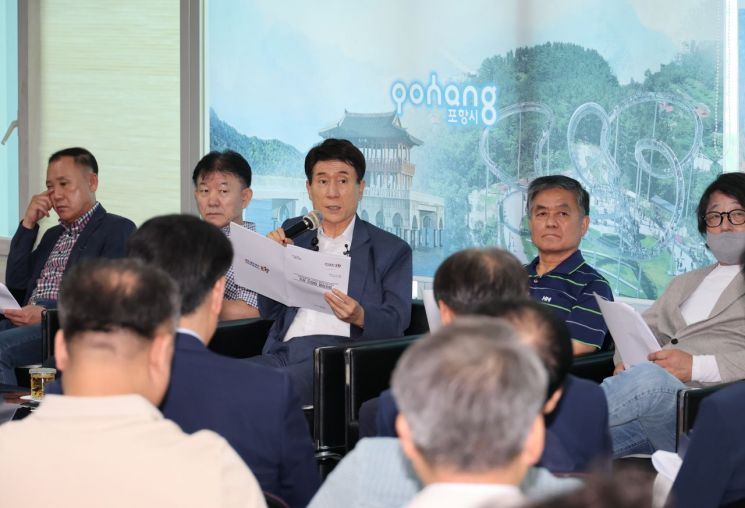 Kangduk Lee, mayor of Pohang, held a press briefing at the city hall on the 27th regarding the establishment of an integrated residential welfare model that combines industry, housing, and welfare to lead balanced regional development. Photo by Pohang City
The three core projects of this policy are: ▲ the largest-ever "1,000-Won Housing" supply by a local government, ▲ a "win-win leasing and rental" initiative utilizing vacant buildings, and ▲ the establishment of the "POBATT Urban Secondary Battery Shared Campus."
The 1,000-Won Housing program allows selected households-youth aged 19 to 45 and newlywed couples without homes-to live in rental units for 1,000 won per day, for an initial period of two years and up to a maximum of four years, helping to reduce their housing cost burden.
This project involves Pohang City subleasing public purchase rental housing from Korea Land & Housing Corporation to provide to young people and newlywed couples. Starting with the supply of 100 units this year, the city plans to gradually expand to 500 units over five years.
Previously, it was confirmed that 50% of residents in the Young Stepping Stone Housing program were newcomers from other cities and counties, proving the effectiveness of population inflow. The new policy is also expected to significantly contribute to the continued influx of young residents.
Pohang City plans to supply 500 units to young people and newlywed couples in the first phase, 1,800 units mainly to newlywed couples, families with multiple children, and workers in the second phase, and 1,200 units mainly to families with multiple children and elderly residents in the third phase-providing a total of 3,500 customized public rental homes by 2030, tailored to different life stages.
Additionally, through the "win-win leasing and rental" project utilizing vacant buildings, the city will revitalize the stagnant old downtown by transforming it into a hub for nurturing young talent and for commerce and culture. Five key facilities will be established, including startup incubator residences, new industry workforce training centers, and complex art villages and creative residencies. The city will also operate 22 programs matching demand for startup and cultural arts spaces, forming youth networks and breathing new life into the city center.
Furthermore, the city will establish the "POBATT Urban Shared Campus" in connection with future strategic industries such as the secondary battery sector. Although the secondary battery industry is currently experiencing a temporary downturn in the "chasm" phase, Pohang plans to prepare for the revitalization of the eco-friendly electric vehicle market by creating a shared platform-based secondary battery training center with participation from all local universities. This will nurture specialized talent linked to local industries and supply them domestically and internationally.
Lastly, the mayor announced plans to expand targeted housing solutions for all Pohang citizens. These include supporting real estate brokerage fees and moving expenses for single-person youth households, and launching a relay of public-private partnership home repair projects.
On this day, Mayor Kangduk Lee also reiterated the urgent need to strengthen the competitiveness of the steel industry. "The regional steel industry crisis is deepening due to the triple challenges of oversupply from China, U.S. tariffs, and global carbon reduction pressures," he said, emphasizing the need for technological development and increased investment to overcome these challenges.
He especially called for active government support for research and development and investment in carbon neutrality technologies such as hydrogen reduction steelmaking. He stressed the importance of strengthening competitiveness through corporate R&D and expanding facility investment for production process innovation to address the aging equipment of local companies, repeatedly urging for the swift enactment of the "K-Steel Act."
The Haeoreum Bridge and Win-Win Park apartment construction sites, promoted by POSCO E&C, have resumed construction after completing safety inspections. The city plans to strengthen safety guidance and inspections at each site to prevent any loss of life in the region in the future.
Mayor Kangduk Lee stated, "We will create a residential environment where young people and newlywed couples can settle with peace of mind, and ensure that all citizens can feel proud of living in Pohang. I am determined to take the lead and do whatever it takes to restore the competitiveness of the regional steel industry."
© The Asia Business Daily(www.asiae.co.kr). All rights reserved.