Population Decline Continues for Five Years
Single-Person Households Make Up 42% of Total
Average Age Rises for Both Men and Women
The resident registration population has declined for five consecutive years from 2020 to last year, continuing the trend of population decrease. For the first time this year, the number of single-person households surpassed 10 million, indicating the spread of the 'solo generation.'
The Ministry of the Interior and Safety announced on August 27 that it has published the "2025 Statistical Yearbook of the Ministry of the Interior and Safety," which contains these findings. The yearbook includes 327 statistics across eight areas-government organization, administrative management, digital government, local administration, local finance, safety policy, disaster management, and others-based on data as of December 31 of last year.
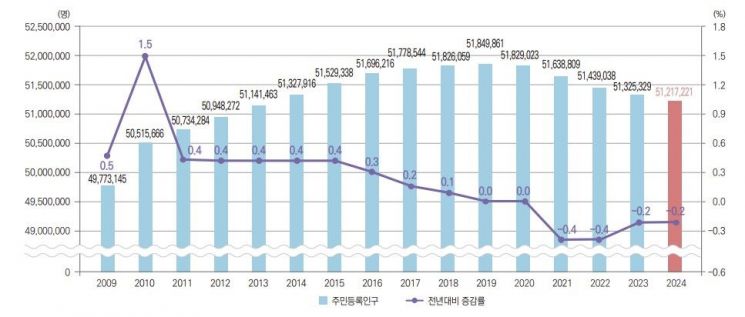
As of last year, the resident registration population was 51,217,221, which is a decrease of 108,108 compared to 51,325,329 in 2023. The resident registration population has declined for five consecutive years since 2020, when it was 51,829,023. However, the rate of decline has slowed since peaking in 2022, indicating a slight easing in the population decrease trend.
The total number of households reached 24,118,928, an increase of about 1 million compared to 2020. Single-person households surpassed 10 million just four years after exceeding 9 million in 2020. Last year, there were 10,122,587 single-person households, accounting for 42% of all households. Two-person households also increased from 5.4 million in 2020 to 6.01 million last year. In contrast, households with four or more members decreased from 4.61 million to 3.94 million over the same period.
The average age was higher for women at 46.8 years, compared to 44.5 years for men. Both figures increased from the previous year's 43.7 years for men and 45.9 years for women.
Accelerated digital transformation led to an increase in the online civil service usage rate from 59.4% in 2020 to 83.7% last year. The number of electronic certificates issued surged from about 480,000 in 2020 to about 18.63 million in 2023, and about 26.2 million last year.
The number of reports filed through the Safety Report Portal soared from about 1.89 million in 2020 to about 12.43 million last year, a 6.6-fold increase. Compared to approximately 7.53 million in 2023, this represents a 65.2% increase.
Due to abnormal climate conditions, the number of days with heat waves has been increasing. It rose from 7.7 days in 2020 to the 10-day range in 2022 and 2023, and then surged to 30.1 days last year.
The statistical yearbook, which includes these key statistics, can be downloaded as a file from the Ministry of the Interior and Safety's website under 'Policy Data - Statistics - Statistical Yearbook & Thematic Statistics.'
Yoon Hojoong, Minister of the Interior and Safety, stated, "The 2025 Statistical Yearbook of the Ministry of the Interior and Safety is an important indicator that comprehensively shows the changes in our society and government operations. Based on this data, we will design policies with greater precision to make daily life more convenient for the public and improve policies so that people can directly experience a safer everyday life."
© The Asia Business Daily(www.asiae.co.kr). All rights reserved.

![Clutching a Stolen Dior Bag, Saying "I Hate Being Poor but Real"... The Grotesque Con of a "Human Knockoff" [Slate]](https://cwcontent.asiae.co.kr/asiaresize/183/2026021902243444107_1771435474.jpg)















