Korean Distribution Law Association and Korean Distribution Association Joint Seminar
Experts Express Concerns Over Amendments to the Large-Scale Retail Business Act
"Preference for Safe Major Brand Products May Deepen the Gap Between Big and Small Businesses"
Potential Disruptions to Consumer Refund Requests
Following last year's incident where TMON and Wemakeprice (TMEP) failed to settle payments with sellers, and Homeplus's abrupt application for corporate rehabilitation at the beginning of this year, there has been a growing movement led by the government and lawmakers to shorten the settlement period in the distribution market. However, distribution industry experts have expressed concern that a uniform legal amendment could actually fuel market confusion. They warn that if payment deadlines are artificially shortened without considering company size and other factors, the burden on small and medium-sized businesses will increase, leading to reduced delivery volumes and higher logistics costs, which could ultimately be passed on to consumers.
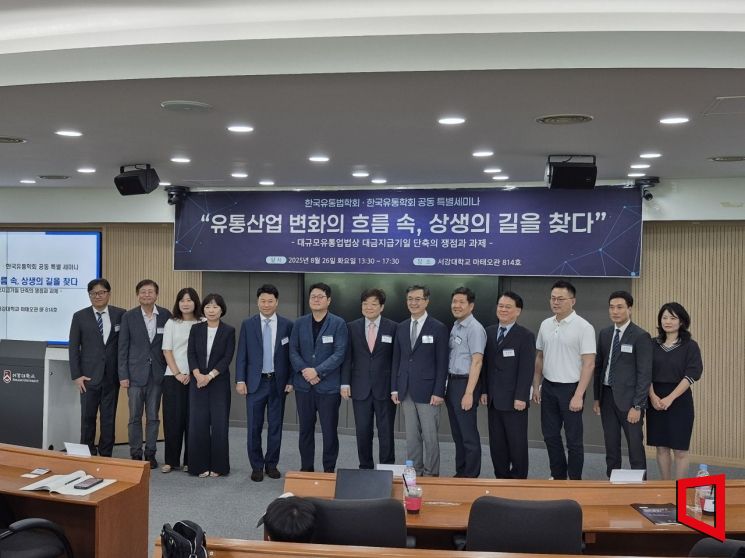 The Korean Distribution Law Association and the Korean Distribution Association held a joint special seminar on the afternoon of the 26th at Sogang University in Mapo-gu, Seoul, under the theme "Issues and Tasks of Shortening Payment Deadlines under the Large-Scale Retail Business Act." Participants are taking a commemorative photo. Photo by Kim Heungsun
The Korean Distribution Law Association and the Korean Distribution Association held a joint special seminar on the afternoon of the 26th at Sogang University in Mapo-gu, Seoul, under the theme "Issues and Tasks of Shortening Payment Deadlines under the Large-Scale Retail Business Act."
During his keynote presentation, Professor Jaehan Shim of Yeungnam University School of Law stated, "If the direct purchase settlement cycle is shortened from the current period, distributors will face reduced cash liquidity and will inevitably have to decrease their purchase volumes." He pointed out, "This will lead to a decrease in volume for small and medium-sized suppliers, and the damage could spread to small and medium-sized distributors." He further noted, "Major domestic distributors might increase their purchases from overseas sellers, such as those in China, whose products are cheaper and for whom the payment burden is relatively lower compared to domestic suppliers subject to various regulations." He warned, "This could result in decreased sales and competitiveness for domestic small and medium-sized companies."
Lee Hwang, President of the Korean Distribution Law Association and a professor at Korea University, also predicted, "If the settlement period is uniformly shortened, companies supplying products to distribution stores may prefer products from large corporations over those from lesser-known small and medium-sized enterprises due to cash flow and inventory burden issues, which could worsen the polarization between the rich and the poor."
There were also opinions that shortening the settlement period could directly harm consumers. Professor Shim explained, "For example, under the current regulations, if a consumer buys a product online believing it is genuine but later discovers it is counterfeit or defective, they can request a return within three months before settlement. However, if the settlement period is shortened, the seller could receive payment and disappear within 10 to 20 days." He added, "In such cases, it is unclear how consumers would be compensated for refunds."
According to the current Electronic Commerce Act, if the purchased product differs from its description or contract, consumers can withdraw their order within three months of receiving the product or within 30 days of discovering the issue. However, if payment is made early, there may be no effective way to prevent harm to consumers even if problems arise.
After the TMEP payment settlement incident in July last year and Homeplus's application for corporate rehabilitation, the government and lawmakers have successively proposed amendments to the "Act on Fair Transactions in Large-Scale Distribution Business" (Large-Scale Retail Business Act) to shorten the payment settlement period for both online and offline distributors in order to protect platform tenants and suppliers.
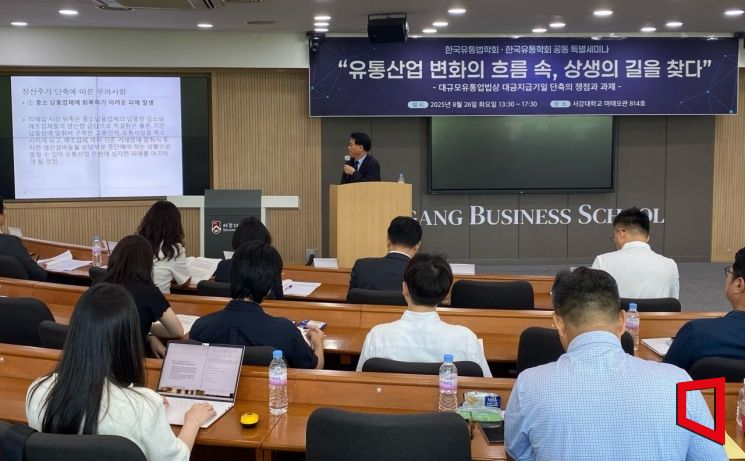 Professor Jaehan Shim of Yeungnam University School of Law is giving a keynote presentation at the special seminar on "Issues and Tasks in Shortening Payment Deadlines under the Large-Scale Retail Business Act," jointly hosted by the Korea Distribution Law Association and the Korea Distribution Association, held at Sogang University on the 26th. Photo by Heungsun Kim
In the 22nd National Assembly, lawmakers including Yoon Youngseok, Lim Mi-ae, Kang Min-guk, Oh Sehee, and Kim Namgeun proposed amendments that would require large-scale distributors and online intermediary platforms to settle payments within 10 to 20 days from the sales closing date, and within 30 to 40 days from the receipt of goods in the case of direct purchases. The Fair Trade Commission also announced in October last year that it would amend the Large-Scale Retail Business Act to prevent a recurrence of the TMEP payment settlement incident.
Under the current Large-Scale Retail Business Act, the settlement period is set at within 60 days from the receipt of goods for direct purchases, and within 40 days for special contract purchases, where goods are purchased on credit with a return condition and payment is made after deducting sales commissions.
Professor Jang Myunggyun of Hoseo University's Department of Business Administration emphasized in his keynote presentation, "The issue of shortening the settlement cycle was triggered by the TMEP and Homeplus incidents, but these stemmed more from the companies' cash management and internal control issues than from the length of the payment period." He suggested, "Rather than applying a uniform settlement cycle, a differentiated approach should be considered based on business type and purchase method," and recommended, "The settlement cycle should be designed based on the structural differences between online and offline distribution transactions." Professor Lee Hotek of Keimyung University, who participated as a panelist, also pointed out, "Before shortening the period to solve the payment settlement issue, institutional supplements such as escrow (deposit) and refund guarantee insurance can be considered."
Jung Jiyeon, Secretary-General of the Korea Consumer Federation, advised, "The proposed amendments focus solely on protecting suppliers and business operators," adding, "It is necessary to thoroughly review the legislative process to ensure that consumers do not suffer disadvantages."
© The Asia Business Daily(www.asiae.co.kr). All rights reserved.


















