The scope of disclosure for materials used in the evaluation process will be expanded along with a reorganization of the composition of the jury for public building design competitions. The Public Procurement Service aims to overhaul the entire process of public building design competitions, focusing on ensuring fairness and expertise.
The Public Procurement Service announced the "Public Procurement Service Architectural Design Competition Innovation Plan" on the 26th. Under the Architectural Service Industry Promotion Act, design competitions are primarily applied when commissioning the design of public buildings with estimated design fees of 100 million won or more. In this process, proposals are solicited from two or more parties, and the best is selected through evaluation.
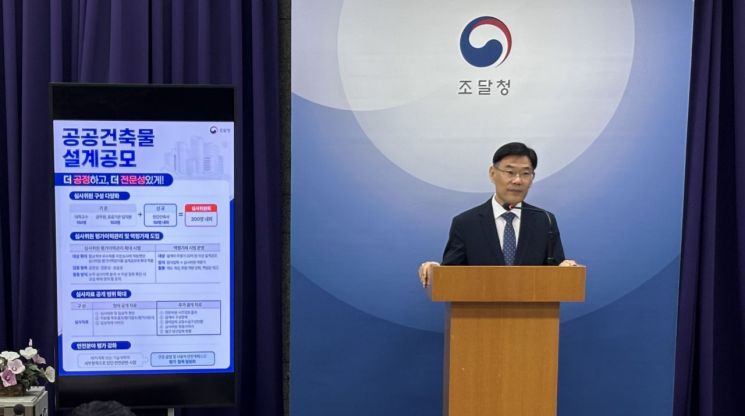 Kang Sinmyeon, Director of the Technical Services Bureau at the Public Procurement Service, is announcing the 'Innovation Plan for Public Procurement Service Architectural Design Competition' on the 26th at the Government Daejeon Complex. Photo by Public Procurement Service
The innovation plan was developed to address concerns about unfairness in design competition evaluations and to enhance expertise. The plan incorporates feedback from related industry groups such as the Korea Institute of Registered Architects, as well as institutional improvement ideas collected internally by the Public Procurement Service.
Through the innovation plan, the Public Procurement Service intends to secure fairness, transparency, and expertise in design competition evaluations by diversifying jury members, strengthening the management of jury members' track records, and expanding the disclosure of evaluation processes.
First, private architects who have previously won design competitions will be appointed as jury members to bring practical expertise to the evaluation process, and the composition of the jury will be diversified to strengthen fairness.
Private architect jury members will be selected from among architects who, as lead architects, have won official domestic or international architectural design competitions within the past five years. Approximately 50 architects will be appointed through recommendations from the Korea Institute of Registered Architects and verification by the Public Procurement Service.
The Public Procurement Service plans to have newly appointed private architect jury members participate in the newly formed Design Competition Jury Committee for one year starting next year. After analyzing the effectiveness in enhancing fairness and expertise, the agency will decide whether to extend their term.
Mechanisms will also be introduced to verify the fairness, expertise, and integrity of jury members. The core measures include the new implementation of "jury member evaluation record management" using the Public Procurement Service's evaluation record management system, and a pilot "reverse evaluation system" in which participating firms evaluate the jury members.
The evaluation record management system, previously used for negotiated contracts and excellent product designation reviews, will be expanded to design competitions. If any irregularities are detected in the areas of fairness, expertise, or integrity, measures such as exclusion or suspension from negotiations will be taken.
Irregularities will be determined by analyzing the accumulated evaluation history of jury members, such as the degree of bias toward specific firms (fairness) and the amount and redundancy of evaluation comments (integrity and expertise).
The reverse evaluation system will be piloted for design competitions with estimated design fees of 2 billion won or more. The results will be used to improve the system and enhance the capabilities of jury members, encouraging greater accountability and higher quality evaluations.
The innovation plan also includes expanding the scope of disclosure for materials related to the evaluation process. Previously, disclosure of evaluation materials was partial, based on the "Architectural Design Competition Operation Guidelines" (Ministry of Land, Infrastructure and Transport) and "Public Procurement Service Operation Standards."
However, moving forward, the agency will accept industry requests and further disclose evaluation process materials on the Nara Marketplace platform, as long as it does not compromise fairness. This is intended to minimize controversy over unfairness. However, construction cost calculation materials prepared by the client institution and lists of participating firms prior to evaluation, which could compromise anonymity and fairness, will remain undisclosed.
Additionally, the Public Procurement Service will unify safety-related evaluation items under the category of "structural, construction method, and user safety plan," ensuring the safety and public interest of public buildings from the initial design stage.
The innovation plan is scheduled to be implemented in mid-September after the revision of the "Public Procurement Service Architectural Design Competition Operation Standards."
Baek Seungbo, Commissioner of the Public Procurement Service, stated, "Securing fairness and expertise in design competitions is the first gateway to constructing high-quality public buildings that guarantee safety. The Public Procurement Service will strive to foster a procurement ecosystem where talented architects can achieve mutual growth in the public building design competition market through the formation of a high-level jury committee and transparent information disclosure."
© The Asia Business Daily(www.asiae.co.kr). All rights reserved.











