Consumer Composite Sentiment Index Reaches 111.4 in August
Highest Since January 2018 (111.6)
"Consumption Coupon Effect" Lifts Current Economic Assessment CSI
Housing Price Expectations Rebound After Just One Month
The Consumer Composite Sentiment Index (CCSI) for August reached its highest level in seven years and seven months since January 2018. The index continued its upward trend for the fifth consecutive month, buoyed by improved consumer spending and strong exports. However, concerns over sluggish exports due to U.S. tariffs limited the increase to a slight uptick, and the outlook for the economy declined. Expectations for housing prices, which had dropped after the June 27 measures, also rebounded after just one month.
Consumer Sentiment Index at 111.4... Highest Since January 2018
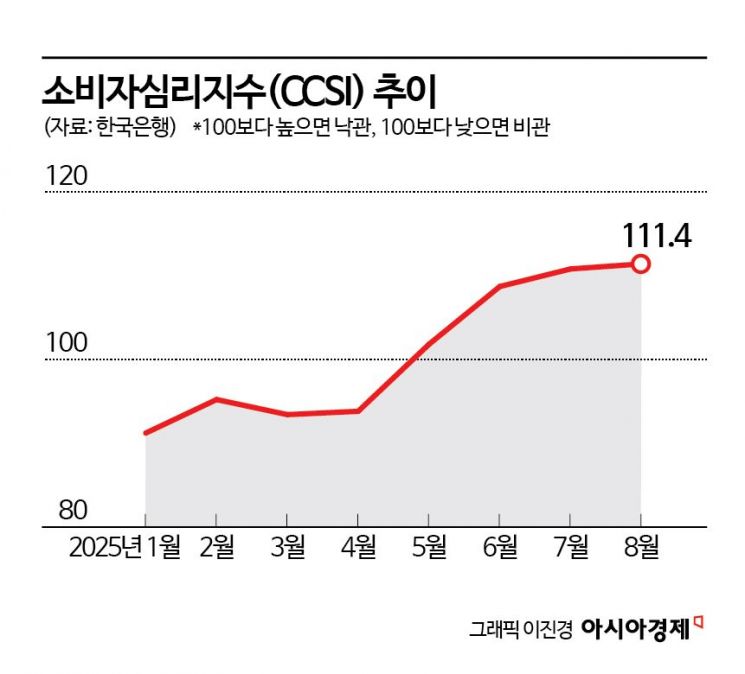
According to the "August 2025 Consumer Survey Results" released by the Bank of Korea on the 26th, this month’s CCSI stood at 111.4, up 0.6 points from the previous month. This is the highest figure since January 2018 (111.6), marking a seven-year and seven-month high. The CCSI is a comprehensive index reflecting consumers’ sentiment about the economic situation. It is calculated using six key indices that make up the Consumer Survey Index (CSI). The long-term average is set at 100; a reading above 100 is considered optimistic, while below 100 is considered pessimistic.
Until November last year, the CCSI remained above 100, but it plummeted to 88.2 in December due to the declaration of martial law, which dampened consumer sentiment. It continued to stay below the baseline until April this year. In May, however, the index jumped by 8 points and surpassed the baseline for the first time in six months, driven by the easing of trade risks following the U.S. mutual tariff suspension and expectations for the launch of a new administration. In August, the CCSI posted a slight increase, remaining above the baseline for the fourth consecutive month.
However, the rate of increase has been narrowing, from 8 points in May, to 6.9 points in June, and 2.1 points in July. Lee Hyeyoung, head of the Economic Sentiment Survey Team at the Economic Statistics Department, explained, "The slight increase in August was due to continued improvements in consumption and strong exports," adding, "Although the rate of increase has slowed compared to before, there have still been significant fluctuations in economic sentiment."
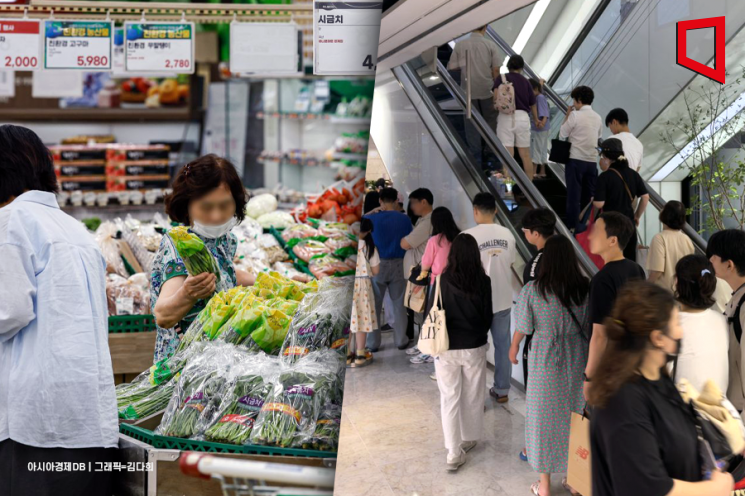
Current Economic Assessment Rises on 'Consumption Coupon Effect'... Future Outlook Drops on 'Tariff Concerns'
By sector, the Current Economic Assessment CSI rose, while the Future Economic Outlook CSI declined. The Current Economic Assessment CSI, which compares the current situation to six months ago, was recorded at 93, up 7 points from the previous month. Although this is below the baseline of 100, it is higher than the long-term average (from 2008 to 2024) of 72. Lee stated, "The current economy is seen more positively than the long-term average, so it would be accurate to say that many view it favorably," adding, "The index rose due to improved consumption and strong exports, and the consumption coupon effect is also considered a contributing factor." The Current Living Conditions CSI (96) also rose by 2 points from the previous month, influenced by rising stock prices.
In contrast, the Future Economic Outlook CSI, which projects the economy six months ahead compared to the present, fell by 6 points to 100. Lee analyzed, "Although the index declined this time due to concerns over sluggish exports caused by tariffs, it had previously reached high levels and still remains above the long-term average (85), so it’s not the case that many view the economy as unfavorable."
Housing Price Outlook CSI Rises Slightly After One Month... "Too Early to Say Policy Effects Have Faded"
The Housing Price Outlook CSI rose by 2 points from the previous month to 111. This index had dropped sharply (by 11 points) after the June 27 household debt management measures but rebounded after just one month. The Bank of Korea analyzed that while the nationwide apartment price growth slowed after the government measures, strong increases continued in some areas of the Seoul metropolitan area.
However, whether this rebound will lead to a continued upward trend remains to be seen. Lee said, "Since the index is above the long-term average (107), it should be closely monitored," but also noted, "The increase is not large, and it remains below the pre-June 27 level (120), so it is necessary to continue monitoring the effects of the policy."
The expected inflation rate for the next year (2.6%) edged up by 0.1 percentage point from the previous month, as the increase in consumer prices slowed slightly due to a turnaround in petroleum product prices but was offset by a wider increase in agricultural, livestock, and fishery product prices. The expected inflation rates for three and five years ahead were both 2.5%, either rising by 0.1 percentage point or remaining unchanged from the previous month. When asked which items are expected to have the most impact on consumer prices over the next year, respondents cited agricultural, livestock, and fishery products (56.1%), public utility fees (40.3%), and industrial products (32.1%) in that order. The response rate for agricultural, livestock, and fishery products increased by 8.1 percentage points from the previous month, while that for petroleum products (-6.9 percentage points) and public utility fees (-1.9 percentage points) decreased.
Lee commented, "Going forward, the CCSI is likely to be influenced by government policies and tariff measures," adding, "The supplementary budget, including a second round of consumption coupons, will be a positive factor, but concerns related to tariffs will be a negative factor."
This survey was conducted from August 11 to August 19, targeting 2,500 urban households nationwide, with 2,278 responses collected.
© The Asia Business Daily(www.asiae.co.kr). All rights reserved.













