Climate Crisis Shakes Global Bottled Water Supply Chain
WRI Predicts Fresh Water Demand Will Exceed Supply by 40% by 2030
Sustainability at a Crossroads for Korea's Bottled Water Market Amid Climate Change
French premium bottled water brands, which have promoted their products as "natural mineral water," are now facing a backlash after allegations emerged that their water undergoes purification processes. Experts and the global bottled water industry are defining this incident not simply as a brand scandal, but as a signal of the tangible reality of the climate crisis. It is a warning that the environment for sourcing natural spring water is no longer sustainable.
According to investigative reports by Le Monde and France Info on August 26, Evian has been sold as "natural mineral water" for years, even though it underwent ultraviolet (UV) disinfection and activated carbon filtration. There are even allegations that the French government was aware of this and covered it up.
In France, under European Union guidelines, products labeled as "natural mineral water" must be bottled without any artificial treatment. The same applies to "spring water" and "natural mineral water," which must be extracted from preserved underground resources and cannot be disinfected. In contrast, "regular bottled water" is allowed to undergo certain purification processes such as chlorination or filtration. However, Evian was labeled as "natural mineral water" while being subjected to UV disinfection and activated carbon filtration, just like regular bottled water.
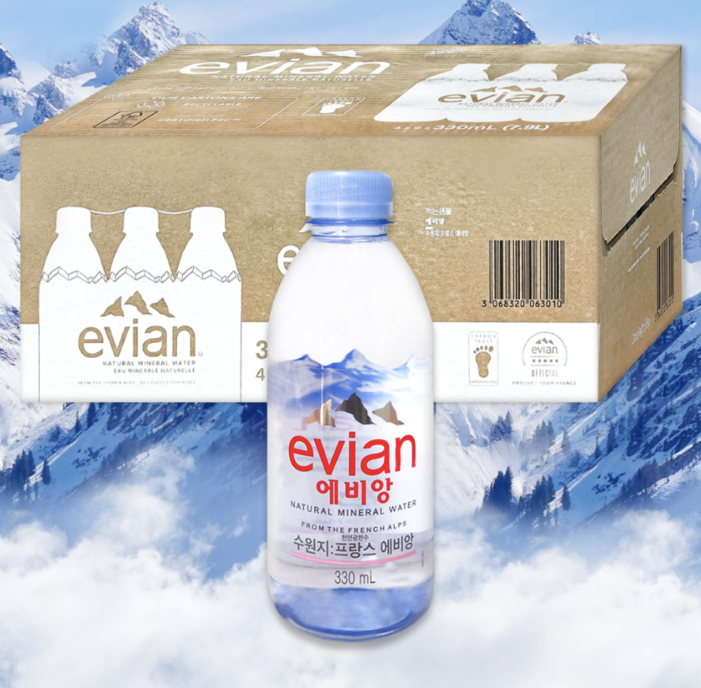
Previously, Perrier, a global beverage brand under Nestle, was also reported to consumer groups for allegedly selling purified water as "natural mineral water" using the same methods.
Natural spring water is formed when rain or snow seeps into underground rock layers and is purified over a long period before emerging as spring water. However, prolonged droughts slow down groundwater replenishment, reducing spring water flow, while heavy rains cause pollutants to rapidly seep underground, worsening water quality. Research has shown that in the French Alps, where Evian is sourced, glacier retreat and irregular precipitation are delaying groundwater replenishment and putting pressure on the water source itself.
The BBC explained that "worsening groundwater contamination is the reason for the introduction of purification processes." According to the BBC, in southern France, where the Perrier water source is located, repeated droughts and rising temperatures since 2017 have led to contamination even in the deep aquifers. Hydrologist Emma Haziza told the BBC, "The fact that major brands are forced to treat their water themselves is already a sign of water quality problems," adding, "In the era of climate change, this kind of commercial model is not sustainable at all."
Climate Crisis... Global Bottled Water Supply Chain 'Shaken'
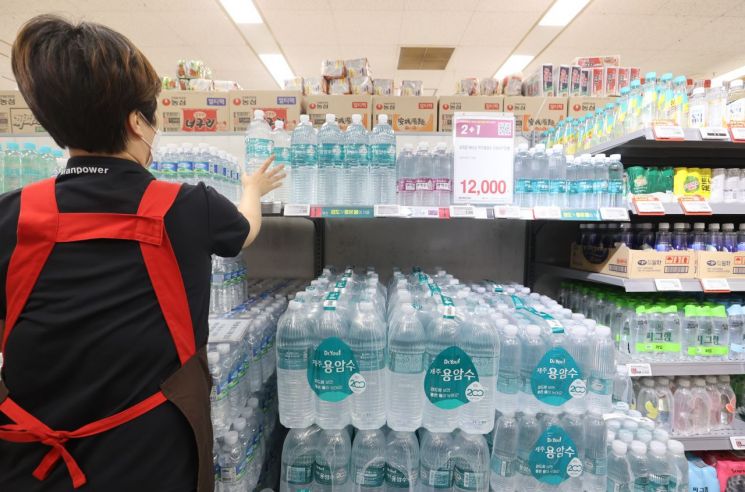
The climate crisis is already shaking the entire supply chain of the bottled water industry. According to the World Resources Institute (WRI), global demand for fresh water is expected to exceed supply by more than 40% by 2030. The United Nations Environment Programme (UNEP) also estimates that water quality risk due to climate change is increasing by 7% each year.
The domestic market is no exception. Jeju Samdasoo, a leading domestic bottled water brand based on volcanic bedrock water from Jeju Island, has recently been warned that groundwater levels are dropping due to climate change and a surge in tourists on Jeju. There are concerns that changes in rainfall patterns could threaten the long-term stability of water collection.
In regions such as Gangwon and Chungcheong, the frequency of droughts is increasing due to the climate crisis, intensifying conflicts between agricultural water use and commercial bottled water extraction. Lotte Chilsung Beverage's Isis, which sources water from these areas, now faces an urgent need to diversify its water sources. Nongshim Baeksansu, which is based on water from the Baekdu Mountain Range, has also been pointed out as being vulnerable to extreme weather events such as heavy rains and landslides.
Bottled water companies are expected to introduce more sophisticated water quality monitoring and sterilization and purification processes in the future. The costs incurred in this process are likely to lead to higher bottled water prices. An industry insider stated, "The bottled water industry is exposed to climate risks at every stage, from securing raw water to purification and packaging waste management," adding, "How responsibly companies manage water and protect the environment will determine the trust and competitiveness of the bottled water market going forward."
© The Asia Business Daily(www.asiae.co.kr). All rights reserved.
![Clutching a Stolen Dior Bag, Saying "I Hate Being Poor but Real"... The Grotesque Con of a "Human Knockoff" [Slate]](https://cwcontent.asiae.co.kr/asiaresize/183/2026021902243444107_1771435474.jpg)

















