Manse, Hyohaeng, Byeongjeom, Dongtan Districts to Be Established After 15 Years of Meeting 500,000 Population Standard
Mayor Jung Myunggeun: "30-Minute Living Zones Through Customized Administration for Each Region"
Four general districts will be established in Hwaseong City, Gyeonggi Province starting in February next year. It has been 15 years since the city surpassed the population threshold of 500,000, which is the standard for establishing general districts set in 2010.
Hwaseong City announced on the 24th that, following the Ministry of the Interior and Safety's approval, it will establish four general districts-Manse, Hyohaeng, Byeongjeom, and Dongtan-divided by living zones, starting in February next year.
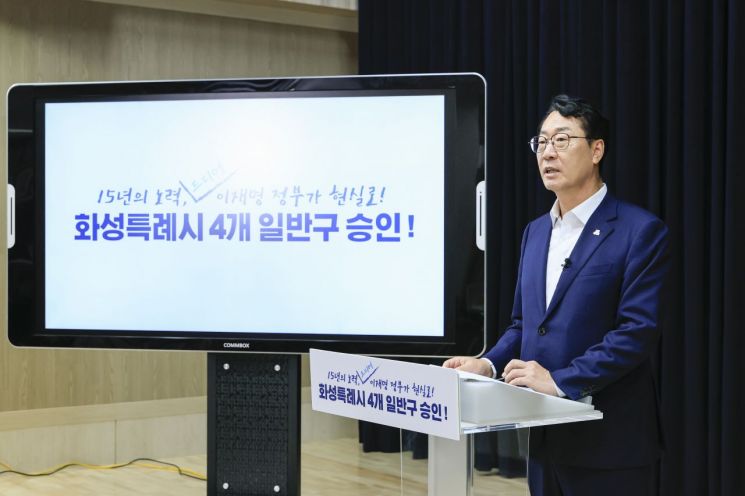 Jung Myunggeun, mayor of Hwaseong City, is announcing the city administration policy following the Ministry of the Interior and Safety's approval of the establishment of a general district. Provided by Hwaseong City
A general district is an administrative organization affiliated with the city, a higher-level administrative body, and is responsible for handling administrative work to improve efficiency.
The newly established general districts are divided based on living zones and will each govern specific towns and neighborhoods (eup, myeon, and dong). Manse District will include the western living zone, encompassing Ujeong, Hyangnam, and Namyang towns; Mado, Songsan, Seosin, Paltan, Jangan, and Yanggam townships; and Saesol neighborhood. Hyohaeng District, which covers the central living zone, will include Bongdam town, Bibong, Maesong, and Jeongnam townships, and Gibaedong. Byeongjeom District will govern Jin'an, Byeongjeom 1, Byeongjeom 2, Banwol, and Hwasan neighborhoods, while Dongtan District will oversee Dongtan 1 through 9 neighborhoods.
The city expects the launch of the general districts to significantly improve administrative service convenience for residents. Hwaseong City covers 844 square kilometers, which is 1.4 times the size of Seoul, resulting in poor accessibility to city hall and causing inconvenience for citizens.
Once the general districts are established, major administrative services such as tax, licensing, welfare, and civil affairs will be handled directly at the district offices within a 30-minute reach in each living zone. This will enable faster and more convenient administrative services through localized administration, tailored budgets, and strengthened on-site civil service, all suited to the characteristics of each region.
Jung Myunggeun, mayor of Hwaseong City, stated, "The establishment of these general districts marks the beginning of a new era for Hwaseong, where we can provide customized administration closer to our citizens," adding, "We will thoroughly prepare for the administrative system reform to deliver warmer and more diverse administrative services."
The city plans to complete the remodeling design for the district offices by next month and revise ordinances related to the establishment of the districts and delegated affairs within the year. After finalizing the organizational structure and personnel assignments and organizing the delegated affairs, the city aims to complete the relocation of departments by January next year.
In addition, the city will prepare measures to enhance citizen convenience, such as reorganizing public transportation routes and establishing a comprehensive civil affairs information system, to ensure the smooth launch of the four district offices in February next year.
Tailored administration will also be implemented according to the characteristics of each district. The city has set visions for each district as follows: Manse District will be "a convergence innovation city where abundant nature and industrial resources are harmonized"; Hyohaeng District will be "a nature-friendly residential city centered on education accessible to all"; Byeongjeom District will be "a people-centered growth city where history and advanced technology meet"; and Dongtan District will be "a future industrial economic city where urban life and nature coexist, leading the Fourth Industrial Revolution."
Meanwhile, Hwaseong City has experienced rapid growth since it was elevated to city status in 2001, surpassing a population of 500,000 in 2010 and thus meeting the requirements for establishing general districts. However, the administrative system reform was not implemented at the time, resulting in continued inconvenience for citizens.
Since the launch of the 8th popularly elected administration, the city has made the establishment of general districts a top priority and actively pursued it. Through research by the Local Administration Research Institute and the Korean Association for Public Administration, as well as regional citizen briefings, public opinion surveys, district naming contests and review committees, and policy plaza voting, the city gathered citizens' opinions. After obtaining approval from the city council, the city drafted a plan for the four new districts and submitted a proposal to the Ministry of the Interior and Safety in November last year.
Mayor Jung stated, "With the opening of the district offices, we will usher in the era of 30-minute living zones and enhance the appeal of Hwaseong across culture, industry, and daily life through tailored policies suited to each living zone."
© The Asia Business Daily(www.asiae.co.kr). All rights reserved.