Director Megi Kang Shares Behind-the-Scenes Stories
Global Success Rooted in Universal Themes and Korean Identity
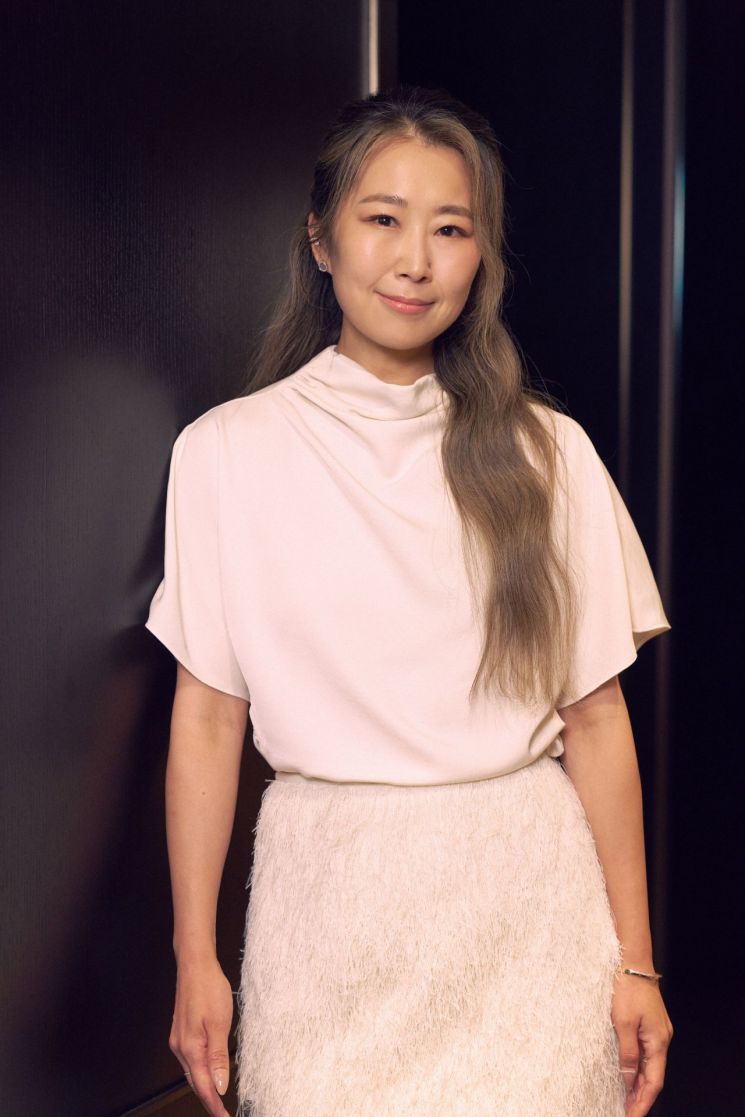
"After 'K-Pop Demon Hunters' was released, my husband and I endlessly scrolled through Twitter (X) and Instagram for ten days. I couldn't put my phone down until 2 a.m. As messages from Korean fans kept pouring in, I realized, 'This has really become a global phenomenon.'"
Director Megi Kang (Minji Kang) shared these thoughts at a press conference held at CGV Yongsan I'Park Mall in Seoul on the 22nd, expressing how she felt the overwhelming response from around the world.
The Netflix original animated film 'K-Pop Demon Hunters,' released in June, sparked a global sensation by ranking No. 1 in 31 countries, including Korea, the United States, the United Kingdom, France, and Japan. It became the highest-grossing Netflix animation of all time and ranked second in cumulative viewership among all films on the platform.
Director Kang said, "It took exactly seven years to complete. I never imagined it would be loved this much. I am truly grateful." She cited universal relatability as the reason for the film's worldwide acclaim.
"Everyone wants to be loved and feel secure. I believe the characters' fears and stories of growth resonated with the audience. When a six-year-old who attended the 'K-Pop Demon Hunters' premiere said, 'I could understand Lumi's fear,' I felt the core theme of this movie became clear. Ultimately, the message the film aims to convey is the process of overcoming shame."
The original soundtrack (OST) also created a global sensation. The theme song 'Golden' topped the US Billboard Hot 100 main singles chart. This is the first time a K-pop song featuring a female vocalist has reached No. 1. 'Your Idol' and 'Soda Pop' also ranked within the top 10. Having three songs from a movie OST enter the Billboard top 10 is a first since 'Saturday Night Fever' (1977) and 'Waiting to Exhale' (1995).
Director Kang recalled, "'Golden' is Lumi's signature song, so it was particularly challenging to produce. It went through seven or eight versions before we finalized it, and at that moment, I was certain, 'This is it.' I was moved to tears."
Elements such as the bathhouse, traditional Korean clinic, street food stalls, fan sign events, and cheering sticks resonated strongly with domestic audiences. This was a deliberate effort by the director to portray Korean culture in detail. She said, "The animation 'Mulan' is set in China, yet features Japanese kimonos. As an Asian, seeing such depictions made me uncomfortable. I wanted to depict Korean culture in a detailed and accurate way. Since there were many Korean staff members on the team, we were able to achieve this level of detail."
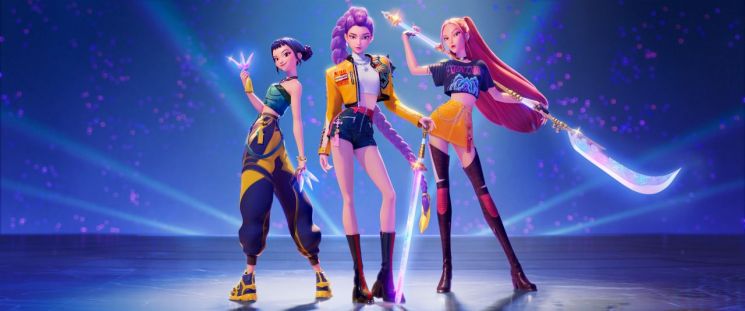
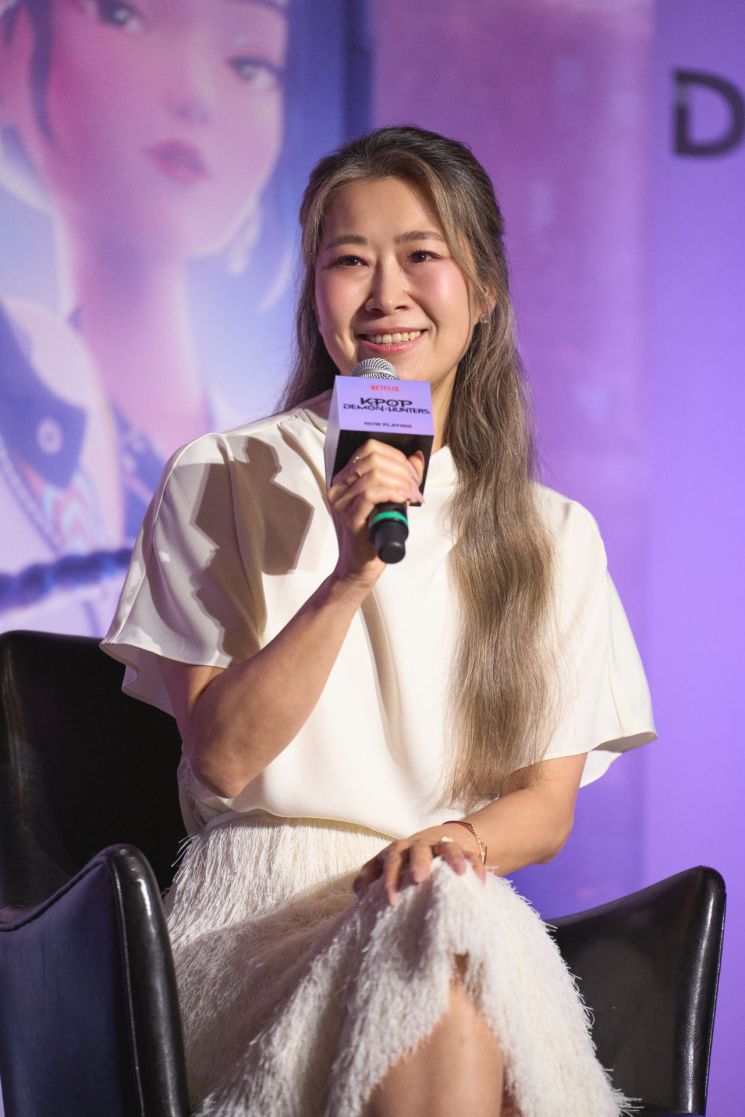 Director Kang Megi is expressing his thoughts at the 'K-Pop Demon Hunters' press conference held on the 22nd at CGV Yongsan I'Park Mall in Seoul. Photo by Netflix
Traditional themes were also used as directorial devices. In the film, the Saja Boys are inspired by the Korean Grim Reaper. Director Kang explained, "Grim Reapers and dokkaebi (goblins) hold special significance in the West, so choosing 'demon' as a theme was not difficult. In our culture, a gut (shamanic ritual) is similar to the start of a concert. The concept of the Huntrix defeating evil spirits and continuing the performance originated from this background."
The shaman character in the opening scene is also connected to the film's focus on women's narratives. Director Kang said, "Shamans have traditionally told women's stories. The image of a woman wearing men's clothing and performing a ritual is a powerful and progressive symbol, and it also has meaning within the context of feminism. That's why I chose to naturally use the shaman and elements of women's narratives as metaphors."
Having immigrated to Canada at the age of five, she also spoke about her identity as a Korean diaspora creator. Director Kang said, "Many members of the Korean diaspora experience identity confusion, but I was closely connected to Korean culture thanks to the language. If we truly want globalization, we must listen to the voices of creators with multicultural backgrounds. There are many creators with diverse cultural backgrounds, and we need to pay attention to their voices."
Netflix's planning and support also contributed to the completion of the film. Director Kang said, "Netflix was well aware of the global impact of Korean content and was enthusiastic about a project combining animation and K-pop. We received full support throughout the production process." She added, "I wanted to break the perception that animation is just for children. By combining mature themes with a superhero story, I aimed to create something meaningful for both adults and children."
Finally, regarding the possibility of a sequel, Director Kang said, "There is nothing official yet, but there are many stories and ideas we haven't shown. I want to include more of Korea's diverse musical styles. Trot music would be an interesting experiment as well."
© The Asia Business Daily(www.asiae.co.kr). All rights reserved.













