National Science and Technology Advisory Council Convenes
Government to Announce "AI Action Plan" in September
The Lee Jaemyung administration has set next year's research and development (R&D) budget at a record-high 35.3 trillion won. This marks a significant increase from the previous administration's reduced R&D budget, with the goal of achieving "genuine growth." President Lee, in particular, views the next two to three years as a "golden time" for fostering the artificial intelligence (AI) sector and has expressed a strong commitment to active budget investment. The newly allocated R&D budget will be distributed across various sectors, including energy, strategic technologies, and defense. The government plans to officially launch the "National AI Strategy Committee" in September and announce the "Korea AI Action Plan."
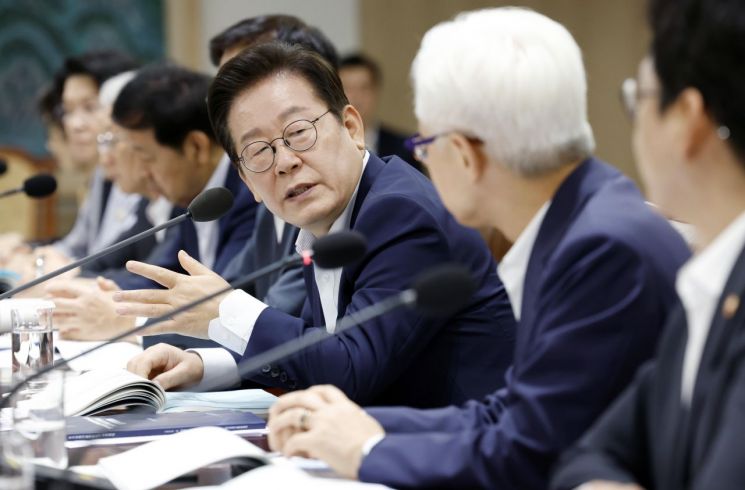
On August 22, President Lee Jaemyung, during his opening remarks at the plenary session of the National Science and Technology Advisory Council held at the Yongsan presidential office, stated, "As we enter an era of intense, limitless competition in science and technology, the race among nations to secure leadership in advanced science and technology is fiercer than ever." He added, "Especially in the AI sector, the next two to three years will be a golden time. If we take even a half-step ahead during this period, we can become a leading nation enjoying limitless opportunities, but if we fall behind, we will remain perpetual followers." The meeting was convened under the theme, "Respecting Researchers and Restarting Investment in Science to Change the Future under a Citizen-Sovereign Government," to discuss the "2026 National R&D Project Budget Allocation and Adjustment Plan," the "New Administration's AI Policy and Investment Direction," and the "2026 R&D Promotion Strategies by Ministry, Centered on Field and User Needs."
President Lee assessed that Korea's science and technology sector has experienced a period of regression over the past three years. He pointed out that the Yoon Sukyeol administration's sharp reduction of the R&D budget from 31.3 trillion won in 2023 to 26.5 trillion won in 2024 drew significant backlash. President Lee remarked, "Even during difficult times, we never hesitated to invest in the future, but the state has deprived researchers of opportunities by cutting research funding." He continued, "Student researchers and young scientists who lost their positions in laboratories have been forced to seek opportunities at foreign universities or in overseas job markets, threatening the ecosystem for basic research and severely undermining the nation's scientific and technological competitiveness."
President Lee further emphasized, "The citizen-sovereign government will correct the mistakes of previous administrations and reinvest in the future." He stressed, "To overcome Korea's current low growth and complex crises, we must make a concerted effort to invest in scientific research and support and foster high-tech industries, including AI." Referring to the 35.3 trillion won R&D budget proposal, he added, "This is a bold decision for Korea's future and a clear demonstration of the government's determination to become a global leader in science and technology."
President Lee also highlighted the need to develop this R&D budget into the "K-R&D Initiative." He stated, "It is crucial to establish a virtuous cycle in which bold R&D investments lead to the growth of future strategic industries through 'technology-driven growth,' while the fruits of innovation are shared equitably among regions and citizens, thereby achieving 'growth for all.'"
Alongside improvements to the R&D system, President Lee addressed talent issues. He acknowledged, "There is a painful criticism that Korea is not attractive to top STEM talent." He explained, "We must gradually abolish the Project Based System (PBS), which has undermined the identity of researchers at government-funded institutes for the past 30 years, and shift the financial structure to a mission-oriented system for each institute. This will boost the pride of young science and technology talent and researchers, and support them in planning concrete futures in Korea over the next five to ten years, allowing them to grow alongside their research."
Additionally, President Lee noted the upcoming launch of the "National AI Strategy Committee" and the announcement of the "Korea AI Action Plan" in September. He called for preparations to realize the vision of becoming one of the "top three AI powers" and establishing an "AI-based society" through the construction of an AI superhighway, securing core AI technologies and talent, driving a comprehensive AI transformation across industry, public, and regional sectors, enabling AI utilization by all citizens, and advancing global AI initiatives. He also stressed the urgent need to prepare measures to address the surge in electricity demand expected from expanded AI research and utilization and the growth of advanced industries such as semiconductors.
Meanwhile, during the open discussion, committee members presented various opinions, including the need for innovation in the R&D ecosystem, expanding autonomy for government-funded research institutes through the abolition of PBS, improving treatment for science and technology talent, securing AI innovation infrastructure, and spreading AX. In particular, they emphasized the necessity of building collaborative systems with the private sector and transitioning to a leading model through expanded investment in basic science, as well as ensuring stable employment for young researchers and introducing bold incentives. In his closing remarks, President Lee Jaemyung stated, "The government R&D budget proposal for next year, discussed today, will be the starting point for a new scientific nation," and called on the committee members to pool their wisdom for innovating the research ecosystem and nurturing science and technology talent.
© The Asia Business Daily(www.asiae.co.kr). All rights reserved.

















