Introduction of Legal Precedents on Insubordination Raises Concerns Over Misperceptions
Image of Handcuffed Soldier Could Undermine Military Morale
Concerns have been raised that some parts of the Ministry of National Defense's recently developed standard curriculum for ideological education on democracy and constitutional protection may actually undermine military discipline and impair combat readiness.
On August 21, Assemblyman Yoo Yongwon of the People Power Party released the special standard curriculum on "Democracy and Constitutional Protection" obtained from the Ministry of National Defense and made these remarks. Earlier, on August 8, the Ministry of National Defense mandated special ideological education on democracy and constitutional protection for all service members and civilian employees at military units and educational institutions nationwide.
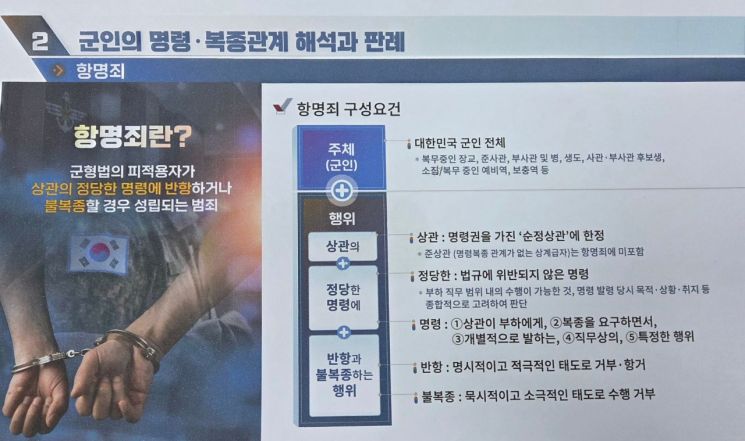
This education program was intended to emphasize political neutrality and constitutional order in the military in the wake of the 12·3 Martial Law, but Assemblyman Yoo pointed out that the actual structure and wording of the curriculum, as well as the selection of trainees and instructors, could instead undermine military discipline and combat capability.
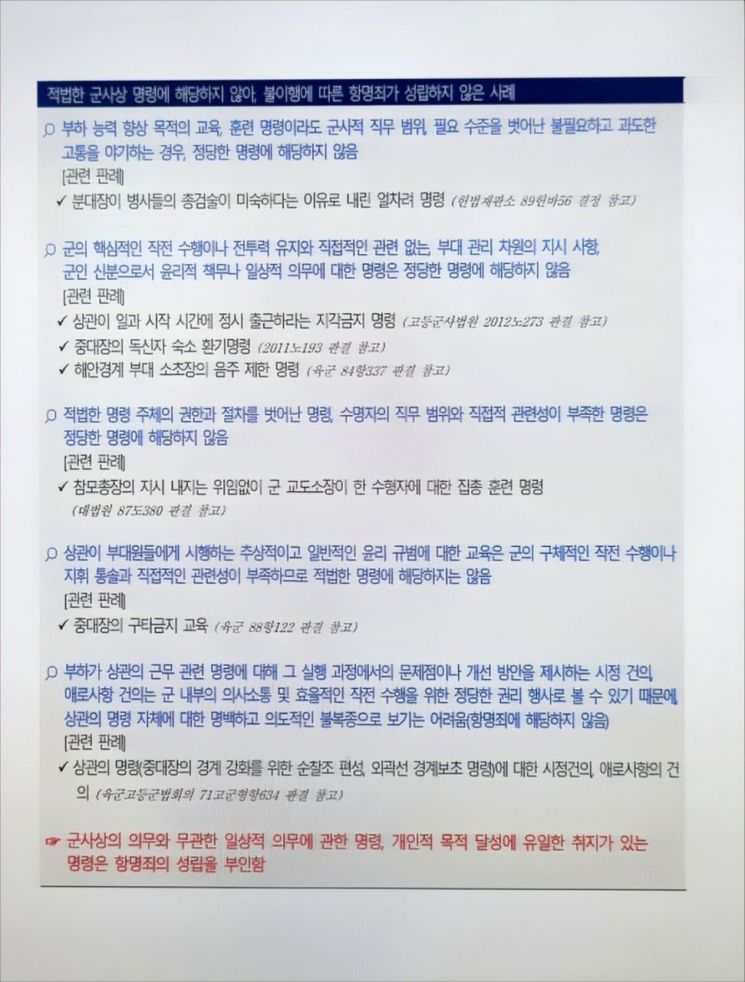
A representative example is the section in the curriculum regarding the establishment and legal precedents of the crime of insubordination. In particular, the curriculum lists cases where insubordination was not recognized even when orders such as "a superior's order to prohibit tardiness," "a company commander's order to ventilate the barracks," and "a coastal guard post commander's order to restrict drinking" were disobeyed.
Assemblyman Yoo argued that such content could give soldiers the mistaken impression that they do not need to follow even the routine instructions of their superiors. Article 25 of the Military Service Basic Act clearly states that "a soldier must obey the official orders of a superior." Although the chain of command is the very foundation and core value of the military, this education could operate in a way that shakes that foundation.
The use of inappropriate images in the curriculum, which could lower the morale of service members, was also criticized. For example, the educational materials include an image of a soldier in uniform that evokes the impression of being handcuffed.
Assemblyman Yoo also pointed out that it is inappropriate to include all service members, civilian employees, and even new recruits and officer cadets as uniform trainees for this program. He stated, "The primary responsibility for determining the legality and justification of an order lies with the commanding officer who issues the order, so this special ideological education should have been conducted first for commanders, such as generals and officers." He added, "Applying the same curriculum to all service members, including enlisted personnel, without distinguishing between command responsibility and the duty to obey, could be a misguided approach that undermines military discipline."
Furthermore, Assemblyman Yoo criticized the decision to distribute the curriculum uniformly to the ideological education departments of each military branch, which lack constitutional and legal expertise, and to assign them the roles of developing detailed educational plans, instructor duties, and educational supervision. He argued that if ideological education officers, who lack relevant knowledge, lead this program, there is a high risk that poorly designed educational messages will be delivered to service members in a distorted manner.
Assemblyman Yoo stated, "Teaching the crime of insubordination based on legal precedents could lead service members to interpret the command-obedience relationship too narrowly, which may undermine the speed and efficiency of order execution in operational settings and negatively impact combat effectiveness. The Minister's instructions can only be fulfilled if commanders respond without hesitation, but this educational material could produce results that are contrary to the Minister's intentions."
He added, "If ideological education in the military is pursued in a way that erodes discipline and combat power, it is not education but a self-destructive act that threatens security. The Ministry of National Defense must conduct a thorough review of the curriculum, target trainees, and instructor assignments for this special ideological education program."
© The Asia Business Daily(www.asiae.co.kr). All rights reserved.


















