IonQ Aims for "Strategic Partnership" with Korea
Quantum Computing and Communication Integration with SK Telecom
KISTI Collaboration to Build Hybrid Quantum-Supercomputing Infrastructure
Kassman: "Korea Could Lead the Global Quantum Ecosyst
IonQ, a U.S.-based quantum computing company, has expressed a strong commitment to strengthening the quantum computing industry in Korea and expanding related research through collaboration with SK Telecom and the Korea Institute of Science and Technology Information (KISTI).
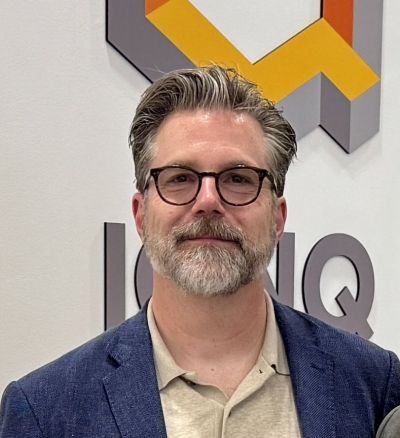
Dean Kassman, Senior Vice President of Engineering at IonQ, who oversees the company’s product roadmap, met with Asia Economy on August 18 (local time) at the company’s research facility in College Park, Maryland. He stated, “Our collaboration with SK Telecom is moving beyond simply signing an MOU and is progressing towards achieving tangible technological results.” He explained, “First, we plan to integrate Quantum Key Distribution (QKD) technology into mobile communication networks to establish a highly secure communication infrastructure in preparation for the 6th generation (6G) era.”
He continued, “As the second phase, we will build a quantum network simulation and testbed. Once IonQ’s quantum computer is connected to SK Telecom’s research labs and operates in a real network environment, Korea will possess the world’s most advanced quantum communication test network.”
SK Telecom transferred its stake in IDQ, a quantum communication security company, to IonQ and acquired a stake in IonQ, establishing a strategic partnership between the two companies.
Senior Vice President Kassman also presented a long-term vision for a Quantum Internet. He said, “SK Telecom already possesses AI and cloud infrastructure, as well as an extensive telecommunications network. If IonQ’s quantum computing capabilities are added, Korea could become the first country in the world to establish a national-level Quantum Internet. This would not only dramatically enhance the security of critical national infrastructure such as military, finance, and energy, but also pave the way for Korea to become a new digital hub through which global data is transmitted.”
IonQ is also working with KISTI to connect quantum computers and supercomputers. This initiative will establish a national foundation for quantum computing utilization and build a hybrid computing service system that integrates supercomputers and quantum computers.
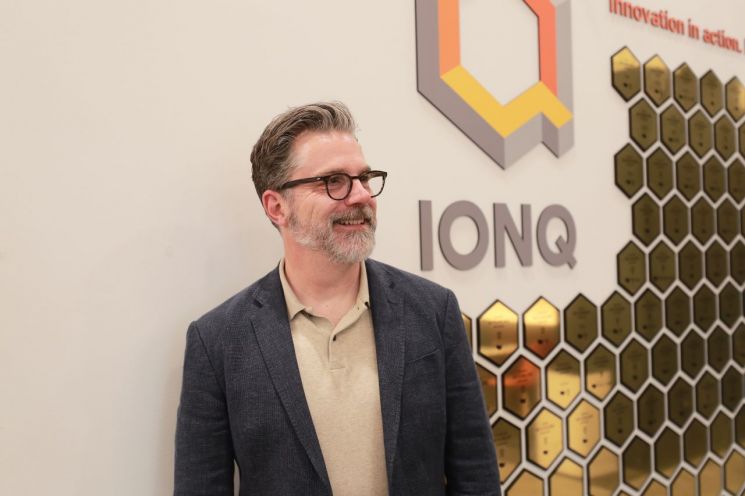 The office wall of IonQ displays the patents secured so far. Dean Casman, Senior Vice President of IonQ, is explaining the patents. Vice President Casman expressed his ambition to fill all the blank spaces with patents. Photo by Jangmin Baek, Tech Specialist
KISTI is a government-funded research institute under the Ministry of Science and ICT, operating the national supercomputing infrastructure and supporting scientists’ research through simulations. Next year, Korea plans to introduce its sixth supercomputer, which will rank among the world’s top ten. With the introduction of IonQ’s ion trap quantum computer, there are high expectations for research at an entirely new level. He said, “KISTI has globally outstanding HPC operational experience,” expressing confidence in the successful integration with IonQ’s quantum computers.
IonQ has also made it clear that it intends to elevate its relationship with Korea to a “strategic partnership.” Senior Vice President Kassman stated, “Korea is not just a customer. As seen in our joint research with Hyundai Motor and Seoul National University, Korea is a country capable of establishing global leadership in the quantum field. Collaboration with KISTI marks the starting point for Korea to become a key player in the global quantum science ecosystem.”
Senior Vice President Kassman dismissed criticism from some quarters that supplying quantum computers to KISTI next year would be difficult. He said, “Anyone can criticize. We are already operating a 64-qubit development system, and next year, we will deliver the 100-qubit quantum computer ‘Tempo’ to Korea. In fact, the schedule is progressing faster than expected, and technical uncertainties are actually decreasing.”
He also outlined IonQ’s long-term roadmap in detail. “Our goal is to reach 256 qubits by 2026, 10,000 qubits by 2027, and 2 million qubits by 2030. Our roadmap is not just an empty promise-it is already being executed.”
Senior Vice President Kassman explained that IonQ is currently one of the few commercial quantum computing companies in the world, and that many researchers and companies are already utilizing its systems through Amazon Web Services, Google Cloud, and Microsoft Cloud. This demonstrates the trust IonQ has already earned.
He also emphasized the geopolitical significance of U.S.-Korea technological cooperation in the quantum field. Senior Vice President Kassman said, “Quantum is not just a research topic; it is a national strategic capability. If we do not focus, other countries will take the lead. This is why allies like the United States and Korea must cooperate. Fields such as AI, new drug development, and cybersecurity will advance more rapidly when supported by quantum computing.”
He also highlighted the significance of IonQ’s recent acquisition of Oxford Ionics. “Combining Oxford Ionics’ microwave control technology with IonQ’s ion trap platform will accelerate the expansion to thousands or even millions of qubits. This will directly benefit partners like Korea,” he said.
IonQ is also well known as a quantum computing startup co-founded by Professor Kim Jungsang of Duke University. A significant portion of its shareholders are Korean retail investors. Senior Vice President Kassman said, “We are grateful for the trust shown by Korean investors and industry. We are ready to repay that trust with results.”
<Glossary>
▲Ion Trap Quantum Computer: A technology that uses electromagnetic fields to trap ions (particles that are atoms missing one electron) suspended in the air and utilizes them as qubits. It offers high accuracy but is difficult to scale.
▲Superconducting Quantum Computer: A method that creates qubits using superconducting circuits, where current flows without resistance in an ultra-low temperature cooling device. Qubits are controlled by electromagnetic pulses. This is the main approach used by companies such as Google, IBM, and Rigetti. While errors can occur, it has the advantage of being easier to scale.
▲HPC (High Performance Computing): HPC refers to supercomputer systems that connect thousands to tens of thousands of processors in parallel for ultra-fast computation. These systems can solve calculations in hours that would take decades on a regular PC. They are used in fields requiring large-scale computation, such as climate change prediction, new drug development, artificial intelligence training, and space simulation.
© The Asia Business Daily(www.asiae.co.kr). All rights reserved.












