Semiconductors and Tech Stocks Drop for Second Day
Profit-Taking Amid Overvaluation Concerns; AI Skepticism Grows
Major Retailers Report Mixed Earnings: Target Down, Lowe's Up
FOMC Minutes Reveal Debate Over Future Rate Path
The three major indexes on the New York Stock Exchange declined on August 20 (local time). Technology stocks fell for the second consecutive day, weighing on investor sentiment and dragging down the overall indexes. Investors are closely watching the minutes of the Federal Open Market Committee (FOMC) meeting from July, which are scheduled to be released later in the afternoon.
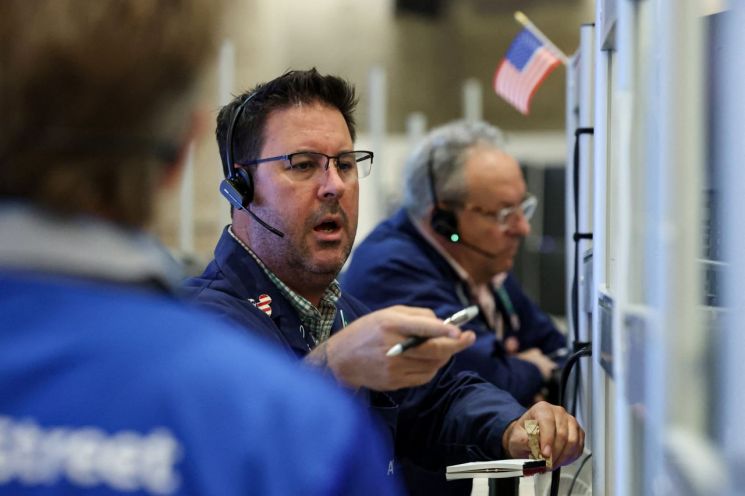
As of 10:59 a.m. on the New York Stock Exchange, the blue-chip Dow Jones Industrial Average was down 111.71 points (0.25%) from the previous trading day at 44,810.56. The large-cap S&P 500 index fell 63.36 points (0.99%) to 6,348.01, while the tech-heavy Nasdaq index slid 390.908 points (1.83%) to 20,924.044.
By sector, technology stocks were weak. Nvidia dropped 3.19%, while AMD and Broadcom fell 4.11% and 3.19%, respectively, as semiconductor stocks broadly declined. Apple was down 1.84%, and Microsoft fell 0.7%. This was due to investors taking profits from semiconductor and technology stocks that had surged recently. In addition, concerns over the overvaluation of tech stocks and doubts about whether the artificial intelligence (AI) boom can be sustained for an extended period further dampened investor sentiment.
Matt Maley, chief market strategist at Miller Tabak, said, "The recent decline in technology stocks may be nothing more than a mild correction that occurred three weeks ago," adding, "To sound the alarm, we need to see if further declines continue."
Investors are also digesting mixed earnings reports from major retailers. Target shares plunged 8.26% following a decline in second-quarter sales and the announcement of a new CEO. In contrast, Lowe's rose 1.21% after reporting results that beat market expectations. TJX Companies also gained 3.88% on stronger-than-expected results and an upward revision of its annual earnings per share (EPS) forecast. As inflation outlooks diverge due to recent tariff effects, the series of earnings announcements from retailers this week is being regarded as a key indicator of the health of U.S. consumer spending.
The main focus for investors today is the release of the July FOMC minutes at 2 p.m. Eastern Time. At last month's meeting, Federal Reserve Vice Chair Michelle Bowman and Fed Governor Christopher Waller voted against the majority's decision to hold rates steady, advocating for a rate cut. It was the first time in 32 years that multiple dissenting votes occurred at an FOMC meeting. With calls for rate cuts resurfacing amid recent signs of a slowdown in employment, the release of the minutes is expected to shed light on the internal discussions within the Fed.
The White House is also intensifying its pressure for rate cuts. President Donald Trump shared a Bloomberg article on his social network service, Truth Social, stating, "Cook must resign immediately!!!" The article reported that Federal Housing Finance Agency (FHFA) Director Bill Pulte had requested Attorney General Pam Bondi to investigate Fed Governor Lisa Cook over allegations of mortgage loan misconduct. In political and financial circles, the prevailing interpretation is that this incident is less about the specific mortgage allegations and more about President Trump's strategy to pressure for rate cuts and reorganize Fed personnel.
The biggest event this week is expected to be Federal Reserve Chair Jerome Powell's speech at Jackson Hole, scheduled for 10 a.m. on August 22. Powell is expected to outline the U.S. economic outlook and the direction of monetary policy. The key question is whether he will signal a rate cut in September or dampen market expectations with hawkish (tightening) remarks. If Powell maintains a cautious stance on monetary easing, there is a possibility that the stock market could weaken further.
U.S. Treasury yields are falling. The yield on the benchmark 10-year U.S. Treasury note declined by 2 basis points (1bp = 0.01 percentage point) from the previous session to 4.28%, while the 2-year Treasury yield fell 3 basis points to 3.72%.
© The Asia Business Daily(www.asiae.co.kr). All rights reserved.












