July Auto Exports to US Plunge 28% Year-on-Year
Volume Decline Smaller Than Drop in Export Value
Bloomberg: "Automakers Appear to Be Absorbing Tariff Burden"
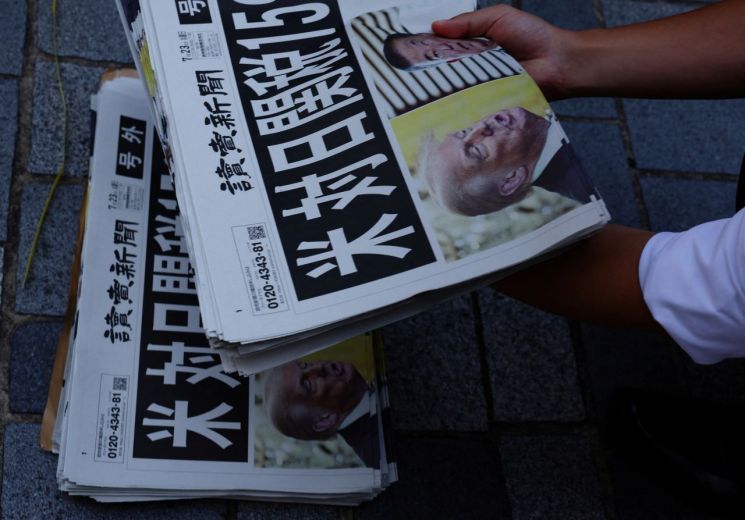 Photo of US President Donald Trump published in Japan's Yomiuri Shimbun on July 23 (local time). Photo by Reuters Yonhap News
Last month, Japan's exports to the United States continued to decline for the fourth consecutive month.This was due to a contraction in automobile and auto parts exports, which account for one-third of Japan's total exports, amid the impact of tariffs imposed by the United States.
According to the preliminary July trade statistics released by Japan's Ministry of Finance on August 20, exports to the United States in July amounted to 1.7285 trillion yen (approximately 16.4 trillion won), a decrease of 10.1% compared to the same month last year. With this, exports to the US have now declined for four straight months.
Exports of automobiles, Japan's main export item, fell 28.4% to 422 billion yen. The number of vehicles exported also dropped 3.2% to 123,531 units. In terms of volume, this was a 3.2% decrease. Bloomberg noted, "It appears that automakers are absorbing some of the tariff burden in order to maintain sales."
A Ministry of Finance official explained that while the number of large vehicles exported has decreased, exports of small vehicles have increased. Nihon Keizai Shimbun (Nikkei) pointed out, "Manufacturers may have prioritized exporting lower-priced models or absorbed costs to reduce the impact of tariffs."
Exports of auto parts to the US also declined. Japan's auto parts exports dropped by 17.4%, and manufacturing equipment such as semiconductors fell by 31.3%.
During the same period, Japan's imports from the US fell by 0.8% to 1.1434 trillion yen, marking a decline for the sixth consecutive month. As a result, Japan's trade surplus with the US reached 585.1 billion yen, down 84.1 billion yen from June's 669.2 billion yen.
Foreign media also noted that it may not be long before Japanese automakers, who have so far postponed price hikes, pass on the tariff burden to US consumers. According to Reuters, Takeshi Minami, chief economist at Norinchukin Research Institute, said, "Ultimately, the cost will inevitably be passed on to US consumers, and this will become an additional burden on future sales."
Meanwhile, Japan continues to face uncertainty regarding automobiles and auto parts. Last month, Japan and the US agreed to reduce tariffs on Japanese car exports to the US from the current 27.5% to 15%, but the implementation date has not been set. The Japanese government plans to continue urging the Trump administration to issue a presidential order for the announcement. Toyota Motor Corporation has previously warned that the US tariffs could result in losses of about 1.4 trillion yen.
© The Asia Business Daily(www.asiae.co.kr). All rights reserved.
![Clutching a Stolen Dior Bag, Saying "I Hate Being Poor but Real"... The Grotesque Con of a "Human Knockoff" [Slate]](https://cwcontent.asiae.co.kr/asiaresize/183/2026021902243444107_1771435474.jpg)
















