Revamping Investment Principles with Internal Carbon Pricing System
A System That Considers "Expected Carbon Tax" in Investment Decisions
HMM, the largest shipping company in Korea, has revamped its vessel investment principles to reorganize its fleet with a focus on eco-friendliness. When purchasing new vessels, the company now gives higher scores to ships that use low-carbon fuels such as liquefied natural gas (LNG) or methanol rather than petroleum.
According to the industry on August 22, HMM recently introduced and implemented an 'internal carbon pricing system' based on these principles. This system involves pre-estimating costs according to carbon emissions and reflecting them when making investment decisions or launching new projects, such as vessel purchases. HMM will prioritize estimated costs based on carbon emissions in its investment decisions and plans to calculate vessel- and period-specific carbon taxes during the second half of the year to set its internal carbon price early next year. Even if a vessel is expected to generate high profits, its investment value will decrease if it emits a large amount of carbon.
The internal carbon pricing system began to emerge in Korea around 2022. In March 2022, KT&G introduced an internal carbon pricing system, setting the cost at about 50,000 won per ton. SK Innovation announced that it would apply internal carbon pricing to investment agenda reviews. As a result, in key regions including Korea, the United States, and the European Union (EU), the price per tCO2 (unit of carbon dioxide emissions) is set to increase to $40-95 this year, $60-105 in 2027, and $200 in 2040.
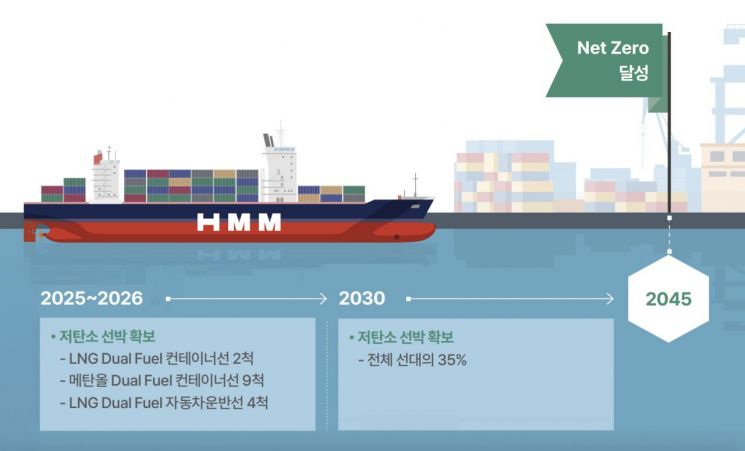
Strengthened global environmental regulations are the driving force behind HMM's accelerated carbon emissions management. The EU, through the 'FuelEU Maritime' regulation implemented in January, is requiring vessels operating at its ports to reduce their annual carbon emissions by 2% each year until 2029. By 2050, emissions must be reduced by 80%. Starting in 2027, the International Maritime Organization (IMO), under the United Nations, will impose a carbon tax of $100-380 per ton of vessel carbon emissions. The more carbon emitted, the higher the surcharge. In response, HMM announced in its '2030 Mid- to Long-Term Strategy' in September last year that it would move up its net-zero (full carbon neutrality) target by five years, aiming to achieve it early in 2045.
HMM is adjusting its vessel portfolio to comply with global environmental regulations. This year, the company acquired two 9,000 TEU (one TEU is equivalent to a 20-foot container) methanol-fueled container ships. By the first half of next year, HMM plans to acquire seven more, bringing the total to nine eco-friendly methanol-fueled vessels.
© The Asia Business Daily(www.asiae.co.kr). All rights reserved.


















