Up to 10 Companies to Submit Restructuring Plans by Year-End
Government to Consider Tailored Support in Finance, Taxation, and R&D
Additional Designation of Industrial Crisis Areas Such as Yeosu and Seosan Under Review
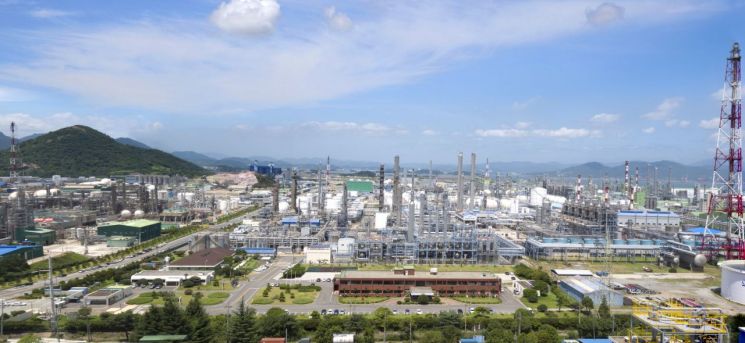
The domestic petrochemical industry is launching a large-scale restructuring effort to overcome a structural downturn by reducing the production capacity of naphtha cracking centers (NCCs) by up to 25% and shifting its focus to high value-added products. The government has announced that it will only provide customized support in areas such as finance, taxation, and research and development (R&D) after companies first establish their own restructuring plans.
On the 20th, at the Ministerial Meeting on Strengthening Industrial Competitiveness held at the Government Seoul Office and presided over by Deputy Prime Minister Koo Yoonchul, the government finalized three main directions for restructuring the petrochemical industry: reduction of excess facilities and transition to specialty products, securing financial soundness, and minimizing the impact on local economies and employment. In addition, the government outlined three key principles for support: simultaneous restructuring of the three main petrochemical complexes (Yeosu, Ulsan, and Daesan), preparation of sufficient self-help efforts and feasible restructuring plans by companies, and provision of a comprehensive government support package.
The government reiterated its principle of "self-help efforts first, government support later," stating, "Simply enduring the structural downturn will not secure future competitiveness." Lee Seungryul, Director of Industrial Policy, explained during a press briefing, "We will respond firmly to free-riding companies," adding, "Support will be differentiated based on the extent of self-help efforts and business restructuring."
Later that day, ten petrochemical companies with NCCs will hold a "Voluntary Agreement Ceremony for the Revitalization of the Petrochemical Industry" at the Korea Chamber of Commerce and Industry in Seoul, attended by Minister of Industry Kim Jeonggwan. They will announce a joint goal to reduce NCC capacity by a total of 2.7 to 3.7 million tons. This represents 18% to 25% of the total domestic NCC production capacity of 14.7 million tons. The target was derived based on consulting results commissioned by the Korea Petrochemical Industry Association from Boston Consulting Group (BCG).
The participating companies plan to establish their respective restructuring plans by the end of the year. The government will comprehensively review the feasibility of the plans and the degree of self-help efforts submitted by the companies before providing a customized support package that includes finance, taxation, R&D, and regulatory easing. However, companies that delay restructuring and expect to benefit solely from the reduction efforts of others-so-called "free riders"-will be excluded from support.
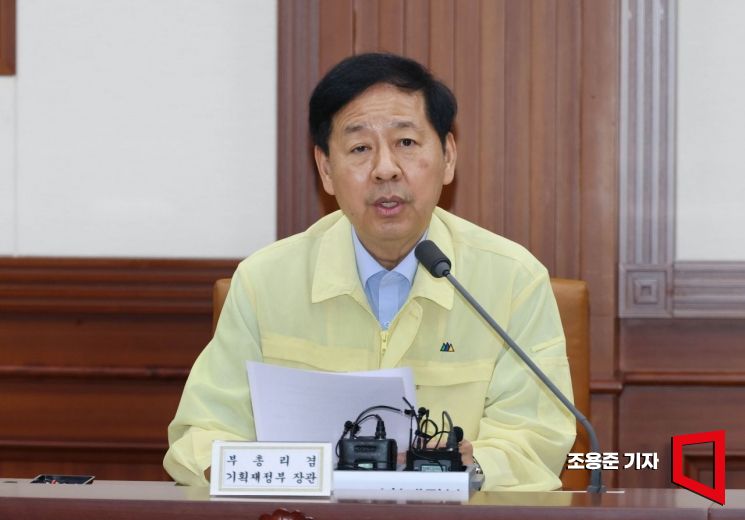 Koo Yoonchul, Deputy Prime Minister for Economic Affairs and Minister of Economy and Finance, attended the Ministerial Meeting on Strengthening Industrial Competitiveness held at the Government Seoul Office in Jongno-gu, Seoul on the 20th, and made remarks regarding the promotion direction for the revival of the petrochemical industry. 2025.8.20 Photo by Jo Yongjun
At the meeting, Deputy Prime Minister Koo urged, "Companies and major shareholders must quickly present binding restructuring and competitiveness enhancement plans based on painful self-help efforts. They should proceed with a sense of urgency, aiming to submit their plans as early as next month, not by the end of the year." To mitigate the impact of restructuring on local economies and employment, the government has already designated Yeosu as a "Preemptive Industrial Crisis Response Area" and is considering additional designations for Seosan and Daesan. The Ministry of Employment and Labor also plans to designate Yeosu as a "Preemptive Employment Crisis Response Area," providing employment retention subsidies and livelihood stabilization loans.
This voluntary agreement is seen as significant because it marks the first time the industry itself has autonomously expressed a commitment to structural transformation, rather than being led by the government. The industry has reached a consensus on the need to move away from a "survival strategy" focused on commodity products and shift toward high value-added and eco-friendly products. A government official stated, "Without a joint effort from the entire petrochemical industry, restructuring cannot succeed. We will use this agreement as a starting point to support the enhancement of competitiveness."
© The Asia Business Daily(www.asiae.co.kr). All rights reserved.


















