460,353 Cruise Tourists in the First Half of the Year
Up 15.2% Compared to Last Year
As the cruise tourism market visiting Korea continues to grow, attention is being paid to whether it will contribute to the government's goal of attracting 30 million inbound tourists.
According to the Korea Tourism Organization Data Lab on August 19, the number of cruise tourists visiting Korea in the first half of this year reached 460,353, a 15.2% increase compared to the same period last year (399,485). The proportion of cruise tourists once exceeded 10% of all inbound tourists during its peak in 2016. This recent growth is expected to have a positive impact on achieving the goal of 30 million inbound tourists by 2030.
Last year, the annual number of cruise tourists visiting Korea was 731,499, which was the third largest on record following 2016 (1,644,436) and 2015 (748,947). This year, it is highly likely to become the second highest since 2016, and there are expectations that the number could surpass one million.
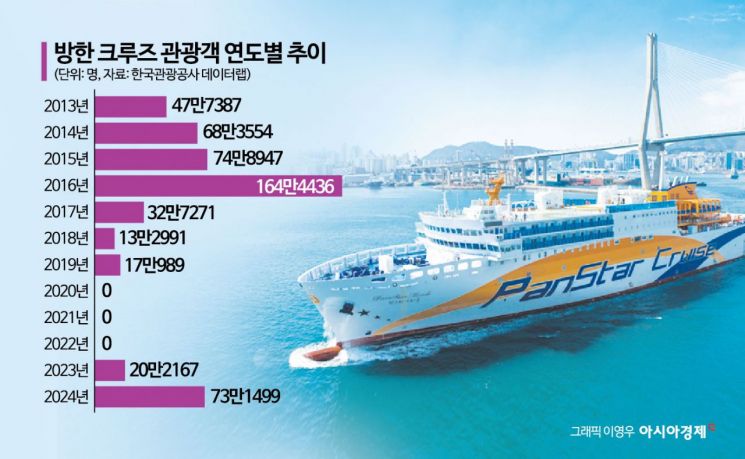
The Data Lab's figures are provisional, based on Ministry of Justice immigration statistics, and the final government statistics, which include data from port authorities, are often higher. In fact, in a press release in January this year, the Ministry of Culture, Sports and Tourism announced that last year's cruise tourists numbered 810,000, 80,000 more than the Tourism Organization's tally. The ministry projects that this year's cruise tourists will reach 1.09 million. As a result, the timeline for achieving the government's annual target of one million cruise tourists could be moved up.
In June last year, the government announced a "Cruise Tourism Promotion Plan" and set a goal of attracting one million cruise tourists to Korea by 2027. Cruise tourism is drawing attention because of its high added value and its potential to disperse inbound tourists, who are concentrated in the metropolitan area, to regional areas, thereby contributing to local economic revitalization.
According to the Ministry of Culture, Sports and Tourism's 2024 survey of inbound tourists, the metropolitan area visitation rate was 82.7%, while the visitation rate for areas outside the metropolitan area was only 33.9%. As a result, cruise tourism, which can attract large numbers of tourists to coastal and fishing villages, is being discussed as a solution to address regional economic imbalances. It is also being evaluated as a countermeasure to the risk of regional extinction in coastal areas suffering from severe population decline.
The international market is also expanding. According to the Cruise Lines International Association (CLIA), the number of cruise tourists worldwide reached 31.7 million in 2023, and is expected to grow to 39.7 million by 2027, with an average annual growth rate of 5.7%.
The government plans to support the industry by expanding new port infrastructure, such as the opening of the Saemangeum New Port cruise pier next year and the groundbreaking of the Mukho Port international passenger terminal. Considering that a significant proportion of cruise tourists to Korea are Chinese, the visa-free entry for Chinese group tourists, which will take effect on September 29, is also expected to contribute to market expansion.
The tourism industry also points to the need to expand demand by linking with K-culture. A Korea Tourism Organization official stated, "Thanks to the popularity of K-pop and other aspects of the Korean Wave, the demographic of cruise tourists is expanding from mainly seniors to include families and the MZ generation (Millennials and Generation Z)."
© The Asia Business Daily(www.asiae.co.kr). All rights reserved.