Introducing Project Viability Adjustment Coefficient, Applied to 108 Sites
Upgrading Zoning to Quasi-Residential for Main Roads and Transit Areas
Parallel Planning and Direct Support for Associations to Shorten Project Duration by Two Years
The Seoul Metropolitan Government will introduce a project viability adjustment coefficient to the Moa Housing and Moa Town projects, similar to what is used in general redevelopment and reconstruction projects. Public contributions will be eased, and the volume of general sales units will be increased to lower the financial burden on residents. For projects located in prime areas such as near subway stations, zoning will be upgraded to quasi-residential areas, laying the groundwork for the additional supply of 7,000 housing units.
On August 19, the Seoul Metropolitan Government announced the "Plan to Revitalize Moa Housing" and revealed that the area of 1-5 Hyeonjeo-dong, Seodaemun-gu, commonly known as "Ddonggol Village," which had been left unauthorized for 20 years, has been selected as the first target site.
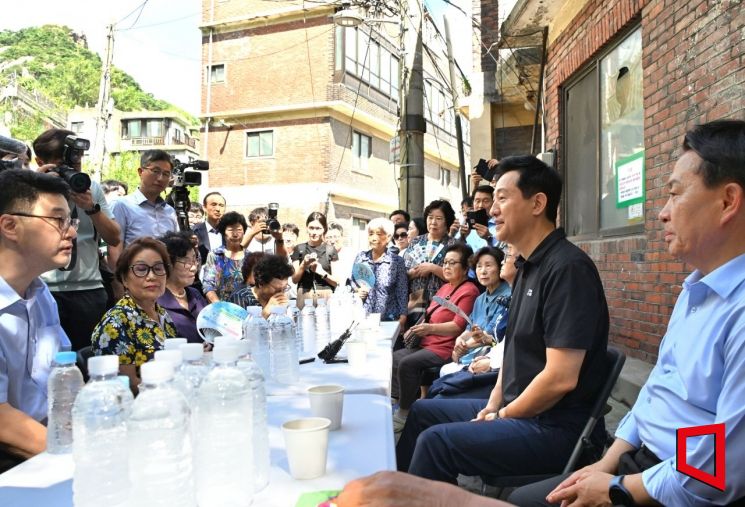 Seoul Mayor Oh Sehoon is holding a meeting with local residents at Moa Town in Hyeonjeo-dong, Seodaemun-gu, on the afternoon of the 19th. Provided by Seoul City
Moa Housing is a redevelopment project in which owners of multi-family and multi-unit houses with a site area of at least 1,500 square meters jointly develop small-scale residential land in block units by consolidating several plots. The Seoul Metropolitan Government designates and manages sites as Moa Housing if the area is within 20,000 square meters, and as Moa Town if within 100,000 square meters.
Since the introduction of the Moa Housing system in 2022, Moa Town projects are currently underway at 116 locations. Moa Housing has received approval for the establishment of associations at 166 sites, covering 34,811 units. The plan to designate 30,000 units by 2026 has already been exceeded. Moa Housing and Moa Town projects are characterized by faster progress and the simultaneous improvement of infrastructure compared to conventional redevelopment.
Increasing General Sales Volume by Introducing Project Viability Adjustment Coefficient
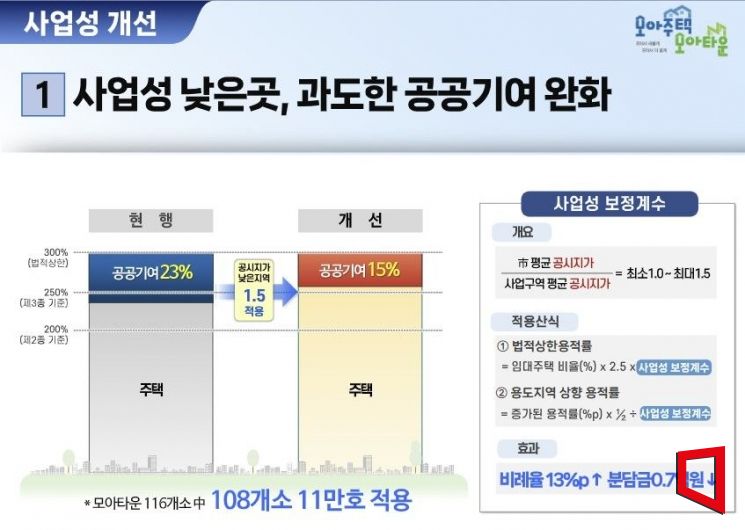
The core of this measure is to enhance project viability so that Moa Town development can proceed quickly. The project viability adjustment coefficient, previously applied only to general redevelopment and reconstruction projects, will now be introduced to Moa Housing as well. Since 93% of Moa Town sites are located in areas with land prices below the Seoul average, most projects are expected to benefit from this measure.
The project viability adjustment coefficient is a mechanism to improve project viability in areas with land prices lower than the Seoul average by reducing the number of rental units and increasing the volume of general sales units. A simulation conducted after applying a coefficient of 1.5 to already selected Moa Town sites showed that the proportional rate increased by an average of 13 percentage points, and the average financial burden on residents decreased by 70 million won.
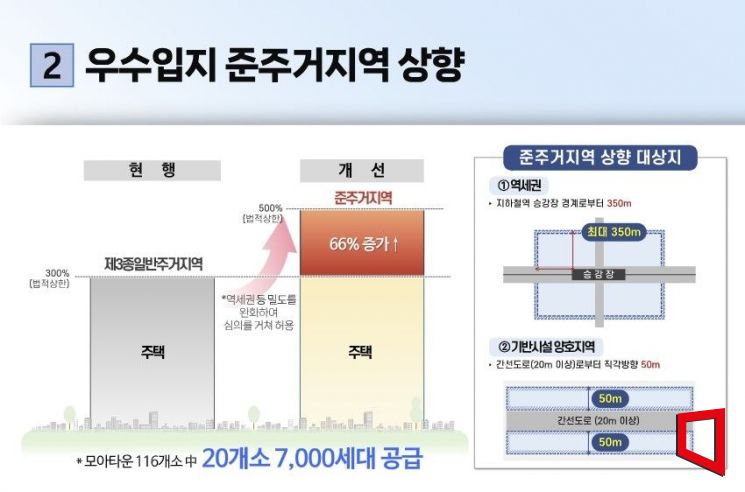
For sites with excellent infrastructure, the floor area ratio will be increased. For locations with superior infrastructure, such as along main roads or near subway stations, zoning will be upgraded to quasi-residential areas, laying the foundation for the additional supply of 7,000 Moa Housing units. In addition, initial financial support for projects will be expanded. The city will directly provide loans of up to 2 billion won for the initial operating and service costs of Moa Housing associations. Construction costs, which account for about 70% of total project expenses, will be financed at a low interest rate, 0.6% lower than that of the existing Housing and Urban Guarantee Corporation (HUG), through collaboration among the Seoul Metropolitan Government, SH Corporation (Seoul Housing and Communities Corporation), and financial institutions. The loan product is expected to be launched as early as next year.
Shortening Project Duration by Two Years Through Parallel Planning and Increased Support
In addition, the previously separated Moa Town management and architectural plans will now be developed in parallel, reducing the planning period by up to one year. The city and district offices will support the entire process, from project viability analysis and collecting consent forms for association establishment to providing project funds, architectural planning, and estimating financial burdens, with the aim of shortening the project duration by another year. SH Corporation will expand its precise project viability analysis services to include not only regulated urban planning areas but also Moa Town and Moa Housing (street housing maintenance projects). Target areas will be recruited in the second half of the year. If more than 50% of association members agree to jointly implement the project with SH Corporation, incentives such as expanding the project area (from 20,000 to 40,000 square meters) and easing the rental housing ratio to 30% will be provided.
Mayor Oh visited the Hyeonjeo-dong area, the first site to which the Moa Housing revitalization measures will be applied. After the Moa Town management plan was approved in June, the consent rate for association establishment has reached 72.1%. Approval for association establishment is expected in October, followed by an integrated review in March next year, approval of the project implementation plan in September, and groundbreaking in December. The goal is to complete 366 units by December 2029, with residents moving in within five years. Of the approximately 20 households (33 people) currently residing in the area, some are basic livelihood security recipients and lower-income households. The city plans to encourage tenant-specific protection measures, such as providing floor area ratio incentives to associations when compensating tenants for losses.
During his visit to the site, Mayor Oh Sehoon said, "We have worked hard to secure sufficient volume, and now the key is speed. The critical point is how quickly we can help the project move forward," adding, "By accelerating the process, improving project viability, and addressing various inconveniences, we will minimize sources of conflict from the association establishment stage and expedite the process, thereby also reducing costs."
© The Asia Business Daily(www.asiae.co.kr). All rights reserved.














