First Designation of Proactive Employment Crisis Response Regions
Yeosu City and Gwangsan-gu Selected for Six Months
172 Job Creation Projects Rated Last Year
Over Half Underperformed: 70 to Improve, 18 to Face Budget Cuts
The government has designated Yeosu City and Gwangsan-gu in Gwangju as regions for proactive employment crisis response. In addition, after evaluating last year's publicly funded job creation projects, it concluded that improvements or budget cuts are needed for 88 underperforming projects.
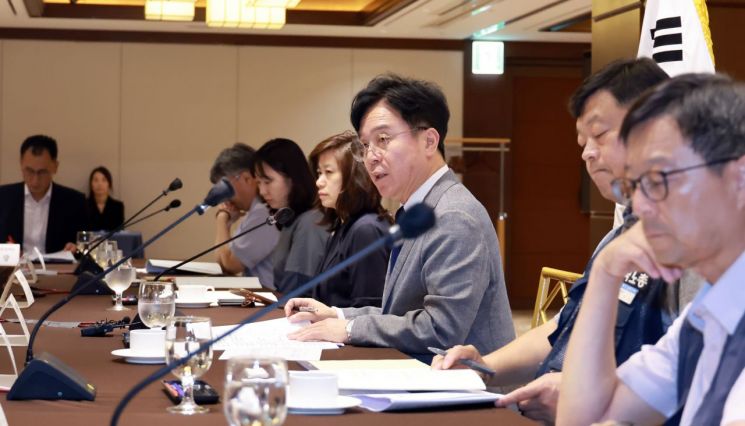 Kim Younghoon, Minister of Employment and Labor, is speaking at the 3rd Employment Policy Council held on the 19th at Royal Hotel Seoul in Jung-gu, Seoul. Photo by Ministry of Employment and Labor
First Designation of Proactive Employment Crisis Response Regions
On August 19, Kim Younghoon, Minister of Employment and Labor, presided over the Employment Policy Council for the first time since taking office. The council, held at Royal Hotel Seoul in Jung-gu, Seoul, was attended by representatives of labor and management, experts, and government officials from relevant ministries.
Participants freely discussed key employment issues, including revitalizing local employment and responding to industrial transitions to ensure every citizen's right to work. They also discussed the new designation of employment crisis response regions and ways to expand the National Employment Support System to more vulnerable job seekers. As a result of discussions regarding Yeosu City and Gwangsan-gu, which recently applied for designation as employment crisis regions, both areas will be designated as 'proactive employment crisis response regions' for six months.
The proactive employment crisis response region system was newly introduced on July 31 to overcome the limitations of the existing employment crisis region system, which could only respond after employment shocks were reflected in indicators. This is the first time the new system has been applied. Regions designated as proactive employment crisis response regions are given preferential consideration when reviewing eligibility or support levels for employment retention subsidies, vocational competency development support projects, and livelihood stabilization loans.
As a follow-up to the establishment of the new system, the council also reviewed and approved revisions to the operating regulations for the National Employment Support System. With this revision, unemployed individuals in proactive employment crisis response regions can now participate in the National Employment Support System regardless of income level and will also be eligible to receive the employment success allowance.
Evaluation of Last Year's Job Projects: 70 for Improvement, 18 for Budget Cuts
The council also discussed this year's evaluation and improvement plans for publicly funded job creation projects. Last year, the government classified 186 publicly funded job projects into seven categories: direct employment, vocational training, employment services, employment incentives, start-up support, unemployment income maintenance/support, and supported employment/rehabilitation. Of these, 172 projects were rated: 15 as excellent, 69 as good, 70 as needing improvement, and 18 as requiring budget cuts.
The council decided to restructure underperforming projects and adjust similar or overlapping projects. Projects rated for budget cuts will have their funding reduced in next year's budget, and projects underperforming for two consecutive years will be subject to comprehensive system improvements. The government also plans to invest in building a safety net where everyone can work and be protected, and support the growth of new industries and smooth job transitions. Encouraging various groups to enter the labor market is also a key goal.
Minister Kim emphasized, "With the possibility of employment crises in vulnerable regions and industries becoming a constant concern, it is important to monitor employment conditions and proactively respond to crises in line with the new government's philosophy."
He added, "The internal and external conditions of the labor market are challenging, including the transition to artificial intelligence (AI), low birth rates and an aging population, and global economic uncertainty. We will turn these crises into opportunities by analyzing and responding to the impact of AI through forums, launching youth-SME cooperation projects, and promoting region-led job creation."
© The Asia Business Daily(www.asiae.co.kr). All rights reserved.












