Seeking Strategies for Trade and Tariff Response
Attended by Choi Taewon, Lee Jaeyong, Koo Kwangmo, and Others
President Lee Jaemyung met with business leaders accompanying him on his upcoming trip to Washington, D.C., where he is scheduled to hold a summit with U.S. President Donald Trump on the 25th (local time), to discuss key economic issues. The purpose was to gather with heads of major business groups, who are closely monitoring changes in the international trade environment, and seek joint response strategies. It is also noteworthy that this meeting between the president and the business community took place at a time when economic organizations have expressed concerns about controversial bills in the National Assembly, such as the Yellow Envelope Act (amendments to Articles 2 and 3 of the Trade Union and Labor Relations Adjustment Act) and the Commercial Act.
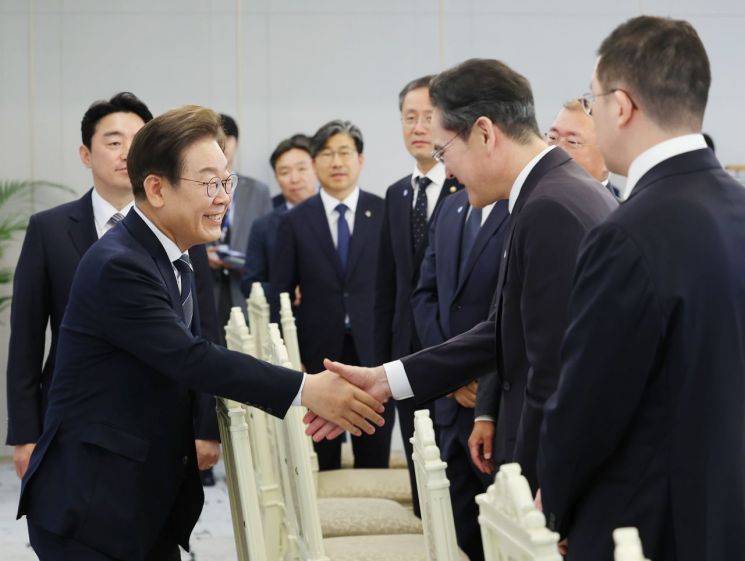
On the 19th, at the presidential office in Yongsan, Seoul, President Lee held a 'Business Leaders and Economic Organizations Meeting Accompanying the U.S.-Japan Visit,' where he widely gathered opinions from business representatives. President Lee is scheduled to hold a Korea-Japan summit with Japanese Prime Minister Shigeru Ishiba on the 23rd, followed by a Korea-U.S. summit with President Trump on the 25th. In particular, the business community is focusing its attention on the Korea-U.S. summit, as detailed negotiations on tariffs are likely to take place.
Attendees at the meeting included Chey Taewon, Chairman of the Korea Chamber of Commerce and Industry; Ryu Jin, Chairman of the Federation of Korean Industries; Lee Jaeyong, Chairman of Samsung Electronics; Koo Kwangmo, Chairman of LG; Cho Won-tae, Chairman of Hanjin Group; and Kim Dongkwan, Vice Chairman of Hanwha Group. Park Ji-won, Chairman of Doosan Enerbility; Seo Jungjin, Chairman of Celltrion; and Jang Jaehun, Vice Chairman of Hyundai Motor Group, were also present. The gathering represented a broad spectrum of industries, including shipbuilding, semiconductors, automobiles, defense, bio, and energy.
The main focus of President Lee's trip is President Trump's potential additional demands. As both sides have agreed to create a $350 billion investment fund in the United States, including the Korea-U.S. shipbuilding cooperation project known as MASGA (Make American Shipbuilding Great Again), there is a possibility that President Trump will request a specific 'framework.' Against this backdrop, President Lee listened to the difficulties faced by companies due to mutual and product-specific tariffs, while also recognizing the need for prior coordination with the business community regarding the government's trade negotiation stance and direction for investments in the U.S.
Given the increased burden on major export items such as semiconductors, automobiles, batteries, and steel, discussions may also be held on institutional support and export strategies. In this context, companies planning large-scale investments in the U.S. may request cooperation on investment incentives, tax benefits, and regulatory approval issues.
By company, Samsung Electronics, Hyundai Motor, LG, and SK are already pursuing the construction and expansion of factories in the U.S., so they are likely to emphasize the impact of local investment and job creation. Shipbuilding-related companies such as Hanwha and HD Hyundai are expected to raise the issue of participating in the U.S. shipbuilding revitalization project.
An industry official stated, "At business meetings held ahead of summits, cooperation measures between the two countries have always been widely discussed, and in the past, economic delegations have focused mainly on cooperation in semiconductors and batteries. This time, it is highly likely that shipbuilding will be included, and product-specific tariff issues will also be key topics."
Meanwhile, it has been reported that President Lee is considering visiting Philly Shipyard in Philadelphia, which was acquired by Hanwha Ocean, during his visit to the U.S. Vice Chairman Kim, who is accompanying the trip, is expected to oversee this schedule. As Philly Shipyard has become a symbol of Korea-U.S. shipbuilding cooperation, this visit is expected to serve as an opportunity for the government and industry to explore ways to collaborate with the U.S. in areas such as ship production, maintenance, repair, and overhaul (MRO).
© The Asia Business Daily(www.asiae.co.kr). All rights reserved.












