A team of Korean researchers has not only identified the causes of depression but also provided a clue for developing new treatment strategies.
On August 19, KAIST announced that the research team led by Distinguished Professor Wondo Hur from the Department of Biological Sciences, in collaboration with Dr. Minju Lee from the National Forensic Service and Professor Seokhui Kim from the Department of Pathology at Ajou University Medical Center, demonstrated through animal model experiments that it is possible to restore antidepressant effects by regulating signaling pathways using optogenetics technology.
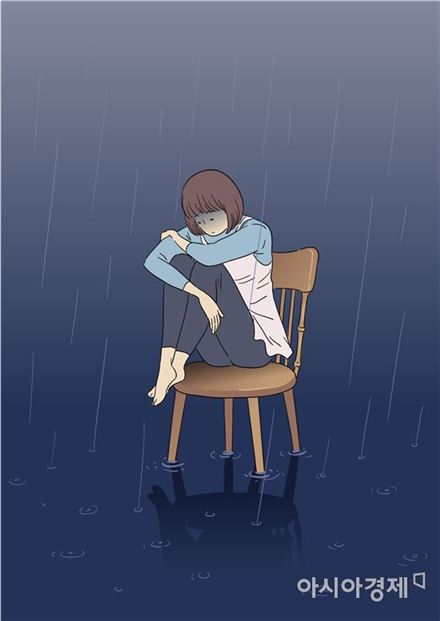
Prior to the experiments, the joint research team identified a new molecular mechanism of depression by analyzing RNA bases and performing immunohistochemical analysis on brain tissue from patients who had died by suicide.
During this process, the researchers focused on the hippocampus and the dentate gyrus, brain regions responsible for memory and emotion. The dentate gyrus, located within the hippocampus, is the site where new memories are formed and neural cells grow when information first enters, and is known to be related to emotional regulation and depression.
Using representative depression mouse models, such as the corticosterone stress model and the chronic unpredictable stress model, the researchers observed that in stress-induced situations, the number of FGFR1 (Fibroblast Growth Factor Receptor 1) signaling receptors, which receive signals from growth factors (FGFs) and transmit growth and differentiation commands within cells, was significantly increased in the dentate gyrus.
Notably, when the researchers created a condition in which FGFR1 was removed-using conditional knockout mice-they observed that the mice became more vulnerable to stress and developed depressive symptoms more rapidly. This suggests that FGFR1 plays a crucial role in normal neural regulation and stress resistance.
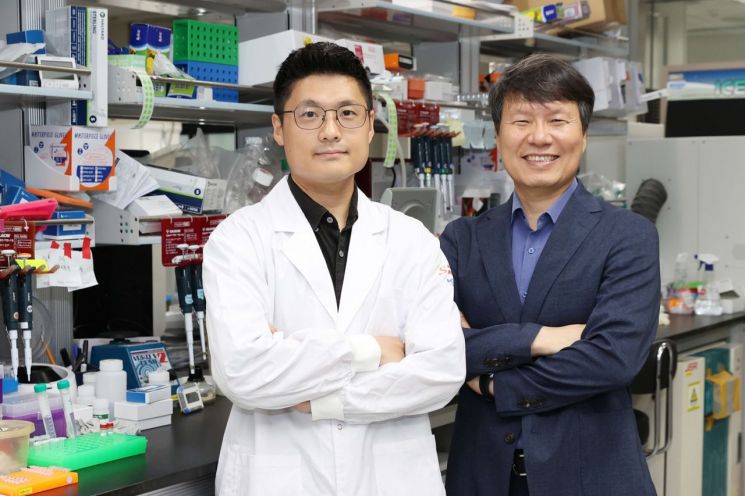 (From left) Dr. Jongpil Shin, Department of Biological Sciences, KAIST, Professor Wondo Hur. Courtesy of KAIST
Based on these findings, the joint research team developed the 'optoFGFR1 system,' which allows FGFR1 to be activated by light. They found that reactivating FGFR1 in depression mouse models with FGFR1 deficiency restored antidepressant effects. This experimentally proved that simply activating the FGFR1 signaling pathway can improve depressive behaviors.
However, in aged depression mouse models, activating the FGFR1 pathway via the optoFGFR1 system did not produce antidepressant effects. The researchers explained that this was due to the excessive expression of a protein called Numb in the aged brain, which interferes with FGFR1 signaling.
In fact, postmortem human brain tissue analysis conducted by the research team also revealed that specific overexpression of the Numb protein was observed only in elderly patients with depression.
Conversely, when the researchers simultaneously activated FGFR1 signaling and expressed a gene regulation tool (shRNA) to suppress Numb in mouse models, neurogenesis and behavior were restored to normal levels even in aged depression mouse models. These findings confirm that the Numb protein acts as a 'blocker' of the FGFR1 signaling pathway and is a key factor that inhibits the antidepressant mechanism of the hippocampus.
Distinguished Professor Wondo Hur stated, "This research is significant in that it reveals depression can arise from disruptions in specific neural signaling pathways. In particular, by identifying at the molecular level why antidepressants are less effective in elderly patients, our findings provide a clue for developing new depression treatments targeting the Numb protein in the future."
This study was supported by the Ministry of Science and ICT, the National Research Foundation of Korea ASTRA program, and the Bio-Medical Technology Development Project. Jongpil Shin, a doctoral student in the Department of Biological Sciences at KAIST, participated as the first author. The results were published on August 15 in the international journal Experimental & Molecular Medicine.
© The Asia Business Daily(www.asiae.co.kr). All rights reserved.
![User Who Sold Erroneously Deposited Bitcoins to Repay Debt and Fund Entertainment... What Did the Supreme Court Decide in 2021? [Legal Issue Check]](https://cwcontent.asiae.co.kr/asiaresize/183/2026020910431234020_1770601391.png)
















