"Funding Threshold Rises and Possibility of Additional Regulations"
"Home Purchase Decisions Delayed Amid Growing Uncertainty"
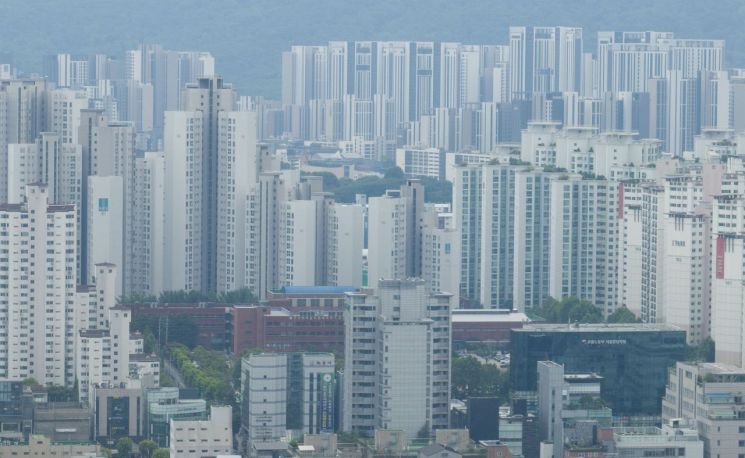
The nationwide Housing Business Sentiment Index for August saw a significant decline. The drop was influenced by weakened buyer sentiment in the Seoul metropolitan area following the loan restrictions implemented on June 27.
According to the Housing Industry Research Institute (HIRI) on August 19, the Housing Business Sentiment Index for August, based on a survey of housing business operators, was recorded at 76.0, a decrease of 24.0 points compared to the previous month. If the index exceeds the baseline of 100, it indicates that a greater proportion of companies expect the housing business climate to improve.
The index had risen for six consecutive months through last month, but turned downward this month due to the impact of the loan restrictions. The decline was particularly sharp in the Seoul metropolitan area. The index for the metropolitan area dropped by 57.1 points to 66.6. Within the metropolitan area, Seoul saw the steepest decline, falling by 71.0 points to 64.1. Gyeonggi Province dropped by 53.0 points to 69.2, and Incheon fell by 47.1 points to 66.6.
HIRI explained, "After the loan restrictions, the threshold for securing funds has risen and the possibility of additional regulations has increased, leading to greater uncertainty. As a result, buyers are postponing their home purchase decisions." The institute added, "Homeowners are also reluctant to adjust prices, and both buyers and sellers are hesitating to proceed with transactions."
HIRI further noted, "In fact, the number of apartment transactions in Seoul plummeted immediately after the regulations took effect. In the four weeks prior to the announcement, there were 10,723 transactions, but in the four weeks following the announcement, this number dropped to 2,506, a decrease of 76.6%."
However, the apartment market in Seoul's three Gangnam districts, which had frozen after the regulations, is now considered to be entering a recovery phase. HIRI stated, "Even before the loan restrictions, there was a steady influx of so-called 'smart single-home' demand from high-income buyers and those with strong cash liquidity, despite these areas being designated as land transaction permit zones. After the new measures, key locations such as reconstruction complexes in Songpa District led the market rebound, and pent-up demand with expectations for regulatory easing is helping to prevent downward pressure across the three Gangnam districts."
Outside the metropolitan area, the index is projected to fall by 16.9 points to 78.0. For major cities, the index dropped by 16.6 points to 82.2, and for provincial regions, it fell by 17.1 points to 74.8.
Among major cities, Daejeon saw the largest drop of 34.8 points (from 106.2 to 71.4), followed by Sejong with a 27.7-point decrease (from 120.0 to 92.3), Ulsan with a 13.7-point decrease (from 93.7 to 80.0), and Busan with a 13.2-point decrease (from 95.0 to 81.8). Among provincial regions, Gyeongnam fell by 28.6 points (from 100.0 to 71.4), Chungbuk by 26.6 points (from 116.6 to 90.0), and Gangwon by 23.3 points (from 83.3 to 60.0).
HIRI stated, "As buyer sentiment has weakened nationwide, especially in the metropolitan area, non-metropolitan regions have also been affected. Although the direct impact of loan restrictions and policies is relatively less pronounced in non-metropolitan areas, resulting in lower short-term volatility, regional supply-demand imbalances and economic stagnation are acting as obstacles to recovery."
Meanwhile, the nationwide Fund Procurement Index for August is forecast to drop by 21.6 points from the previous month to 71.2, and the Material Supply Index is recorded at 93.2, a decrease of 6.8 points.
© The Asia Business Daily(www.asiae.co.kr). All rights reserved.

















