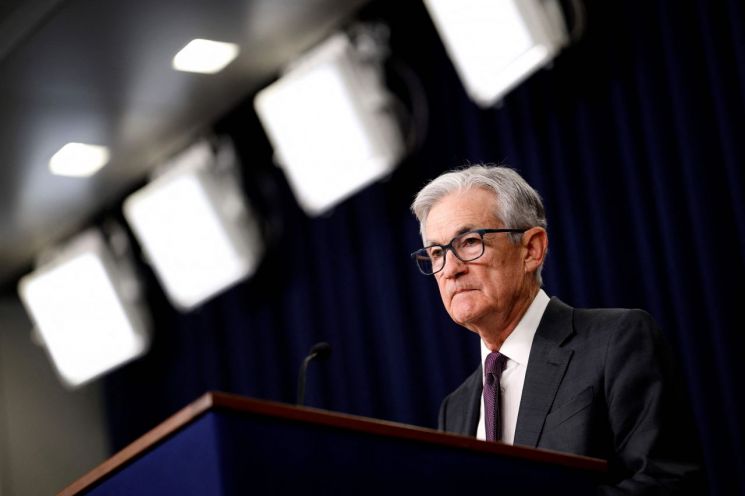
Securities firms have assessed that this week's Jackson Hole Economic Policy Symposium (Jackson Hole Meeting) hosted by the U.S. Federal Reserve (Fed) is unlikely to pose a risk factor for the stock market. There are also projections that Fed Chair Jerome Powell’s keynote address, which triggered a market shock several years ago, will remain largely theoretical this year, as it is his final year in office. After the Jackson Hole Meeting, it is anticipated that the U.S. stock market will see increased concentration within leading sectors, while the Korean stock market may experience gains in previously neglected industries.
On August 19, Kim Dooun, a researcher at Hana Securities, stated in his report "Is the 2025 Jackson Hole Meeting a Risk Factor?" that "In conclusion, no. This year’s Jackson Hole is likely to be much ado about nothing."
Kim noted, "Although there was temporary volatility in the stock market due to events such as the additional quantitative easing (QE2) in 2010, the absence of Chair Ben Bernanke in 2013, and Chair Powell’s hawkish remarks in 2022, overall, the Jackson Hole meeting has had a positive impact on the stock market." According to Hana Securities, an analysis of the average daily stock price increase on the day of the Fed Chair’s Jackson Hole speech from 2000 to 2024 showed that the S&P 500 rose by 0.30% and the KOSPI by 0.36%.
Three key points were identified for the upcoming Jackson Hole Meeting, scheduled for August 21-23 (local time). The first is Chair Powell’s speech on the second day of the symposium. Kim explained, "Given that this is Powell’s final year in office and that it is still difficult to assess the impact of tariffs on economic indicators, he is likely to repeat a theoretical 'wait and see' message." He added, "Financial markets, which had hoped for an insurance rate cut ('move and see'), are expected to interpret this as a hawkish (tightening) stance."
The second point is this year’s theme: "The Labor Market in Transition: Demographics, Productivity, and Macroeconomic Policy." Kim stated, "The symposium will delve into the effects of aging populations, changes in immigration patterns, the spread of artificial intelligence (AI) and automation, and wage disparities on the labor market. The impact of MAGA policies and tariff policies under the Donald Trump administration on monetary policy will also be discussed." He further noted, "Structural changes in the labor market are expected to become a significant factor in the Fed’s monetary policy decisions."
Lastly, Kim said, "The third point is the transition in the monetary policy framework," predicting that "the Fed will shift from a data-driven approach to an outlook-based policy and adopt a more flexible monetary policy to manage uncertainties arising from labor market changes." Accordingly, he expects that the Federal Open Market Committee (FOMC) in September is highly likely to resume interest rate cuts that had been halted since December 2024.
Kim especially emphasized, "After Jackson Hole, market attention will quickly shift to the September FOMC meeting," and added, "From a stock market perspective, it is important to watch for changes in market consensus ahead of the September meeting." He explained, "The consensus formed just before the FOMC is typically divided between hawks expecting a rate hike and doves anticipating a cut. However, investment strategies should be differentiated depending on whether the actual outcome aligns with the consensus," citing "differences in profitability" as the reason.
He explained that both the S&P 500 and KOSPI performed well when a Jackson Hole forum expected to be hawkish (favoring tightening) turned out to be dovish (favoring easing). He added, "If, as expected, Chair Powell’s remarks at this Jackson Hole meeting remain theoretical, focusing on inflation indicators, the best-case scenario (a shift from hawkish to dovish) ahead of the September meeting is worth anticipating."
Based on past characteristics of stock market sectors, Kim predicted, "In the U.S., concentration within leading sectors will intensify," mentioning information technology, communication services, industrials, and utilities as the current leading sectors in the S&P 500. For Korea, he said, "While the momentum of leading stocks may slow, there is potential for price gains in previously neglected sectors," identifying automobiles, healthcare, secondary batteries, and content as representative neglected industries. He added, "Within these sectors, it may be worthwhile to look for financially stable companies with improving earnings."
© The Asia Business Daily(www.asiae.co.kr). All rights reserved.












