First Epidemiological Evidence Presented in Korea
A domestic epidemiological study has found for the first time that long-term use of humidifier disinfectants dramatically increases the risk of developing lung cancer. The risk of lung cancer was 4.6 times higher in the group that used the disinfectant for 30 months or more compared to those who used it for less than 5 months.
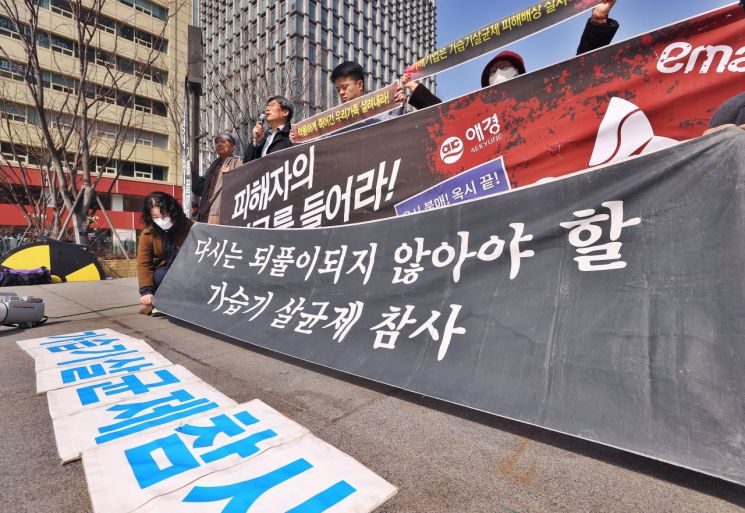 Members of civic groups such as the Citizens' Center for Environmental Health and the Seoul Environmental Federation held a press conference related to the humidifier disinfectant disaster on March 11 in front of the Admiral Yi Sun-sin statue in Gwanghwamun, Jongno-gu, Seoul. Photo by Yonhap News
According to the medical community on August 17, a research team led by Professor Kim Kyungnam from the Department of Preventive Medicine at Yonsei University College of Medicine published these findings in the latest issue of the Korean Journal of Epidemiology. The team analyzed the risk of lung cancer by dividing 3,605 humidifier disinfectant victims, who had applied for government compensation, into groups based on their duration of use.
The researchers classified the victims into four groups: less than 5 months (240 people), 5 to 14 months (909 people), 15 to 29 months (934 people), and 30 months or more (1,522 people). The analysis showed that 121 of all victims were diagnosed with lung cancer within four years of using the disinfectant. Of these, 82 belonged to the group that used the disinfectant for 30 months or more. This accounted for 67.9% of all lung cancer cases, which was significantly higher than the proportion in the same group among those not diagnosed with lung cancer (41.3%).
The results remained clear even after adjusting for external factors such as gender, age, and smoking status. Compared to the group that used the disinfectant for less than 5 months, the risk of lung cancer was 1.81 times higher in the 5 to 14 months group, 2.45 times higher in the 15 to 29 months group, and 4.6 times higher in the 30 months or more group. The research team explained, "This is the first epidemiological evidence proving the association between long-term use of humidifier disinfectants and the development of lung cancer," adding that "the results are consistent with those of animal experiments."
The team further stated, "This is the first case to present epidemiological evidence that long-term use of humidifier disinfectants affects the development of lung cancer." However, they added, "To confirm these results, studies on groups not exposed to humidifier disinfectants are necessary."
The humidifier disinfectant disaster, which first came to light in 2011, remains the worst environmental disaster in Korea, with 5,908 victims officially recognized by the government to date. In June of last year, following a Supreme Court ruling that the state also bears responsibility for the disaster, the government began actively pursuing a 'final resolution through social consensus.' Earlier this month, Minister of Environment Kim Seonghwan met with representatives of victim groups to express his apologies to the bereaved families and stated, "We will actively pursue improvements to victim-centered policies."
© The Asia Business Daily(www.asiae.co.kr). All rights reserved.
![Clutching a Stolen Dior Bag, Saying "I Hate Being Poor but Real"... The Grotesque Con of a "Human Knockoff" [Slate]](https://cwcontent.asiae.co.kr/asiaresize/183/2026021902243444107_1771435474.jpg)
















