Prioritizing Menus Based on Customer Needs
Reducing Consultant Connection Wait Time by 10 Seconds
On August 18, LG Uplus announced that it has introduced a customized ARS (Automated Response System) menu service to enhance customer convenience. As a result of this service, customers who call the customer center and request to speak with a consultant have seen their waiting times reduced by up to 66%.
Previously, when customers called the customer center, all callers were given the same sequence of guidance messages: 1 for billing and payment inquiries, 2 for mobile payment inquiries, 3 for plan and value-added service inquiries, and 4 for subscription information. Because of this, customers had to wait to be guided to the menu they actually needed.
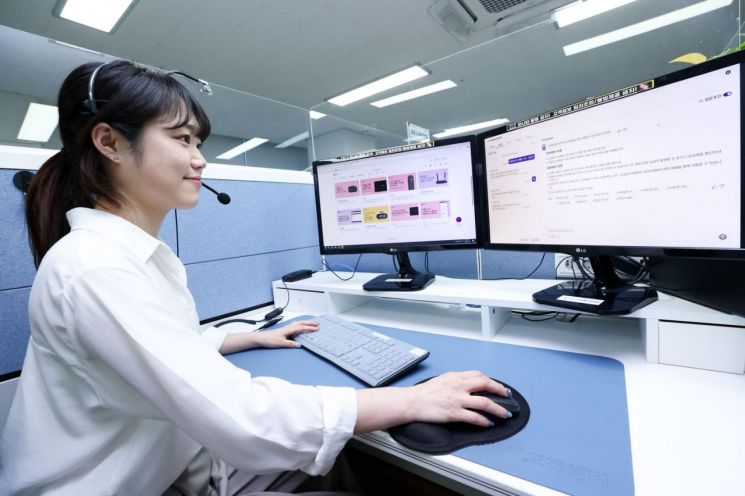 LG Uplus announced on the 18th that it has introduced a customized ARS (Automated Response System) menu service to enhance customer convenience. A LG Uplus consultant responding to a customer inquiry. Photo by LG Uplus
To address this inconvenience, LG Uplus implemented a customized ARS menu service tailored to different customer types. For example, if a customer whose contract is nearing expiration calls the customer center, the system guides them to "contract renewal inquiries" as option 1. New customers who have joined within the past 90 days are first guided to plan, value-added service, and bundled service menus.
The visual ARS has also been revamped, switching from a simple list to a card format that displays a variety of information on a single screen. The menu most relevant to the customer's characteristics is placed at the top, and frequently used or recently accessed menus are also provided to further reduce the time customers spend searching.
This service overhaul has also shortened the time it takes to connect with a consultant after making a request. Last year, the average waiting time to connect with a consultant was 16 seconds for mobile and 14.7 seconds for home services (IPTV and internet). As of July, these times have dropped to 6.7 seconds and 3.7 seconds, respectively, representing a 66% reduction for both mobile and home. The number of self-service cases handled without a consultant increased nearly fourfold, from a daily average of 868 in March to 3,746 in April, allowing consultants to respond more quickly to customers who do require assistance.
For this overhaul, LG Uplus utilized behavioral data according to customer segments. The company applied inference technology to optimize menus, using not only information on ARS menu selections but also data on issues resolved after connecting to a consultant.
By the end of this year, LG Uplus plans to prioritize menus for quality inquiries, customers aged 65 and older, and home product relocation guidance during moving season, according to each customer's situation. In the future, the company will further advance its artificial intelligence (AI) models to develop "hyper-personalized ARS" that can accurately predict customer inquiries. This will include proactively calling customers to provide information they need, rather than waiting for them to call first.
Suh Namhee, head of Customer Value at LG Uplus, said, "We aimed to solve unnecessary waiting times and menu selection complexity by placing the information customers need most at the very front of the ARS menu. Going forward, we will expand to AI-based hyper-personalized services to quickly identify and resolve each customer's difficulties, delivering a differentiated customer experience."
© The Asia Business Daily(www.asiae.co.kr). All rights reserved.

















