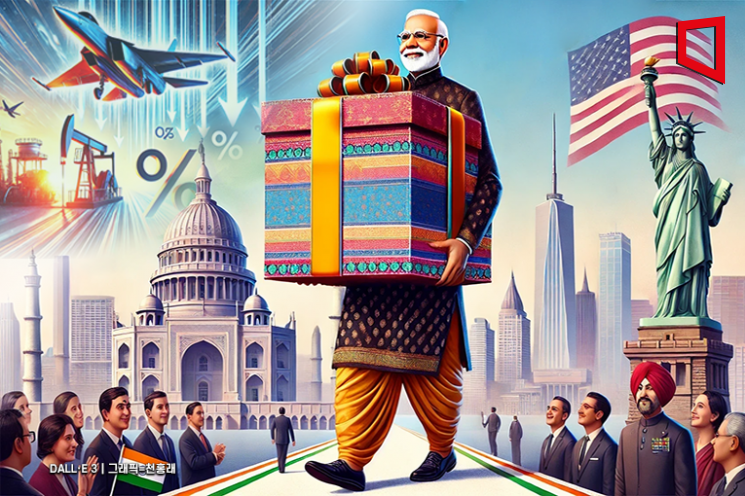
As the Donald Trump administration in the United States has decided to impose an ultra-high tariff rate of 50% on India starting later this month, the likelihood of a near-term agreement has diminished following the postponement of scheduled trade talks between the two countries.
According to Yonhap News Agency and foreign media outlets, the planned visit of the U.S. trade delegation to New Delhi, India, which was set for August 25 to 29, has reportedly been canceled. While it is highly likely that the talks will be postponed, a new date has not yet been set.
Earlier this month, the United States imposed a 25% reciprocal tariff on India, and is set to impose an additional 25% tariff starting on the 27th, citing India's imports of Russian crude oil as an issue. This will bring the total tariff rate to 50%, the highest among the United States' trading partners.
With the postponement of these talks, the possibility that India could reach an agreement before the 27th and avoid the additional tariffs has become even slimmer. Previously, in April, the United States announced plans to impose a 26% reciprocal tariff on India, after which the two countries held five rounds of negotiations. However, they failed to reach an agreement due to differences over India's reluctance to lower tariffs on U.S. agricultural and dairy products, as well as disagreements regarding imports of Russian oil.
President Trump strongly criticized India's transactions involving Russian oil, announcing additional sanctions on top of the existing 25% reciprocal tariff, and ultimately formalized the imposition of extra tariffs. In response, the Indian government protested, arguing that India was being unfairly singled out while the United States and the European Union continue to import Russian goods.
Additionally, the Narendra Modi administration has taken a confrontational stance, postponing the announcement of plans to purchase U.S.-made weapons, including six Boeing P-8 maritime patrol aircraft, Stryker armored vehicles, and Javelin anti-tank missiles, worth approximately $3.6 billion (about 5 trillion won).
In his Independence Day speech on August 15, Prime Minister Modi also emphasized the need for a "strong India," stressing that key technologies and products, such as jet engines and electric vehicle batteries, should be produced domestically.
© The Asia Business Daily(www.asiae.co.kr). All rights reserved.












