Ministry of Health and Welfare Analyzes Data from Pilot Program Medical Institutions, 2020-2025
Remote Consultations Account for 0.2% to 0.3% of All Outpatient Visits
Since the pilot program began in 2020, a total of 4.92 million patients have received remote medical consultations at approximately 23,000 medical institutions nationwide. This accounts for about 0.2% to 0.3% of all outpatient visits. Based on these statistics, the government plans to work with the National Assembly to begin full-scale discussions on institutionalizing remote medical consultations.
According to the Ministry of Health and Welfare on August 14, the 'Remote Medical Consultation Pilot Program Advisory Group' held its 10th meeting at the Seoul International Electronics Center the previous day to discuss key statistics from the pilot program and the direction for future institutionalization.
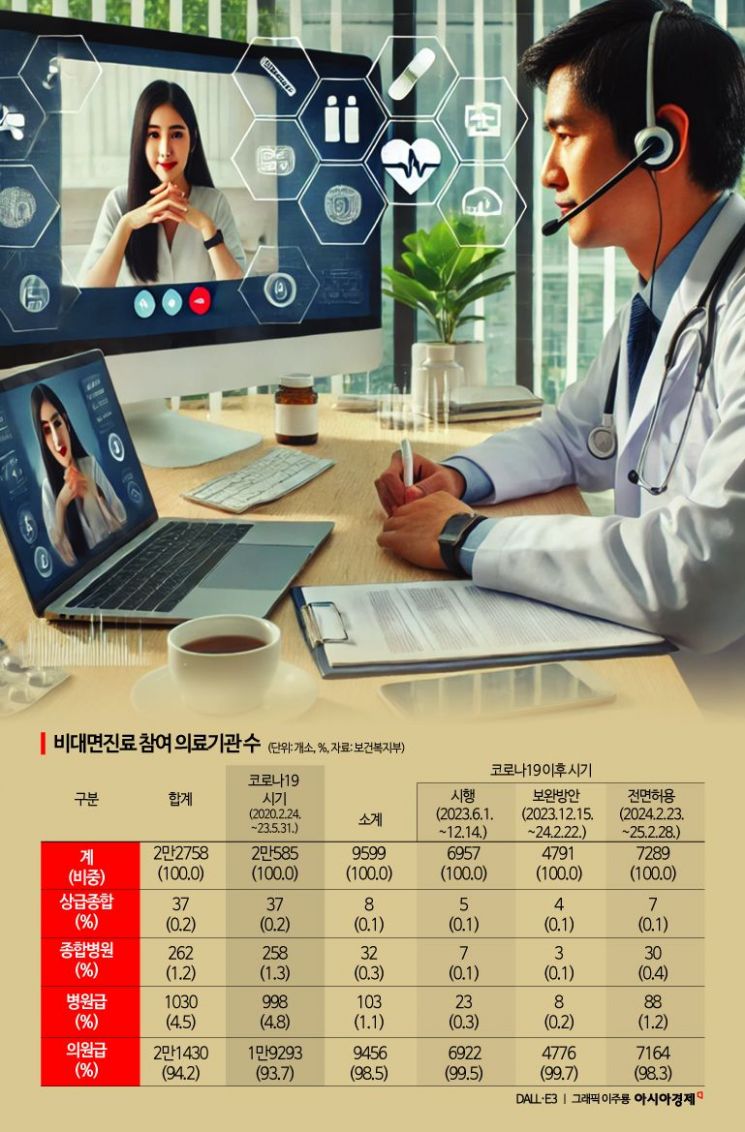
An analysis of medical institution billing data over the five-year pilot period, from February 2020 to February of this year, showed that 22,758 institutions had provided at least one remote medical consultation. Among these, 94.2% (21,430 institutions) were clinics. This was followed by 1,030 hospital-level institutions (4.5%), 262 general hospitals (1.2%), and 37 tertiary hospitals (0.2%). The data indicated that the larger the institution, the less likely it was to provide remote consultations.
During the COVID-19 period (February 2020 to May 2023), 20,585 institutions provided remote consultations. In the post-COVID-19 period (June 2023 to present), 9,599 institutions have participated. The total number of patients who used remote consultations was tallied at 4.92 million.
During the COVID-19 period, the average monthly number of remote consultations was about 220,000, accounting for 0.3% of all outpatient visits (78.02 million). In the post-COVID-19 period, the average monthly number of remote consultations was about 170,000, representing 0.2% of all outpatient visits (78.97 million).
During the COVID-19 period, follow-up consultations accounted for 7,132,588 cases, which was 80.1% of all remote consultations (8,907,320 cases). In the post-COVID-19 period, follow-up consultations totaled 2,905,582 cases, making up 78.7% of all remote consultations (3,690,003 cases). Last year, follow-up consultations in remote care (1,730,895 cases) accounted for 76% of all remote consultations (2,276,237 cases), whereas follow-up consultations in in-person care accounted for about 70% of all in-person visits.
The Ministry of Health and Welfare analyzed that, when including approximately 50,000 non-insured consultations estimated through reports from remote consultation intermediary platforms, about 250,000 remote consultations are conducted each month. Additionally, about 15% of remote consultations occur on holidays or at night, which is higher than the 8% seen in in-person consultations. The main conditions treated were mostly chronic or mild illnesses, such as hypertension, diabetes, colds, and rhinitis.
Medical professionals attending the meeting argued that remote consultations should be implemented in a limited manner. Kwon Yongjin, a professor at Seoul National University Hospital, suggested, "Initial and follow-up consultations are administrative concepts, and instead of legal restrictions, it would be preferable to adopt regulatory measures such as restrictions on medication prescriptions." Jung Jiyeon, Secretary General of the Korea Consumer Federation, recommended, "Non-insured medications should be minimized and only used when absolutely necessary." Kim Chungki, Policy Director of the Korean Medical Association, emphasized, "The role and responsibility of professional organizations in monitoring, evaluating, and self-regulating remote consultations must be a minimum prerequisite."
Currently, three proposed amendments to the Medical Service Act aimed at institutionalizing remote consultations are pending before the National Assembly's Health and Welfare Committee. Kim Kukil, Director of Health and Medical Policy at the Ministry of Health and Welfare, stated, "Over the past five and a half years, many people have experienced remote consultations through the pilot program, and the need for institutionalization has been consistently raised. We will do our best to ensure that remote consultations are institutionalized through discussions in the National Assembly."
© The Asia Business Daily(www.asiae.co.kr). All rights reserved.












