On-site Meeting for Leading Public AX
Calls for Building an Industrial Foundation Model and a Marketplace-Based Ecosystem
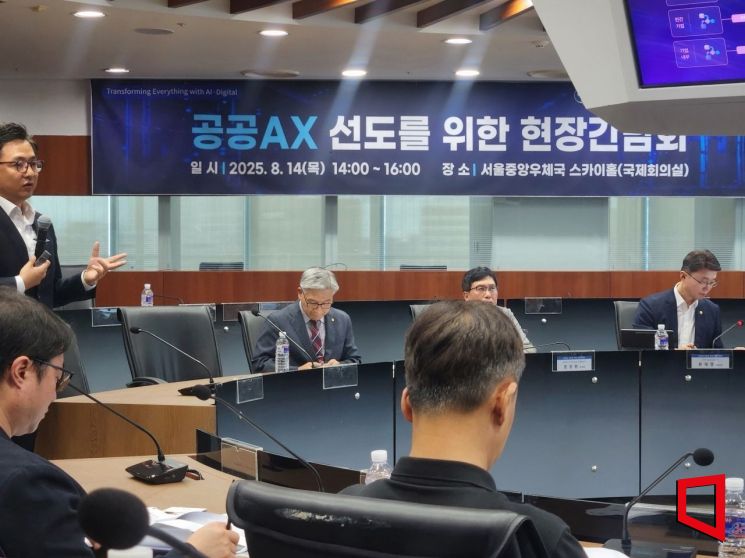 At the "On-site Meeting for Leading Public AX" held on the 14th, Song Hochul, CEO of the Platform Business Division at Douzone Bizon, is giving a presentation. Photo by Park Yujin
The government has joined forces with businesses to accelerate the transition to artificial intelligence (AX) in the public sector. At the event, participants stressed the urgent need for industry-specific AI development, inter-ministerial collaborative governance, regulatory easing, and a shift toward a demonstration-centered procurement structure.
The "On-site Meeting for Leading Public AX," hosted by the Ministry of Science and ICT on August 14 at Seoul Central Post Office, brought together AI companies such as Douzone Bizon, FortyTwoMaru, Deepnoid, HancomInSpace, Splatform, Mediazen, and Infinite Information Technology, as well as professors from KAIST and Baekseok University, and officials from the National IT Industry Promotion Agency. Hocheol Song, CEO of the Platform Business Division at Douzone Bizon, who delivered the keynote presentation, emphasized, "We need to build an integrated AI agent that provides customized services to the public, utilizing public, financial, and healthcare MyData held by the government." He added, "It is essential to establish an agent-to-agent communication system that adopts global standards, along with a 'marketplace'-based ecosystem."
Song further pointed out, "Current Requests for Proposal (RFPs) remain at an abstract level, making it difficult for companies with proven technologies to be selected." He suggested, "We need a structure similar to that of the U.S. Department of Defense (DOD), where prototypes are validated first and, based on their performance, the project is expanded into full-scale implementation."
Daegeun Lim, CEO of Splatform, stated, "Industry-specific AI must be combined with areas where large language models (LLMs) are weak, such as time-series and sensor data." He stressed, "It is imperative to develop foundation models tailored to industrial field data, especially in sectors like manufacturing and infrastructure safety."
Woosik Choi, CEO of Deepnoid, pointed out institutional limitations that prevent public AX projects from moving beyond the development stage and becoming established in the field. He said, "Training for public institution staff must come first, and there must be clear response guidelines for issues such as underperformance during the initial implementation phase. Otherwise, agencies will inevitably be reluctant to adopt these solutions." As an example, Choi cited the demonstration of X-ray reading AI at domestic airport security checkpoints. Under current regulations, only certified monitors can be used, so monitors equipped with AI cannot be installed and are instead used as 'auxiliary screens' placed next to the existing monitors. He added, "It is also legally impossible to reduce the number of monitors from two to one for efficiency. Without regulatory improvements, AI solutions developed with government support will struggle to fulfill their roles in the field."
The issue of project sustainability was also raised. Minkyu Song, CEO of Mediazen, said, "For AI systems, operation and improvement are more important than development. However, after a project ends, ongoing support is left to the individual ministry's budget, making it difficult for the system to take root." He emphasized, "From the project selection stage, we need to consider measures that ensure continued operation and maintenance."
Deputy Minister Jemyoung Ryu stated, "The key to advancing into the future AI G3 lies in how effectively we utilize AI technologies. To realize AX nationwide, the public sector must play a priming role." He added, "We will work closely with the private sector to achieve a rapid AI transition in the public sector going forward."
© The Asia Business Daily(www.asiae.co.kr). All rights reserved.

![Clutching a Stolen Dior Bag, Saying "I Hate Being Poor but Real"... The Grotesque Con of a "Human Knockoff" [Slate]](https://cwcontent.asiae.co.kr/asiaresize/183/2026021902243444107_1771435474.jpg)















