Growth Maintained for Two Consecutive Quarters
Pace of Expansion Moderates
BOE Faces Greater Dilemma Over Rate Cuts
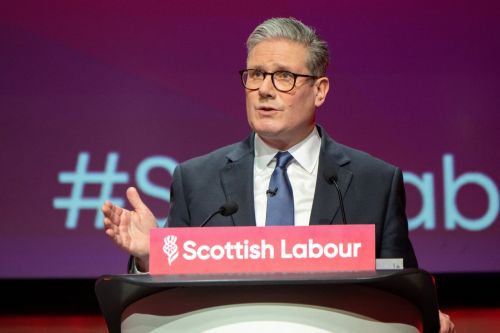 Keir Starmer, the Prime Minister of the United Kingdom, is delivering the keynote speech at the annual event held in Glasgow, Scotland, UK, on February 23 (local time). Photo by Reuters Yonhap News
The United Kingdom's gross domestic product (GDP) grew by 0.3% quarter-on-quarter in the second quarter, surpassing market expectations.
On August 14 (local time), the Office for National Statistics (ONS) announced that the UK's preliminary second-quarter GDP increased by 0.3% compared to the previous quarter. This figure exceeds the 0.1% growth forecasted by both the private sector and the Bank of England (BOE). Although the pace slowed compared to the first quarter's 0.7% growth, the UK economy has now maintained growth for two consecutive quarters.
On an annualized basis, the second-quarter economic growth rate stood at 1.2%, slightly down from 1.3% in the first quarter. Looking at the most recent month, GDP in June rose by 0.4% month-on-month, doubling the market expectation of 0.1%. This is a significant improvement compared to the 0.1% decline recorded in May.
Bloomberg interpreted this as evidence that the UK economy has remained resilient despite turmoil caused by the government's large-scale tax hikes and tariffs imposed by US President Donald Trump. Chancellor of the Exchequer Rachel Reeves implemented a payroll tax increase of 26 billion pounds in April this year, alongside hikes in the minimum wage and stamp duty on property transactions. These measures were expected to place a significant burden on both households and businesses.
The 0.7% growth rate recorded in the first quarter was partly artificially elevated, as manufacturers rushed to ramp up production ahead of US tariff implementation. However, Prime Minister Keir Starmer argued that the fact the UK has outperformed other G7 nations is evidence that the economy is entering a recovery phase.
With the relatively robust economic growth rate, the BOE is expected to face greater challenges. In fact, according to Bloomberg, traders have not fully priced in the possibility of additional interest rate cuts this year. Borrowing costs (interest rates) are expected to stabilize at around 3.5% next year. The current UK base rate stands at 4.00%, after being cut by 25 basis points (1bp = 0.01 percentage points) from 4.25% at the meeting held on August 7. The UK has consistently maintained a policy of 'cautious and gradual' rate reductions.
© The Asia Business Daily(www.asiae.co.kr). All rights reserved.












