Part 1: "Hometown - The Lost Land"
Exploring Perceptions of Our Land During the Imperialist Era
Part 2: "Love for Hometown - The Reclaimed Land"
The Hometown Regained After Liberation
Part 3: "Loss of Hometown - The Devastated Land"
Hometowns in Ruins During the Korean War
Part 4: "Longing for Hometown - The Land of Yearning"
The Pain of Displacement and Separation
The Japanese colonial period and liberation, division and war, industrialization and urbanization... How did artists who lived through each era, enduring adversity and hardship, capture their hometowns on canvas? In commemoration of the 80th anniversary of liberation, the exhibition "Nostalgia: Painting the Hometown," which offers a look at Korea's modern and contemporary history, is being held at the National Museum of Modern and Contemporary Art, Deoksugung. The exhibition features around 210 works by 75 modern and contemporary artists and 50 archival materials.
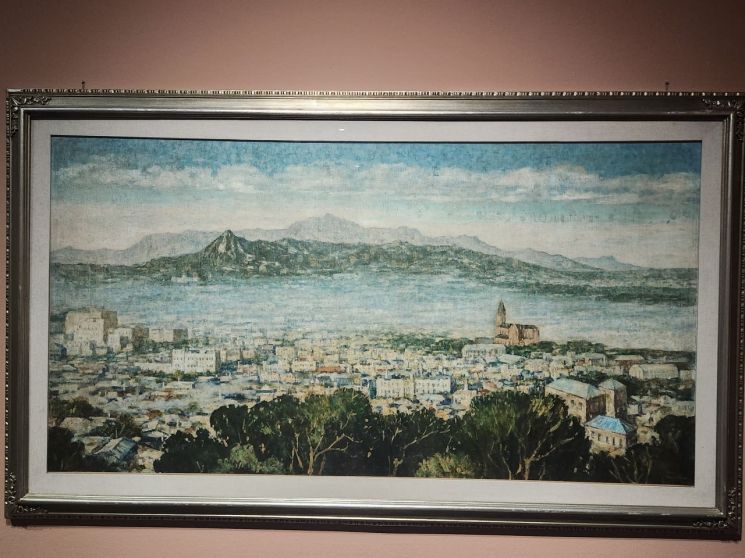 Sangok Park,
 The exhibition explores the concept of "hometown" through the eyes of artists, from the loss of local identity during the Japanese colonial period, to "love for hometown" after liberation, as well as the "loss of hometown" due to war and "longing for hometown" resulting from division. In particular, the exhibition has unearthed and introduced a large number of works by regional artists and landscape paintings depicting various regions. A museum official explained, "The curator in charge traveled across the country, visiting museum storage rooms, private collectors, and artists' families." Over four sections, the exhibition presents works by various artists who depicted their hometowns from all over the country.
Part 1: "Hometown - The Lost Land"...Exploring Perceptions of Our Land During the Imperialist Era
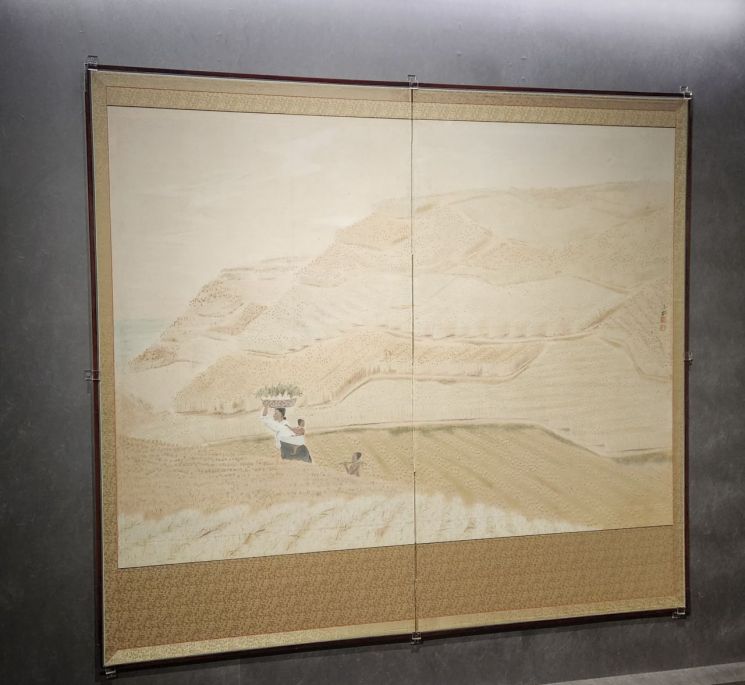 Kim Junghyun 'Landscape' (1940s). A work depicting a woman carrying a child on her back while holding a basket full of radishes between the rice fields of the southern provinces, with a boy following behind. Photo by Seo Mideum
Part 1, "Hometown - The Lost Land," examines perceptions of Korea's land during the Japanese colonial period through regional landscape paintings. At the time, the peaceful and pure rural scenery of Joseon, untouched by modern civilization, was interpreted negatively by the Japanese authorities. These works were classified as so-called "local color" paintings, depicting the colony as lethargic and uncivilized. In response, Korean artists sought to recognize "hometown" as a space that inspires national sentiment and endeavored to discover the unique colors of their homeland. To this end, groups such as Nokhyanghoe in Gyeongseong, Hyangtohoe in Daegu, Chungwanghoe in Busan, and Yeonjinhoe in Gwangju emerged nationwide, leading a paradigm shift in "Joseon painting." Kim Junghyun's "Landscape" (1940s) vividly depicts a woman holding a basket of radishes between rice fields, with a boy following behind, rendered with pronounced textures.
Writings expressing longing for the lost land, which could not be fully conveyed through painting, are also on display. These include verses by the national resistance poet Lee Sanghwa, poems about nostalgia by Jeong Jiyong, Baek Seok, Lee Yongak, and Oh Janghwan, as well as the lyrics of independence activists exiled in Manchuria, many of which are registered with UNESCO. "To the far eastern end of the wide field / An old story babbles along a winding stream / A spotted yellow cow / Languidly cries a golden, lazy bellow / How could I ever forget that place, even in my dreams?" - From "Nostalgia" by Jeong Jiyong
Part 2: "Love for Hometown - The Reclaimed Land"...The Hometown Regained After Liberation
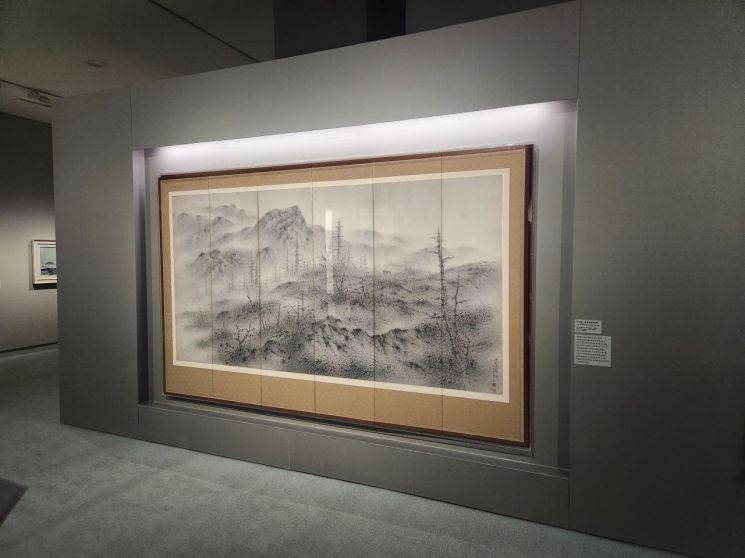 Sangbum Lee 'Return to Hyochon' (1945). This work is known to have been created by Sangbum Lee on August 15, 1945, the day of liberation. It depicts a farmer driving cattle home over a hill in a field shrouded in early morning mist. Photo by Seomdeum Seo
Part 2, "Love for Hometown - The Reclaimed Land," explores the "hometown" regained after liberation. Works by artists such as Son Ilbong, who returned to his hometown Gyeongju after teaching in Japan and painted landscapes, and Moon Shin, who studied in Japan and then depicted the vibrant energy of the sea off Masan, reveal traditional Korean motifs, colors, and aesthetics. Lee Ungno, who captured the scenery of his hometown Hongseong in various forms and revolutionized modern ink painting, and Kim Whanki, who completed a uniquely Korean abstract style using the moon reflected on the sea as a motif, vividly convey the beauty of the reclaimed land.
Part 3: "Loss of Hometown - The Devastated Land"...Hometowns in Ruins During the Korean War
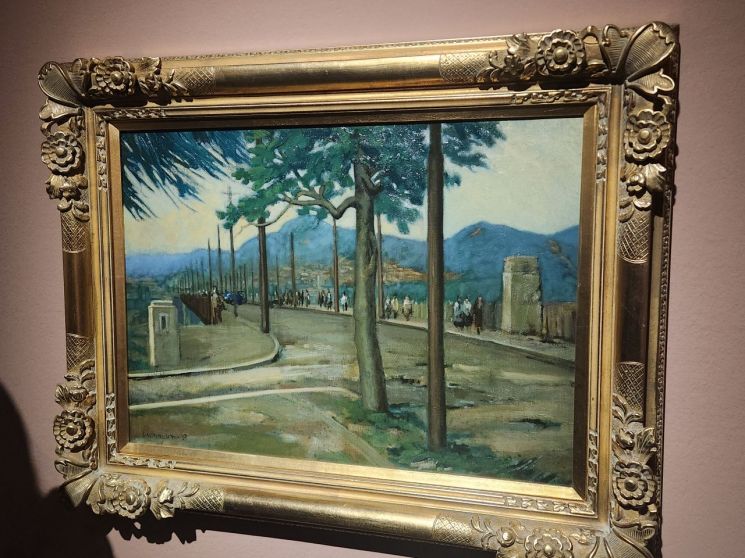 Park Deuksun, "Hangang Pedestrian Bridge" (1956). Painted shortly after the restoration in 1954 of the bridge that was blown up to block the southward advance of North Korean troops at the outbreak of the Korean War in 1950. Photo by Seo Mideum
Part 3, "Loss of Hometown - The Devastated Land," looks at how artists perceived and recorded the Korean landscape amid the tragedy of the Korean War. Works such as Lee Jongmu's "City After the War" (1950) and Do Sangbong's "Ruins" (1953), which depict war-torn cities, portray a bleak reality with a sense of solitude and tranquility. In addition, abstract and semi-abstract landscapes such as Shin Youngheon’s "Tragedy at Daedong Bridge, Pyongyang" (1958), Lee Soo-eok’s "The Korean War" (1954), and Nam Kwan’s "Refugees" (1957) use dark colors, rough brushstrokes, and the fragmentation and disintegration of forms to evoke the horrors of war and memories of suffering.
Part 4: "Longing for Hometown - The Land of Yearning"...The Pain of Displacement and Separation
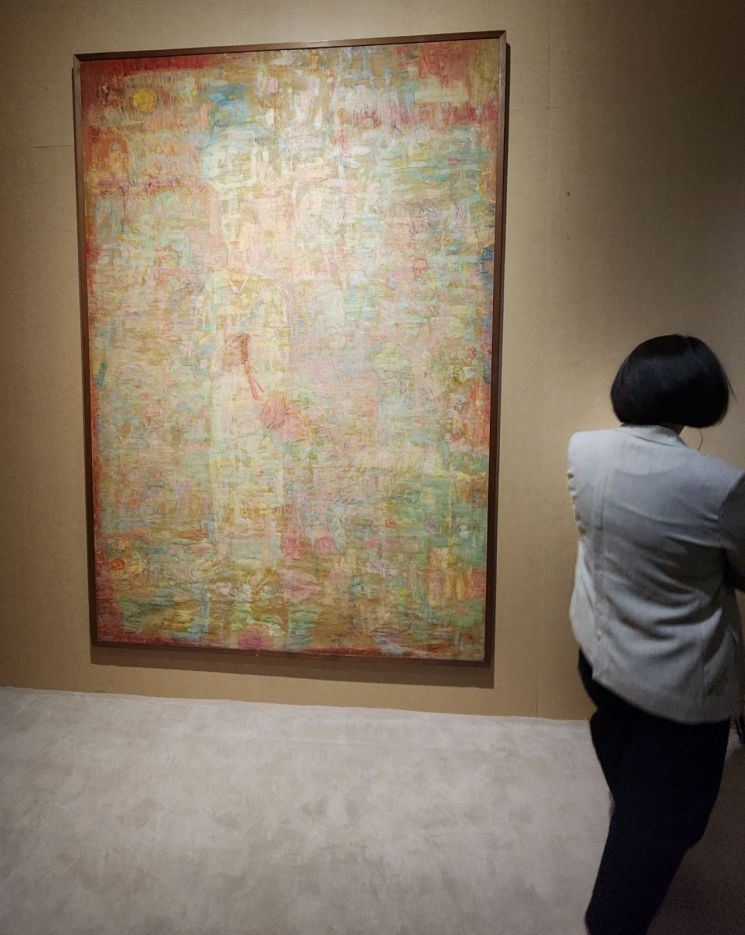 Sung-Hwan Park's "Manghyang" (1971). The artist is a displaced person from Haeju, Hwanghae Province, who moved south after liberation. His work expresses the pain of displacement and longing for his hometown through a dreamy and colorful impressionistic technique. In the painting, around a woman carrying an earthenware jar, he depicted various objects of longing throughout. Photo by Seomideum.
Part 4, "Longing for Hometown - The Land of Yearning," features artists and works that built their own worlds based on "the sentiment of longing," carrying the pain of displacement and separation caused by division after the war. The use of motifs reminiscent of their hometowns, scattered throughout the works and often depicted as paradises or utopias, is particularly notable. Representative works such as Yoon Joongsik’s "Spring" (1975), Park Sunghwan’s "Manghyang" (1971), and Choi Younglim’s "Spring Hill" (1982) pose fundamental questions to viewers about what art leaves behind and what it exists for in times of loss and deprivation.
Kim Migeum, the curator of this exhibition, commented on Park Sunghwan’s "Manghyang," saying, "This is a work that captures the longing for his hometown by an artist who moved south from the North. The image of a woman carrying a water jar is one of the motifs symbolizing Joseon. It is noteworthy how the painting symbolically expresses the fading landscape of his hometown, disappearing into distant memories."
Among the approximately 210 works created by 75 artists, there are no traces of female painters. It is presumed that very few women were able to take up the brush during such turbulent times. The fact that the hometown was depicted only through a male perspective highlights the need for continued research and discovery, as well as regret over this absence.
Kim Sunghee, director of the National Museum of Modern and Contemporary Art, stated, "This exhibition presents artists’ perspectives on their hometowns and our land across four sections, spanning the Japanese colonial period and the era of upheaval. There are many deeply moving works that blossomed amid the turbulence of modern and contemporary history. This exhibition is an opportunity to experience the strength, affection, and sorrow of the Korean people." The exhibition runs through November 9.
© The Asia Business Daily(www.asiae.co.kr). All rights reserved.