A Breakthrough in Light Control Overcomes Obstacles to Metalens Commercialization
Demonstrating the Potential for Even Thinner Metalenses
Samsung Electronics announced on the 13th that a research paper on a "metasurface lens for ultra-small eye cameras," conducted through industry-academic collaboration with Pohang University of Science and Technology (POSTECH), has been published in the world-renowned journal Nature Communications.
Samsung Electronics emphasized the significance of this research, noting that it demonstrates the potential to reduce the height of smartphone cameras and thus address the so-called "camera bump" issue, where only the camera protrudes from the smartphone body.
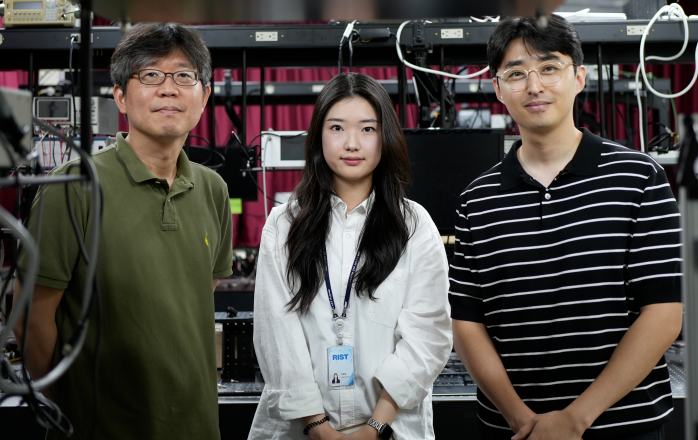 Samsung Electronics announced on the 13th that the research paper on the "metasurface lens for ultra-small eye cameras," conducted through industry-academic cooperation with Pohang University of Science and Technology (POSTECH), was published in the world-renowned journal Nature Communications. From left: Junseok Noh, professor at POSTECH; Hyunjung Kang, researcher; and Junggeun Yoon, researcher at Samsung Research. Photo by Samsung Electronics
The metalens is a next-generation optical technology that manipulates light in a fundamentally different way from conventional refractive lenses. By engraving microscopic structures onto a thin substrate to act as a lens, it enables the production of much thinner and lighter optical devices. For a metalens to produce sharp images, "phase delay"-which controls the speed of light waves-is required. However, the design and fabrication process is challenging, and the lens is prone to breakage, making commercialization difficult.
To address this, the research team attempted a new design rule that precisely controls light using only the minimum amount of velocity control. As a result, they maintained the same optical performance as before, while reducing manufacturing complexity and defect rates, thereby improving stability. This, in turn, enables higher yields and greater price competitiveness.
Samsung Electronics explained that this research presents a new design principle for controlling light diffraction, opening up the possibility of reducing the phase delay required for metalens implementation while achieving optical performance, mechanical stability, and price competitiveness all at once. The company expects that, by extending this technology to the visible light spectrum in the future, it will be possible to reduce the protrusion of smartphone camera modules and make imaging sensors even smaller.
A Samsung Electronics representative stated, "We plan to continue pursuing a variety of research initiatives, including industry-academic cooperation, to secure innovative technologies that will lead the future."

© The Asia Business Daily(www.asiae.co.kr). All rights reserved.
![Clutching a Stolen Dior Bag, Saying "I Hate Being Poor but Real"... The Grotesque Con of a "Human Knockoff" [Slate]](https://cwcontent.asiae.co.kr/asiaresize/183/2026021902243444107_1771435474.jpg)

















