Presiding Over the National Budget Conservation Meeting:
"We Lack Even the Seeds to Sow"
Stressing the Need for Growth Through Borrowing if Necessary
and Securing Available Resources via Expenditure Adjustments
On August 13, President Lee Jaemyung stated, "The national finances have become too fragile," and, using a farming analogy, pointed out, "We are now in a situation where we lack even the seeds to sow." President Lee has consistently emphasized the need for each ministry to boldly adjust wasteful budgets and to focus on drafting an efficient budget centered on the people's livelihood and the economy.
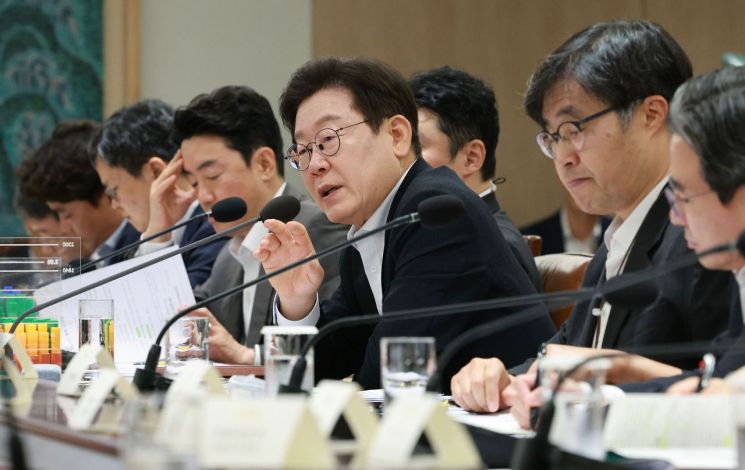
President Lee made these remarks during a 'National Fiscal Savings Meeting' held at the presidential office in Yongsan on this day. Regarding the current fiscal situation, President Lee said, "If we compare it to farming, we need seeds to sow in the spring," and added, "Although the national finances should play that role, recently, they have become so fragile that we are now lacking even the seeds to sow." He further commented, "Fiscal policy should serve as the priming water for growth, but tax revenues have declined, and economic growth has also deteriorated."
He described the current fiscal situation as "frustrating." President Lee said, "Managing the nation's finances, there are so many things that need to be done, but there is no money to spend, so I have a lot of concerns," and reiterated, "We have prepared many fields, but since we have no seeds to sow, the thought of leaving the fields fallow is truly frustrating."
President Lee also expressed the view that national debt should be allowed to increase if necessary to pursue expansionary fiscal policy. He said, "When I try to borrow seeds from the neighbor, there are people who ask why I am borrowing, insisting that we should live within our means," and questioned, "If borrowing seeds allows us to harvest a full sack in the fall, isn't it only natural to borrow and sow them?" In this way, he explained, using the farming analogy, that if necessary, the government should take on debt to promote economic growth and restore people's livelihoods.
He went on to say, "If we are told never to borrow and to live only with what we have, we will not be able to farm. I hope we can consider this issue together." President Lee also emphasized, "How to increase national revenue and how to address tax evasion have not become major agenda items," and added, "I believe we need to secure available resources by adjusting expenditures and to shift inefficient budget spending to more efficient areas."
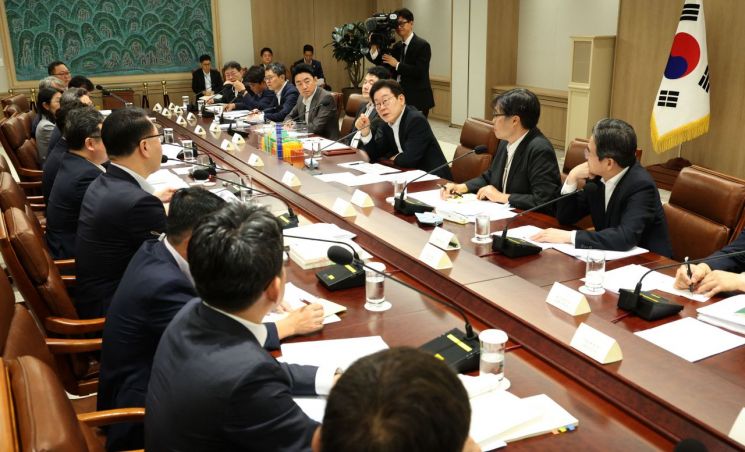
To the attendees, President Lee said, "I hope you will closely examine the current budget issues and discuss what can be saved, what can be reallocated, how we can achieve real growth, and how we can restore the people's livelihoods."
The meeting continued with the Ministry of Economy and Finance presenting measures for budget savings after the president's opening remarks. This was followed by a free discussion attended by President Lee, during which private sector experts made proposals and engaged in additional discussions. From the private sector, proposals were presented on improving financial support systems for small and medium-sized enterprises, rationalizing and improving similar or overlapping welfare programs, and introducing private sector suggestions for budget-saving projects.
The challenging budget situation is the reason why President Lee, who has typically advocated for expansionary fiscal policy, convened this meeting focused on 'budget savings.' Due to two supplementary budget bills this year, deficit-related debt has surpassed 900 trillion won, already exceeding last year's government estimate of 883.4 trillion won. As of May, the managed fiscal balance showed a deficit of 54.2 trillion won, the fourth largest deficit on record. The tax revenue shortfall crisis, amounting to 87 trillion won in 2023-2024, has further weakened fiscal capacity.
In response, President Lee has previously announced plans to identify and utilize wasteful budgets as resources. In his opening remarks at the Cabinet meeting on July 15, he pointed out, "There is also the issue that the country's fiscal capacity is not that great right now," and instructed, "Each ministry should boldly adjust budgets that are allocated out of habit, budgets with low efficiency, and wasteful budgets." The Ministry of Economy and Finance also began working to secure additional fiscal capacity by reducing unnecessary and non-urgent spending in line with the president's directive.
Meanwhile, the meeting was attended by both government and private sector budget officials. From the government, officials from the Ministry of Economy and Finance, including Budget Office Director Yoo Byungseo, and policy planning directors from various ministries participated. From the private sector, representatives from the Korea Institute of Public Finance, the Center for Fiscal Reform, and the People's Solidarity for Participatory Democracy attended. From the presidential office, Chief of Staff Kang Hoonshik, Policy Chief Kim Yongbeom, Fiscal Policy Advisor Ryu Deokhyun, and Senior Secretary for Economic Growth Ha Junkyung were present.
© The Asia Business Daily(www.asiae.co.kr). All rights reserved.













