Pressure on CEOs, Golden Shares, and Media Control
Is Trump Adopting Xi Jinping's Ruling Methods?
Analysts have pointed out that President Donald Trump is shifting the United States from a traditional free-market system toward "state capitalism," with an approach that resembles China's model of control.
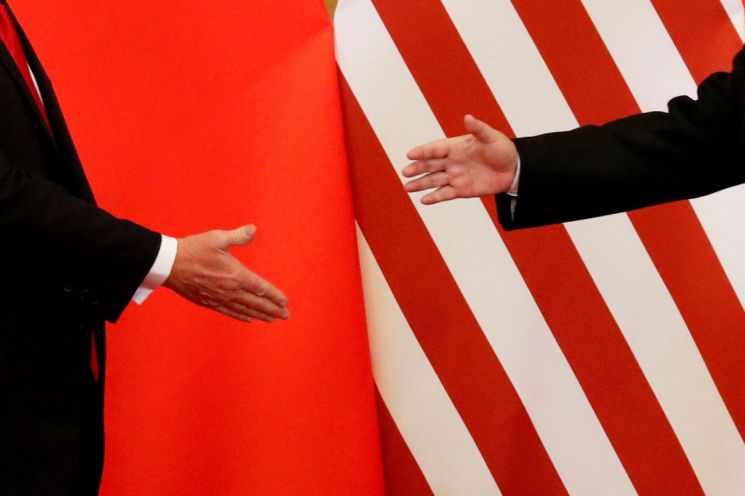
On August 11 (local time), The Wall Street Journal (WSJ) published an article titled "America Moves Toward American-Style State Capitalism," analyzing a series of measures and policies taken by President Trump during his second term and reporting these findings.
WSJ cited several examples of "American-style state capitalism," including the $1.5 trillion (approximately 2,090 trillion won) in investment pledges secured through the imposition of reciprocal tariffs on other countries; demands for the resignation of Intel CEO Pat Gelsinger; the acquisition of a "golden share" (a share that grants veto power over key management decisions even if only one is held) from Nippon Steel as a condition for allowing the US Steel acquisition; and the agreement by Nvidia and AMD to pay 15% of profits earned from selling certain semiconductors to China to the US government.
Additionally, President Trump has taken a harsh stance against institutions that oppose him or that he finds unfavorable, with WSJ itself serving as a prime example in this report. Previously, President Trump filed a $10 billion defamation lawsuit against WSJ and its owner, media mogul Rupert Murdoch, after WSJ attacked him over the so-called "Epstein allegations."
Furthermore, the Federal Reserve, which refused to lower interest rates despite repeated demands from Trump, and the US Bureau of Labor Statistics (BLS), which released politically disadvantageous statistics, both saw their leaders pressured to step down or actually replaced. Banks and law firms also faced disadvantages if they fell out of favor with President Trump.
WSJ pointed out that these actions are similar to those taken by Chinese President Xi Jinping against Jack Ma, the founder of Alibaba, China's largest e-commerce company. After Ma criticized Chinese regulators for stifling financial innovation, he faced severe retaliation, including the cancellation of Ant Group's IPO and a $2.8 billion (approximately 3.9 trillion won) antitrust fine.
WSJ also noted that Chinese private companies issue golden shares to the Communist Party, and that the golden share acquired by President Trump through the US Steel sale was modeled after this practice.
Regarding these developments in the US, WSJ described it as "a hybrid of socialism and capitalism in which the state leads private sector decisions," naming it "state capitalism with American characteristics." The article emphasized that "this represents a dramatic shift compared to the free-market spirit that the US has embodied in the past." While measures such as the Defense Production Act during World War II, bailouts during the global financial crisis, and policies during the COVID-19 pandemic were temporary, the current Trump administration is seeking to make state intervention permanent.
WSJ analyzed that President Trump's approach, reminiscent of China's "Xi Jinping system," is increasingly resembling Chinese-style socialism. However, unlike China, which is built on planned construction under party leadership, the US is, according to President Trump, hampered by the "inefficiencies of democracy," rooted in the separation of powers, the rule of law, and due process.
Nevertheless, WSJ pointed out that although China's success may appear to stem from state-led growth, it was actually driven by market principles. For example, the article noted that as President Xi strengthened state control over the economy, China's growth slowed, and overproduction in industries such as steel and automobiles led to plummeting prices and corporate profits.
WSJ concluded, "Although President Trump has long praised President Xi, there are limits to how much he can emulate him," adding, "Ultimately, whether state capitalism can replace the existing American model of capitalism depends on how well the system of checks and balances in democracy is maintained."
© The Asia Business Daily(www.asiae.co.kr). All rights reserved.
![User Who Sold Erroneously Deposited Bitcoins to Repay Debt and Fund Entertainment... What Did the Supreme Court Decide in 2021? [Legal Issue Check]](https://cwcontent.asiae.co.kr/asiaresize/183/2026020910431234020_1770601391.png)
















