July CPI to Be Released on the 12th... Increase Expected
PPI and Retail Sales Data Coming on the 14th and 15th
Trump Extends US-China Tariff Truce
"No Tariffs Will Be Imposed on Gold"
All three major indexes on the New York Stock Exchange closed lower on August 11 (local time). Despite positive news such as a 90-day extension of the US-China tariff truce, investors remained cautious ahead of the July Consumer Price Index (CPI) release scheduled for this week.
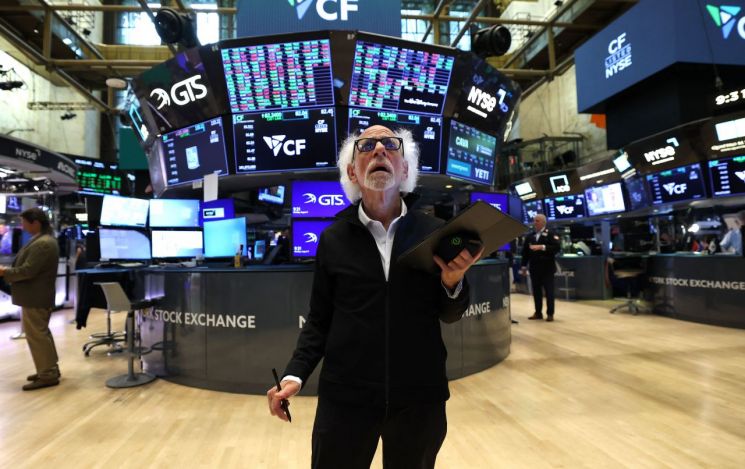
On this day, the blue-chip Dow Jones Industrial Average closed at 43,975.09, down 200.52 points (0.45%) from the previous session. The large-cap S&P 500 Index fell by 16 points (0.25%) to 6,373.45, while the tech-heavy Nasdaq Index slipped 64.62 points (0.3%) to finish at 21,385.4.
Market attention is focused on the July CPI, which is set to be released on August 12. Market expectations are for a 2.8% year-on-year increase, marking a larger gain than June's 2.7%. The core CPI, which excludes the volatile food and energy sectors, is expected to rise 3.0% year-on-year, slightly above June’s 2.9%. As the stock market has rallied since the April low, some analysts warn that increased inflationary pressure could limit further gains.
With signs of a slowdown in employment becoming more apparent, the market is likely to use the July CPI to gauge the extent of possible interest rate cuts by the end of the year. In the interest rate futures market, the probability of the US Federal Reserve lowering rates by 0.25 percentage points at the September Federal Open Market Committee (FOMC) meeting currently stands at 86.5%. The probability of a total 0.5 percentage point cut by year-end is 43.8%, while the probability of a 0.75 percentage point cut is 42.8%.
Some analysts argue that market expectations for rate cuts are excessive.
Sam Stovall, Chief Investment Strategist at CFRA Research, said, "I am concerned that the market may ultimately end up disappointed," and questioned, "If inflation becomes entrenched and consumers remain willing to spend, would the Fed really need to cut rates?"
Other key indicators will also be released this week. The July Producer Price Index (PPI), to be announced on August 14, is expected to rise 0.2% from the previous month, a larger increase than June’s 0%. July retail sales, due on August 15, are expected to grow by 0.5%, a slightly slower pace than June’s 0.6% increase.
Jay Woods, Chief Global Strategist at Freedom Capital Markets, stated, "The most important indicator is the CPI," adding, "This figure will definitely have a significant impact on monetary policy."
The US-China tariff truce, which was set to expire on this day, has been extended for an additional 90 days. US President Donald Trump signed an executive order extending the 115 percentage point tariff reduction on China for another 90 days. In April, both countries imposed ultra-high tariffs exceeding 100% on each other, but at the first high-level trade talks held in Geneva, Switzerland in May, they agreed to reduce tariffs by 115 percentage points each. As a result, the US has been applying a 30% tariff and China a 10% tariff on each other for 90 days, and this extension will keep the tariff reductions in place.
President Trump also announced that gold would not be subject to tariffs. Previously, on August 8, reports emerged that US customs authorities had classified 1 kg and 100-ounce gold bars as items subject to tariffs, which drove gold prices to record highs and heightened market uncertainty.
Recently, the stock market has been testing its potential for further gains amid concerns about overvaluation from the rally and stagflation triggered by tariffs (rising prices alongside economic stagnation). According to a Bank of America (BoA) survey, the proportion of fund managers who view US stocks as overvalued since the April low has reached 91%, the highest level since 2001.
Woods, the Chief Global Strategist, noted, "The market is likely to enter a digestion phase more than at any other time," and added, "Even if the market moves sideways going forward, it is not necessarily a bad sign."
US Treasury yields are moving in a narrow range. The 10-year US Treasury yield, a global benchmark, stands at 4.28%, while the 2-year yield, which is sensitive to monetary policy, is at 3.76%, both unchanged from the previous session.
By stock, Nvidia fell 0.32%, and AMD dropped 0.28%. The Financial Times (FT) reported the previous day that both companies had agreed to pay 15% of their local sales to the US government as a condition for receiving semiconductor export licenses to China. Intel jumped 3.66% after news that CEO Lip-Bu Tan, whom President Trump had publicly pressured to resign, would visit the White House. Tan is expected to clarify allegations of ties to China and emphasize Intel’s contributions to the US. Tesla rose 2.84%, while Apple declined 0.83%.
© The Asia Business Daily(www.asiae.co.kr). All rights reserved.












