Korea and Vietnam Discuss Sustainable Growth and Creative Cooperation in the Cultural Industry
Ministers Highlight Expanding Trade, Tourism, and Policy Support for Content Industry
"Vietnam is Korea's third-largest trading partner after the United States and China. I hope that Korea and Vietnam will continue to grow together and achieve mutual prosperity through culture, and that our creative cooperation will continue in the future."
Choi Hwiyoung, Minister of Culture, Sports and Tourism, made these remarks at the "Korea-Vietnam Cultural Industry Development Cooperation Meeting" held on August 11 at Lotte Hotel Seoul in Jung-gu, Seoul. The meeting was organized to explore ways to promote sustainable growth in the cultural industries of both countries through cooperation.
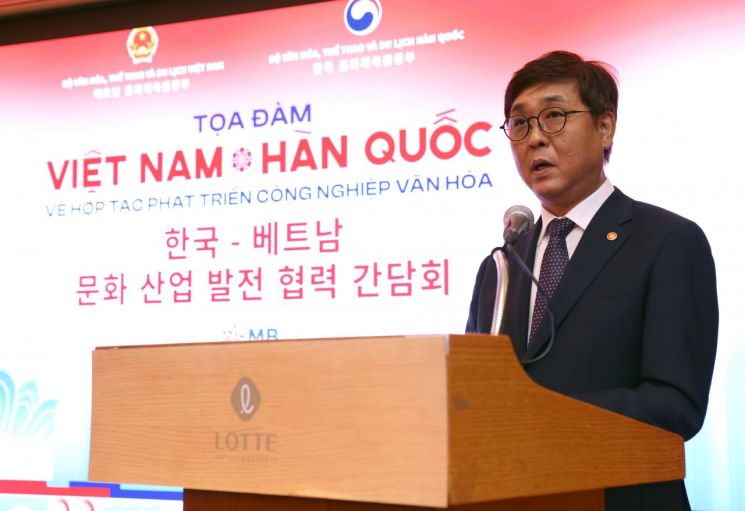 Choi Hwiyoung, Minister of Culture, Sports and Tourism, delivers a congratulatory speech at the "Korea-Vietnam Cultural Industry Development Cooperation Meeting" held on the 11th at Lotte Hotel Seoul in Jung-gu, Seoul.
 Photo by Ministry of Culture, Sports and Tourism
Since 2022, the 30th anniversary of diplomatic relations, Vietnam has overtaken Japan to become Korea's third-largest trading partner after the United States and China. In 2023, Korea and Vietnam established a comprehensive strategic partnership to further strengthen their cooperation.
Minister Choi emphasized, "Last year, the number of Korean companies operating in Vietnam surpassed 10,000, solidifying Korea's position as the largest foreign investor in Vietnam." He added, "Tourism exchanges between the two countries are also very active. Of the 17.6 million foreign tourists who visited Vietnam last year, 4.5 million were Korean, making Korea the top source of foreign visitors. Meanwhile, the number of Vietnamese tourists visiting Korea last year recovered to over 90% of pre-COVID-19 levels."
The number of Vietnamese tourists visiting Korea reached 550,000 in 2019, decreased after the outbreak of COVID-19, but rebounded to 510,000 last year, nearly returning to pre-pandemic levels.
Nguyen Van Hung, Vietnam's Minister of Culture, Sports and Tourism, stated that Korea is a powerhouse in the cultural industry and expressed a desire to learn from Korea's extensive experience. Minister Hung said, "Korea has created a cultural industry by leveraging cultural values and adopting new technologies. Korea is far ahead of Vietnam in the cultural industry, and we hope to learn not only from Korea's specific experiences but also from its policy-making processes."
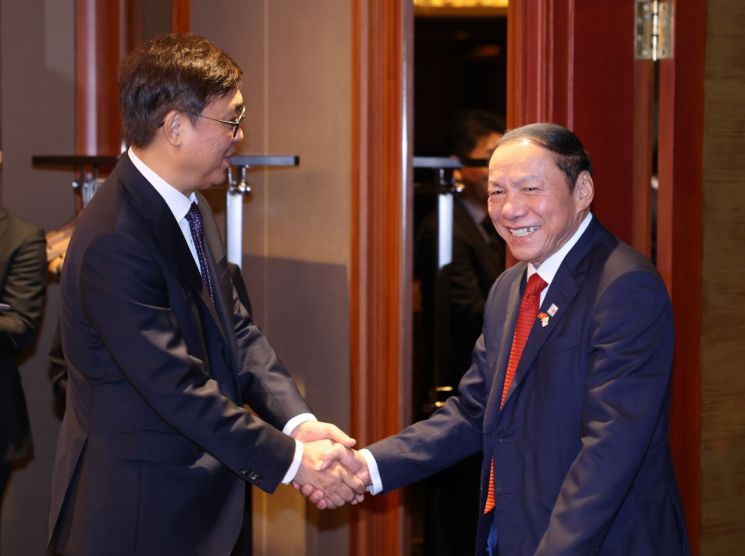 Choi Hwiyoung, Minister of Culture, Sports and Tourism (left), and Nguyen Van Hung, Minister of Culture, Sports and Tourism of Vietnam, are greeting each other at the Korea-Vietnam Cultural Industry Development Cooperation Meeting held on the 11th at Lotte Hotel in Jung-gu, Seoul.
 Photo by Ministry of Culture, Sports and Tourism
Both the Korean and Vietnamese governments view the cultural industry as an important driver of economic growth. Accordingly, they have set clear policy goals for fostering the cultural industry and are seeking to strengthen mutual cooperation and pursue sustainable growth to achieve these objectives.
As of 2023, Korea's content industry recorded sales of 154 trillion won and exports of 13.3 billion dollars (approximately 18.463 trillion won). The government aims to increase these figures to 300 trillion won in sales and 50 trillion won in exports by 2030. The Vietnamese government also aims to raise the cultural industry's contribution to GDP to 7% by 2030.
Kim Hyunjun, Director-General for International Cultural Policy at the Ministry of Culture, Sports and Tourism, emphasized, "The content industry is no longer just an ancillary industry." He continued, "If semiconductors are the leading export item in manufacturing, content is emerging as the leading export industry in the service sector. The popularity of K-content, represented by the Korean Wave, is spreading to related industries such as tourism, food, cosmetics, and apparel." He added, "Behind the success of Korean K-content lies the strong support policies of our government since 2000. Going forward, the Korean government plans to supply 10 trillion won in policy financing to foster the cultural industry, strengthen research and development in cultural technology including artificial intelligence (AI), promote the joint overseas expansion and sharing of achievements in content and related industries, and enhance customized support for the five core content genres?games, film, webtoons, music, and broadcasting."
© The Asia Business Daily(www.asiae.co.kr). All rights reserved.













