Reduced Hallucinations and Enhanced Answer Diversity
Record-High Scores in Math, Science, and Coding Benchmarks
Surpassing Expert-Level Performance in Korean Language Benchmarks
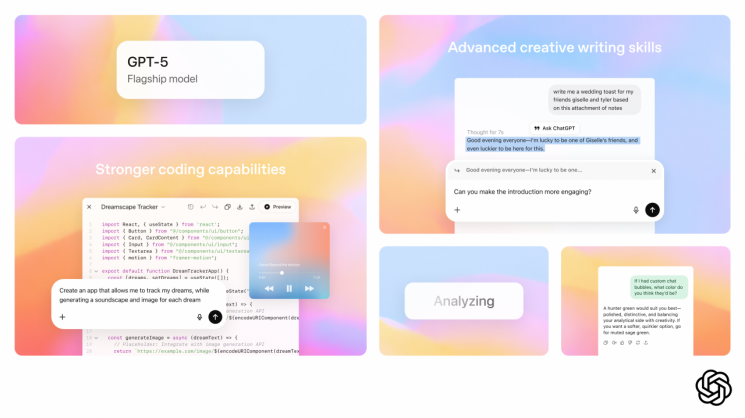 OpenAI's next-generation flagship model GPT-5 has been released. GPT-5 is the smartest, fastest, and most useful frontier model, advancing one step beyond its predecessor. Photo by OpenAI
"When asked how many rings Saturn has, GPT-4o took 6.5 seconds, while GPT-5 took 3.1 seconds."
This is the result of a direct comparison between GPT-4o and GPT-5 by Mrwhosetheboss, a British tech YouTuber with 21.3 million subscribers. For short and simple questions, such as the number of iPhone models released (11.2 seconds vs 8.3 seconds) and the number of possible Pok?mon type combinations (11 seconds vs 5 seconds), GPT-5 demonstrated speeds 30% to 55% faster than the previous generation. He commented, "Tasks that require deeper reasoning, such as complex coding or game generation, may take a bit longer, but the quality of the output has improved," adding, "For everyday information queries, it is definitely faster."
According to the IT industry on August 11, OpenAI unveiled its latest ChatGPT base model, "GPT-5," on August 7 (local time). This new model upgrades and integrates the previous conversational "GPT-4o" and the inference-specialized "o3" into a single model. Now, users no longer need to select a specific model when using ChatGPT.
Sam Altman, CEO of OpenAI, said the day before the release, "GPT-5 is a major leap forward and a significant step toward artificial general intelligence (AGI). If GPT-3 felt like talking to a high school student and GPT-4 felt like talking to a college student, GPT-5 feels like conversing with a PhD-level expert." He added, "After using GPT-5, it was really hard to go back to GPT-4. It's like when the iPhone switched from a low-resolution screen to a Retina display?you just don't want to go back."
OpenAI stated that GPT-5 has achieved state-of-the-art (SOTA) performance on major benchmarks in mathematics, science, and coding, and has reduced the incidence of "hallucinations." Response speeds have improved, and the model now provides a wider variety of answers to the same question, giving users more options.
OpenAI has made GPT-5 available to all ChatGPT users. Free users can access both GPT-5 and the lightweight "GPT-5 mini," with a limit of 10 messages every 5 hours. Plus plan subscribers can use GPT-5 up to 80 times every 3 hours, and will be switched to the lightweight version if they exceed the limit. The Pro plan offers unlimited access to GPT-5 and the advanced inference mode "Thinking," with no message restrictions. The Team plan also provides unlimited benefits, and starting next week, GPT-5 will become the default model.
Notably, GPT-5 achieved the highest score (SOT) on the Korean language evaluation benchmark (KMMLU). OpenAI explained, "This is the result of improving Korean language processing technology that began with GPT-4o, and the achievement comes from tests that evaluate not only modern Korean but also cultural and historical knowledge."
While the improvements in speed and performance are clear from the numbers, experts believe the core of this update lies elsewhere. Choi Byungho, a professor at Korea University's Artificial Intelligence Research Institute, said, "GPT-5 has strengthened its 'routing' structure, which allows the AI to automatically select and combine various versions and inference/non-inference models, rather than simply raising performance metrics." However, he analyzed, "Since this routing is not yet fully perfected, the perceived performance may still be somewhat limited."
Professor Choi also noted, "There is a clear shift in direction from B2C (business-to-consumer) to B2B (business-to-business). While optimizing for coding, medical and health, and enterprise fields, OpenAI has introduced quality enhancement technologies such as a 'universal verifier.' As a result, accuracy in complex tasks has improved, but conversations have become somewhat more dry, and the friendly style that existing users felt has diminished." He added, "These changes may not be noticeable in everyday Q&A, but the differences will become clear in tasks that require expertise, such as complex coding requests, in-depth health consultations, and multi-agent-based services."
Meanwhile, on August 8, AI platform company Ruitten began offering the paid version of GPT-5 for free and without limits. The company created a dedicated GPT-5 menu in its application and on the web, allowing anyone to use it without restrictions. Ruitten also became the first in Korea to provide GPT-4 for free last year.
© The Asia Business Daily(www.asiae.co.kr). All rights reserved.
![Clutching a Stolen Dior Bag, Saying "I Hate Being Poor but Real"... The Grotesque Con of a "Human Knockoff" [Slate]](https://cwcontent.asiae.co.kr/asiaresize/183/2026021902243444107_1771435474.jpg)
















