Differences Emerge Over Japan's Reciprocal Tariff
Final Tariff Rates Vary Depending on Inclusion of Existing Tariffs
Korea, Previously Tariff-Free Under FTA, Remains Unaffected
Auto Industry "Relieved by Resolution of Tariff Uncertainty"
Divergent interpretations regarding the calculation method of the 15% reciprocal tariff imposed by the United States on Japan have led to contrasting fortunes for the Korean and Japanese automotive industries. While Japan faces increased uncertainty over auto tariffs after being excluded from the list of tariff exemptions, Korea, as a country benefiting from a Free Trade Agreement (FTA), has seen its final tariff rate set at 15%, allowing for a relatively more relaxed response.
The reciprocal tariffs imposed by U.S. President Donald Trump on major trading partners took effect at 1:01 p.m. on August 7 (Korean time). Although the European Union (EU), Japan, and Korea all concluded negotiations with the U.S. at a 15% rate, controversy has arisen over the calculation method. As a result, there is speculation that Japan's final tariff rate could end up being higher than Korea's.
Japan explained that, during last month's tariff negotiations with the U.S., it was agreed that items with a pre-existing tariff rate below 15% would be subject to a final 15% tariff, while items with a pre-existing tariff rate above 15% would continue to be subject only to the existing rate, without an additional reciprocal tariff.
However, the U.S. specified that this calculation method would apply only to the European Union (EU) as a special exemption. In the presidential executive order published in the U.S. Federal Register on August 5, Japan was omitted and remains unlisted. Korea was also excluded from the list of special exemptions. Nevertheless, because Korea already enjoys tariff-free benefits under an FTA, the final tariff rate is fixed at 15% even without the special exemption. The Japanese government has requested that the U.S. revise the policy to include Japan among the special exemptions.
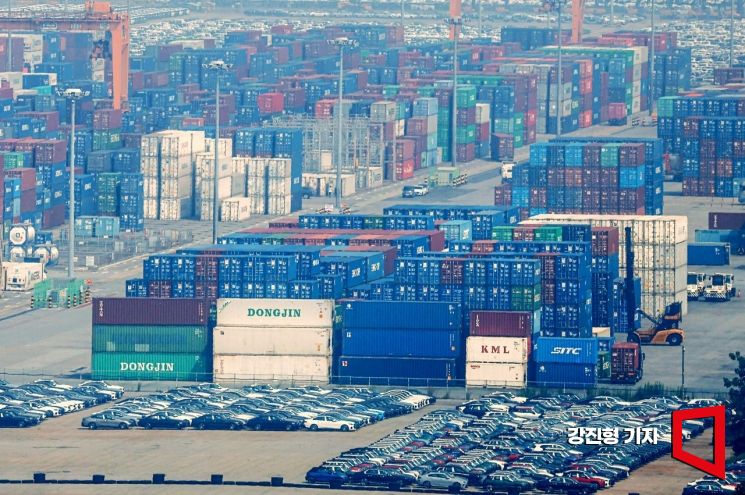 As U.S. President Donald Trump announced on August 1 that a 25% reciprocal tariff would be imposed on all imports from Korea, cars awaiting shipment are lined up at the export yard of Pyeongtaek Port in Gyeonggi Province on August 8, 2025. Photo by Kang Jinhyung
The reciprocal tariff applies to most products except for certain items such as automobiles and steel, which are subject to separate item-specific tariffs. Although an executive order regarding item-specific tariffs on automobiles has not yet been published in the U.S. Federal Register, Korea is expected to be largely unaffected thanks to its existing FTA, regardless of how the interpretation unfolds.
An official from the Ministry of Foreign Affairs explained, "Although the application of the U.S. reciprocal tariff appears to be the same, the actual calculation method differs by country, resulting in differences in the final rates," adding, "For some items such as automobiles and steel, executive orders have not yet been issued, so the rates have not been finalized."
However, if the same logic as the reciprocal tariff is applied, Japanese automobiles would be subject to a total tariff of 17.5%, which is the sum of the existing 2.5% tariff and the new 15% tariff. In contrast, Korean automobiles, which previously enjoyed a zero tariff (0%), would be subject to a total tariff of 15%. As a result, the 2.5 percentage point tariff gap between Korean and Japanese vehicles in the U.S. market prior to the Trump administration's tariff imposition remains unchanged.
The Japanese automotive industry is facing increased uncertainty due to confusion over the interpretation of the tariffs. In contrast, the Korean industry is expressing relief as the 15% tariff has been effectively finalized. Some observers believe that this tariff measure could create a favorable environment for domestic automakers. An official from the Korean automotive industry stated, "Since Korea was already a tariff-free country, the 15% tariff is essentially fixed for us. The biggest obstacle to doing business?uncertainty?has been resolved, placing us in a much more advantageous position compared to our competitors."
© The Asia Business Daily(www.asiae.co.kr). All rights reserved.

















