Introduction of the Korean Version of the IRA
"Under Review with Experts"...
"US Negotiations, Weathered the Storm"
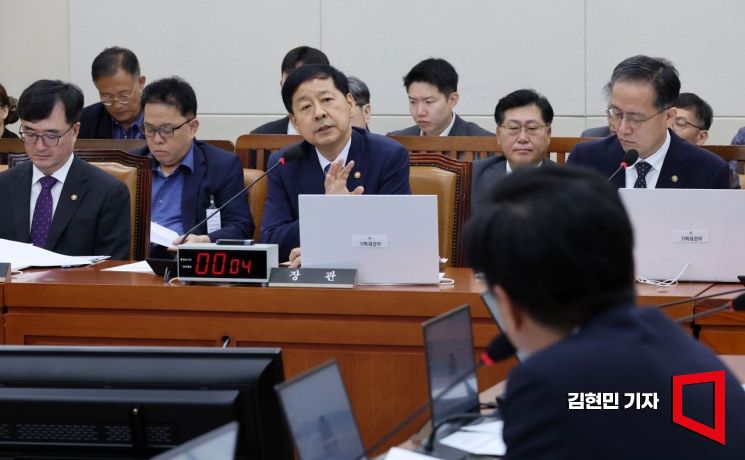 Deputy Prime Minister and Minister of Economy and Finance Koo Yoonchul is responding to questions regarding current issues in tariff negotiations with the United States at the Planning and Amendment Committee plenary meeting held at the National Assembly on August 6, 2025. Photo by Kim Hyunmin
Deputy Prime Minister and Minister of Economy and Finance Koo Yoonchul stated on August 6 that he would "review the matter in practice" in response to suggestions that the criteria for major shareholders subject to stock transfer income tax should be improved to be based on total holdings rather than by individual stock.
Deputy Prime Minister Koo made this remark during a National Assembly Planning and Finance Committee inquiry, responding to questions from Ahn Dogeol, a member of the Democratic Party of Korea. The Lee Jaemyung administration has proposed, as part of its first tax reform, to strengthen the criteria for major shareholders subject to stock transfer tax from those holding at least 5 billion won per stock to those holding at least 1 billion won per stock. This proposal has faced strong opposition from the opposition parties and stock market investors.
Koo explained the rationale behind the reform, stating, "Korean investors hold an average of 5.79 stocks, so if the threshold is 5 billion won per stock, it would be possible to hold 25 billion won in stocks without paying taxes." He added, "We adjusted the criteria in consideration of this." Regarding concerns about a potential decline in stock market vitality, he said, "We will listen to a wide range of opinions."
In response to Representative Cha Gyugeun of the Korea Innovation Party, who pointed out that "the basis for stock transfer income tax should be changed from the amount of stock held to capital gains," Koo said, "Taxing capital gains would have a similar nature to the financial investment income tax, which the National Assembly decided to abolish," and added, "A comprehensive review is necessary."
Regarding concerns that the effectiveness of separate taxation on dividend income could be undermined without corporate governance reform, Koo said, "Since the majority of shareholders are minority shareholders, in the short term, we should expect the effect of revitalizing the stock market through expanded dividends."
When asked by Representative Kim Taenyeon whether a research project was underway regarding the domestic production promotion tax system, known as the Korean version of the Inflation Reduction Act (IRA), Koo replied, "We are reviewing it with experts," and added, "As soon as the review is complete, the government will prepare to implement what it can."
The domestic production promotion tax system is centered on providing tax credits based on production volume to national strategic and advanced technology industries that manufacture domestically. Although it was one of President Lee's campaign pledges, it was not included in the latest tax reform proposal.
In addition, in response to suggestions that tariff exemptions should be applied to related facilities when making investments in the United States, Koo said, "We will make additional requests during negotiations with the United States." He also rejected opposition party claims that the tariff negotiations with the United States were "humiliating."
He argued, "It is not that the public thinks we did a great job, but we did our best to weather the storm within the limits of what was possible," and added, "We avoided the worst-case scenario."
Regarding the controversial issue of opening the market to additional agricultural and livestock products such as beef over 30 months old and rice, Koo stated, "There is absolutely no opening of the agricultural and livestock market," and warned, "If people keep talking as if there are issues related to rice domestically, the United States might actually raise the issue."
© The Asia Business Daily(www.asiae.co.kr). All rights reserved.












