The Republic of Korea Marine Corps announced on August 6 that it has been conducting the 2025-2nd KMEP joint exercise with the U.S. Marine Corps since mid-last month in various locations including Gimpo, Ganghwa, Pohang, Pocheon, Ganghwa, and Dongducheon. KMEP is a deployment training program of the U.S. Marine Corps on the Korean Peninsula, aimed at enhancing the combined operational capabilities and interoperability of the ROK and U.S. Marine Corps.
Approximately 1,500 personnel from the 3rd Marine Division of the 2nd Marine Expeditionary Force, stationed in Okinawa, are participating in this exercise. They are sharing practical combat skills and tactics with the 1st Division, 2nd Division, 6th Brigade, Yeonpyeong Unit, Aviation Group, and Logistics Group of the Republic of Korea Marine Corps.
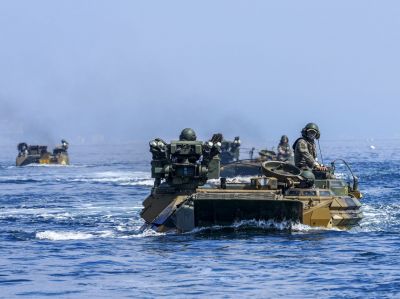
During this exercise, the ROK and U.S. Marine Corps are enhancing their combined operational capabilities through more than 10 realistic training tasks. These range from branch- and echelon-specific training such as infantry, reconnaissance, mechanized, engineer, air defense, and medical, all based on combat missions, to battalion-level amphibious landing exercises that verify the integrated operational capabilities of all elements.
First, from July 21 to August 1, battalion-level combined infantry training was conducted separately at the 1st Division (Pohang) and 2nd Division (Gimpo). ROK and U.S. Marines formed combined units to conduct river-crossing and rappelling mountain warfare training, urban area close-quarters combat skills training, and live-fire exercises with individual and crew-served weapons. These activities helped to operationalize small unit ground combat procedures and allowed for the sharing of mutual know-how.
During the same period, combined CBRN training focused on unexploded chemical munitions and weapons of mass destruction removal, reconnaissance and decontamination, and response to unexpected situations was conducted in Gimpo and Dongducheon. In Pocheon, combined engineer training to improve IED response and mobility/counter-mobility support capabilities, as well as combined medical training to master combat casualty care, were carried out simultaneously.
In particular, during the combined infantry training, the use of drones enabled detection of enemy threats and secured entry routes, thereby enhancing battlefield awareness. In the combined engineer training, ultra-compact tactical ground robots were used to detect and remove explosives, providing an opportunity to understand and experience operational concepts of unmanned combat systems.
Additionally, since July 31, the core combined amphibious landing exercise has been taking place in Pohang. On this day, ROK and U.S. Marines conducted a "decisive action" in the areas of Dokseok-ri Beach and Josari using amphibious assets such as KAAVs, Marineon helicopters, and CH-47 helicopters.
Colonel Woo Seunggi, commander of the 23rd Battalion, who participated in the infantry and amphibious training, stated, "All the training sessions where we sweated together and exchanged combat skills with the U.S. Marine Corps provided a great opportunity to instill pride and confidence in every member of the battalion," adding, "We will continue to become even stronger Marines and earn the trust of our country and people."
© The Asia Business Daily(www.asiae.co.kr). All rights reserved.

![Clutching a Stolen Dior Bag, Saying "I Hate Being Poor but Real"... The Grotesque Con of a "Human Knockoff" [Slate]](https://cwcontent.asiae.co.kr/asiaresize/183/2026021902243444107_1771435474.jpg)















