Selective Bidding Strategy Drives Major Builders’ Focus on Seoul Metropolitan Area and Major Cities
Profitability and Demand in Key Regions Lead to Strong Performance Amid Market Downturn

Major construction companies continue to pursue a selective bidding strategy, focusing on regions with guaranteed profitability such as the Seoul metropolitan area. This is because they can set sales prices that offset rising construction costs, which is cited as a key reason for their resilient performance even as the construction market downturn persists.
As of the end of the second quarter this year, GS E&C's housing order backlog stood at 31.7797 trillion won, with Seoul and Gyeonggi Province accounting for 30.7% and 23.2% of the total, respectively. Excluding Incheon, these two regions still made up more than half of the backlog. This is a slight decrease of 0.3 percentage points from 54.2% in the first quarter, but the share remains above 50%. Including Incheon, the share of major metropolitan cities rose from 25.1% in the first quarter to 26.5% in the second quarter. In contrast, the share of housing order backlog in non-metropolitan provincial areas fell by 1.1 percentage points, from 20.7% in the first quarter to 19.6% in the second quarter.
GS E&C's new orders in the first half of this year were also concentrated in more desirable locations such as the Seoul metropolitan area and major cities, rather than provincial regions. Key projects secured by the Architecture and Housing Division include the Boksan 1 District Housing Redevelopment Project in Dongnae-gu, Busan (1.1392 trillion won), the Bongcheon 14 District Housing Redevelopment Project in Gwanak-gu, Seoul (627.5 billion won), the Osannaesammi 2 District Apartment Project in Osan, Gyeonggi Province (547.8 billion won), and the Sillim 1 Urban Renewal Project in Gwanak-gu, Seoul (461.6 billion won).
Other construction companies also tend to focus on regions where profitability is assured. According to disclosures on the Financial Supervisory Service's electronic disclosure system by DL E&C, Samsung C&T, Hyundai E&C, and Daewoo E&C, with the exception of Daewoo E&C's announcement in January regarding the Bunpyeong-Mipyeong District Apartment Construction Project in Seowon-gu, Cheongju, North Chungcheong Province (414.3 billion won), most projects are concentrated in the Seoul metropolitan area-including Suwon, Gwacheon, Gimpo, and Seo-gu in Incheon-as well as major cities such as Daejeon.
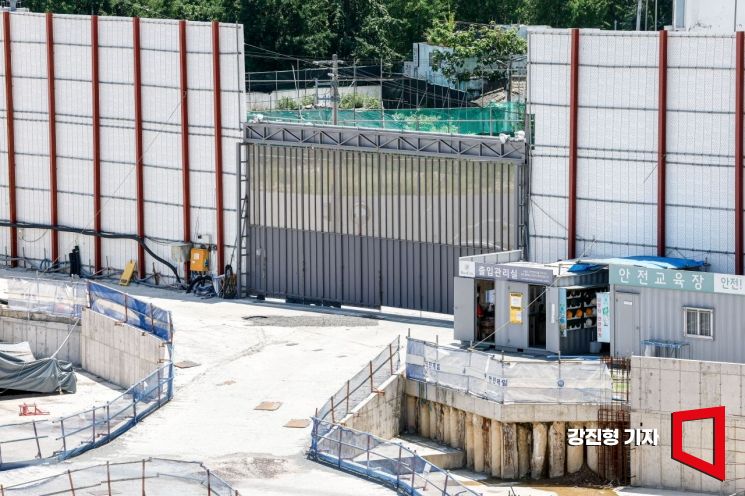 An apartment construction site in Daemyeong-dong, Nam-gu, Daegu, visited in June this year. The construction is halted. Photo by Kang Jinhyung
The reason major construction companies are selectively bidding in these regions is not only because there is strong demand, but also because they can absorb higher construction costs. Even if sales prices are raised to reflect increased construction costs, the market can accept these prices due to expectations of rising home values. In contrast, the provincial presale market continues to struggle with a prolonged downturn and persistent unsold inventory risks, making companies hesitant to bid for projects there.
This selective bidding strategy appears to have contributed to improved performance. GS E&C's consolidated operating profit for the second quarter reached 162.1 billion won, up 74% from the same period last year. For the first half of the year, operating profit was 232.4 billion won, a 42% increase year-on-year. The Architecture and Housing Division's second-quarter revenue was 2.1484 trillion won, up 7% from the previous quarter. DL E&C's second-quarter operating profit was tallied at 126.2 billion won, about four times higher than the same period last year.
An industry insider commented, "Not only has the presale market in provincial areas deteriorated, but there are also fewer profitable projects being offered, so major construction companies are not actively participating in bidding. Given the ongoing structural challenges such as rising labor and material costs and the continued slump in the provincial construction market, companies will likely maintain their selective bidding strategies to improve performance going forward."
© The Asia Business Daily(www.asiae.co.kr). All rights reserved.