High School Credit System Advisory Committee Holds Two Meetings
Improvement Plan to Be Prepared in the Second Half of the Year
Early Childhood Education Integration and Protection of Teachers' Rights Remain Unresolved
AI Textbook Issue Settled for Now, but Lawsuits and Aftereffects Continue
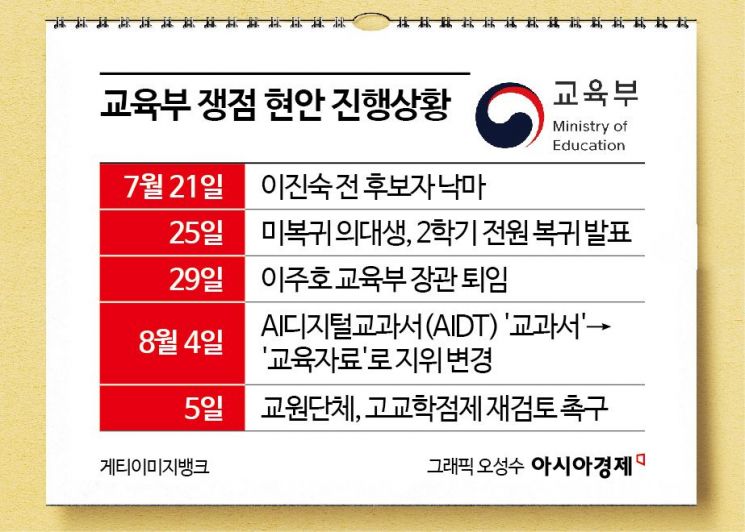
With the position of the new Minister of Education still vacant, major education issues are being addressed one after another. The prolonged conflict between the government and medical students was resolved, at least for now, as all medical students who had not returned for the second semester announced their return. The highly controversial Artificial Intelligence Digital Textbook (AIDT) was downgraded from 'textbook' to 'educational material' with the passage of the amendment to the Elementary and Secondary Education Act on August 4.
However, pressing issues such as the integration of early childhood education and care, and the protection of teachers' rights remain unresolved, making the appointment of an Education Minister with both field experience and political acumen urgently needed. Meanwhile, as the new semester approaches, calls for improvements to the high school credit system are growing in schools, making it the next major issue following the government-medical student conflict and AIDT controversy.
According to the Ministry of Education on August 6, the Advisory Committee for the Improvement of the High School Credit System, which was formed on July 17, has held two regular meetings so far to gather opinions from the field. The committee, consisting of 21 members including teachers, professors, students, and parents, is discussing ways to supplement the credit system and plans to prepare an improvement plan in the second half of the year.
The high school credit system allows students to graduate by earning 192 credits over three years of high school and was introduced during the Moon Jae-in administration based on absolute grading. However, under the Yoon Suk-yeol administration, relative grading has been applied, raising concerns about students flocking to certain subjects. In particular, starting this year, the internal grading scale for first-year students changed from a nine-tier to a five-tier system, intensifying the issue of advantages and disadvantages depending on elective subjects. While this year focuses mainly on core subjects, from next year, relative grading for elective subjects will be fully implemented, which is expected to increase confusion. In the first year of implementation, students take only common subjects such as Korean, mathematics, English, social studies, and science, but from the second year, they can choose electives, marking the full-scale implementation of the credit system.
Teachers have also pointed out the excessive workload resulting from the credit system. On August 5, three teachers' organizations and some members of the National Assembly called for a complete reexamination of the high school credit system. According to a survey of 4,162 high school teachers nationwide, 78.5% were responsible for two or more subjects, and among them, 86.4% expressed concern about a decline in the quality of instruction.
The Ministry of Education maintains that the system will be retained but with effective improvements. The three teachers' organizations also lean toward a 'comprehensive reexamination' rather than outright abolition. An official from the National Assembly's Education Committee stated, "We will first see to what extent the high school credit system is included in the National Policy Planning Committee's agenda, and only then will we consider whether discussions on abolishing the system are necessary." A Ministry of Education official said, "We are actively collecting feedback from the field to create an improvement plan that will increase acceptance," adding, "We will make sure it does not end as a stopgap measure."
While the government-medical student conflict and the AI textbook issue appear to have been settled, some aftereffects are expected, requiring a response from the government. On this day, AI textbook developers and publishers held a press conference in Yeouido, announcing plans to file a constitutional complaint, an administrative lawsuit, and a damages claim against the government.
AI textbook developers strongly protested, saying, "We invested about 800 billion won in developing AI textbooks based on trust in the government, but now we are effectively being forced out of the market."
© The Asia Business Daily(www.asiae.co.kr). All rights reserved.