Trump Administration's Intentions Revealed in Recent U.S.-South Korea Defense Ministers' Call
Summit May See Demands for Increased Defense Spending and Strategic Flexibility
Elbridge Colby, the U.S. Deputy Secretary of Defense for Policy, who has emerged as a key figure in shaping the Trump administration's global alliance strategy, recently drew attention by expressing expectations for South Korea to play a greater role in North Korea defense and defense spending.
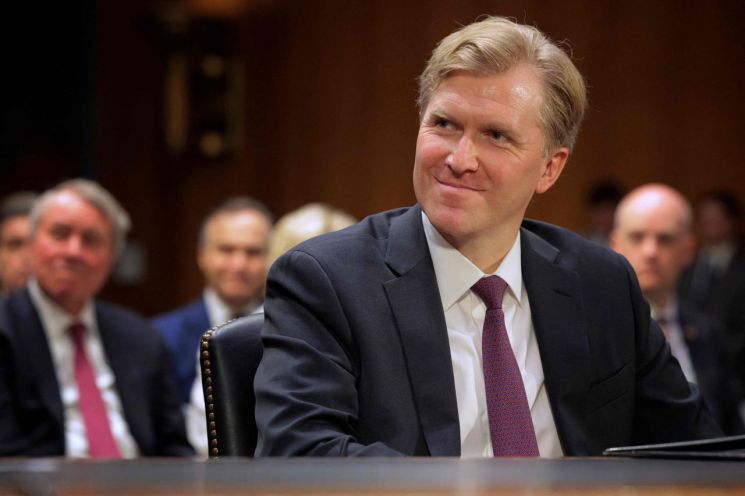
On July 31, commenting on the phone call between the U.S. and South Korean defense ministers, Colby posted on X (formerly Twitter), "South Korea continues to be a role model in defense spending and is willing to take a more leading role in strong defense against North Korea." He added, "The U.S. and South Korea are closely linked in the need to modernize the alliance in response to the regional security environment," and, "We will work closely with South Korea to create a strategically sustainable alliance that is ready to defend against common threats."
This post, made ahead of the U.S.-South Korea summit, is seen as an explicit indication of the Trump administration's expectations regarding South Korea's role within the alliance. The 'leading role in North Korea defense' mentioned by Colby essentially reflects the view or expectation that the U.S. needs to allocate more military resources to the Indo-Pacific region for China deterrence, so South Korea should take on a greater share of conventional defense against North Korea and therefore needs to increase its defense spending.
It was previously reported by U.S. media that the Trump administration, in its 'Interim National Defense Strategy Guidance' prepared in March, prioritized defending against a potential Chinese invasion of Taiwan and protecting the U.S. homeland, while planning to leave most responses to other threats such as North Korea and Iran to allied countries. In particular, Colby has long argued, even before joining the administration, that while the U.S. should continue to provide extended deterrence (the nuclear umbrella) to protect South Korea from North Korea's nuclear weapons, South Korea should take a more leading role in defending against North Korea's conventional threats. His consistent stance has not changed since becoming Deputy Secretary.
Furthermore, Colby's mention of South Korea's leading role in North Korea defense appears to be connected to the possibility of accelerating discussions on the transfer of wartime operational control, a process the South Korean government has pursued since the administration of former President Roh Moo-hyun.
Regarding the mention of 'defense spending,' there is room to interpret this as being linked to President Trump's recent push for NATO member states to agree to a defense spending standard of 5% of GDP, a benchmark that he has successfully obtained. The intention appears to be to apply the same '5% of GDP defense spending' standard used in NATO to U.S. alliances in Asia, and to encourage South Korea, ahead of the summit, to take the lead in meeting this expectation.
Previously, on June 19, U.S. Department of Defense spokesperson Sean Parnell stated that U.S. allies in Asia should also spend around 5% of their GDP on defense. According to South Korea's Ministry of National Defense, South Korea's defense budget this year is 61.2469 trillion won, which is 2.32% of its GDP; raising this to 5% would mean more than doubling the current level.
Additionally, Colby's references to "alliance modernization," "defending against common threats," and a "strategically sustainable alliance" indicate a perception that the U.S.-South Korea alliance should play a role not only in countering North Korea but also in deterring threats from China, the U.S.'s top strategic competitor.
Given Colby's long-held views, there is growing speculation that the U.S. will pursue so-called "strategic flexibility," expanding the role and operational range of U.S. Forces Korea to prepare for a potential Chinese invasion of Taiwan. In this context, the Financial Times (FT) reported on July 12 that in recent meetings with Japanese and Australian defense officials, Colby asked them to clarify what roles Japan and Australia would play if the U.S. went to war with China over Taiwan.
Colby, who previously served as Deputy Assistant Secretary of Defense for Strategy and Force Development during the first Trump administration, has been given a key role in the second Trump administration and is leading the development of the "America First" defense policy. In particular, he is heading the formulation of the new U.S. National Defense Strategy (NDS), which is expected to be released in late summer this year.
© The Asia Business Daily(www.asiae.co.kr). All rights reserved.












