Joint Keynote with Meta... Outlining the Future Direction
Debut of Gen6 Controller "Sierra"
Ten Years of Dedicated Technology Development Since Founding
Leading Storage Innovation for the AI Era
Pado, a semiconductor company specializing in data center solutions, announced on August 6 that it participated in 'FMS 2025,' held from August 5 to 7 (local time) in Santa Clara, California, USA. At the event, the company unveiled its next-generation solid-state drive (SSD) technology strategy for the era of artificial intelligence (AI) and shared its corporate vision for the next decade.
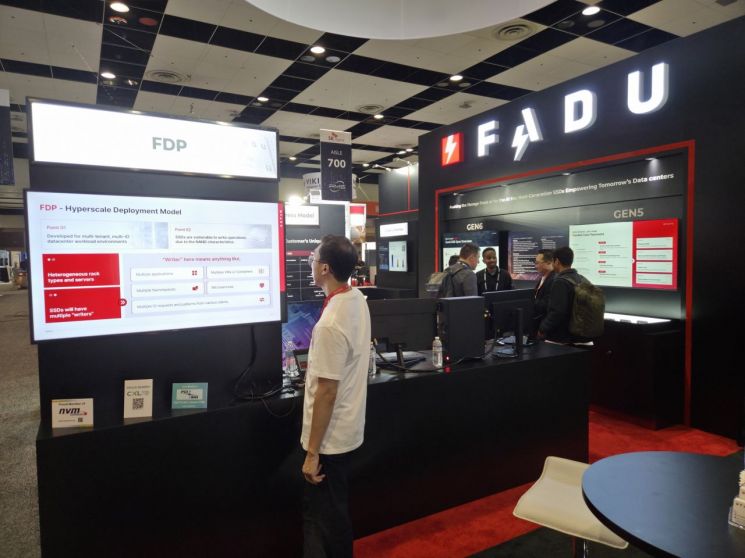 Pado booth installed at 'FMS 2025,' the world's largest memory and storage technology exhibition. Photo by Pado
On the opening day, August 5, Pado CEO Lee Jiho appeared as a joint keynote speaker alongside Ross Stenfort, a hardware systems engineer at Meta. Together, they delivered a keynote address titled "Expanding the Boundaries of Storage: Next-Generation SSDs for AI Data Centers," sharing storage architectures optimized for AI data center environments and outlining mid- to long-term strategies.
Reflecting on Pado's journey as it marks its 10th anniversary this year, CEO Lee explained that the storage market can be divided into three generations, and that the industry has now entered the era of "third-generation AI SSDs" designed to handle AI workloads.
He emphasized the importance of not only improving SSD controller performance, but also considering power efficiency in design, highlighting Pado's philosophy of low-power, high-efficiency engineering. Lee then outlined the company's technology roadmap for the AI era, including plans to achieve processing of 100 million data transactions per second, support for 512 terabytes (TB) of storage capacity, and the development of petabyte (PB)-class SSD controllers.
At this event, Pado set up a large-scale exhibition booth comparable to those of global corporations and unveiled a range of next-generation storage technologies optimized for AI and cloud workloads.
Pado showcased the achievements of its Gen5 SSD controllers, which have seen significant market adoption this year, and introduced for the first time its sixth-generation controller, codenamed "Sierra," based on PCIe 6.0. This product boasts more than twice the performance of existing Gen5 products, supports up to 512TB of capacity, delivers sequential read and write speeds of 28.5 gigabytes (GB) per second, random read performance of 6.9 million input/output operations per second (IOPS), and random write performance of 1 million IOPS (with 7% over-provisioning), all while maintaining industry-leading performance and a low-power structure consuming less than 9W.
Pado also unveiled its "Device Self Power Monitoring (DSPM)" technology, based on the next-generation NVMe specification jointly proposed by industry leaders such as Meta. This technology measures and analyzes real-time power data within the SSD by integrating the controller's firmware (FW) and the power management integrated circuit (PMIC). This enables accurate power prediction during server design and improves energy efficiency during operation, helping to reduce capital expenditures (CapEx) and operating expenses (OpEx), thereby lowering total cost of ownership (TCO).
The company also exhibited key technologies designed to meet the advanced demands of AI data center environments. These included FDP, which eliminates interference between users in multi-user environments and physically separates the SSD's internal structure to ensure consistent performance and lifespan; QLC, an ultra-high-density storage technology optimized for AI training and inference servers; and PMIC technology, which achieves both power efficiency and system stability. Through these solutions, Pado demonstrated its capabilities as a leading enterprise SSD technology provider, excelling in performance, longevity, and energy efficiency.
Pado also introduced a new business model called "FlexSSD," designed to flexibly meet the demand for customized SSD development. This model involves joint hardware and software design from firmware (FW) development to validation, going beyond simple chip supply to deliver optimized system quality and integrated efficiency. Based on this approach, Pado plans to use FlexSSD as a strategic foundation to address customers' real-world challenges, respond to next-generation demand, and expand new customer touchpoints.
CEO Lee Jiho stated, "Since our founding in 2015, Pado has dedicated the past ten years to technology development, striving to create the world's fastest and most innovative SSD controllers with a focus on the global market, and has proven its technological capabilities to global clients. We will continue to lead the storage market in the AI era by providing SSDs with greater capacity, faster performance, and higher efficiency."
© The Asia Business Daily(www.asiae.co.kr). All rights reserved.
![Clutching a Stolen Dior Bag, Saying "I Hate Being Poor but Real"... The Grotesque Con of a "Human Knockoff" [Slate]](https://cwcontent.asiae.co.kr/asiaresize/183/2026021902243444107_1771435474.jpg)
















