There is still a strong possibility that the Bank of Korea will cut interest rates in August, ahead of the US Federal Reserve (Fed), according to analysis from the securities industry. Despite the implementation of an additional supplementary budget, downside risks to the economy persist. In addition, the inflation rate is in line with the 2% target, and there are signs of stabilization in the previously overheated Seoul housing market. From the perspective of the bond market, some experts suggest that investors should seek opportunities in long-term rather than short-term government bonds.
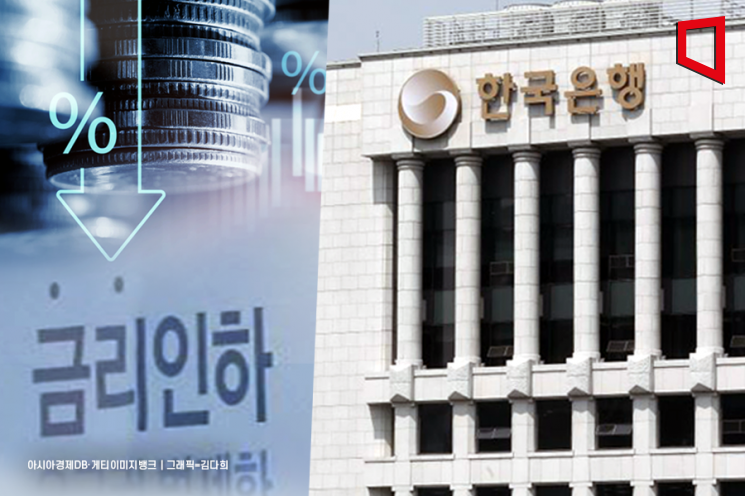
Kim Myungshil, a researcher at iM Securities, stated in a bond brief titled "August, the Trigger for a Rate Cut" on the 6th, "The main decision variables for the August Monetary Policy Board (MPC) meeting of the Bank of Korea are ▲growth rate ▲inflation ▲financial stability (slowing household loans, housing price stabilization)," explaining the outlook.
First, Kim noted, "Domestic demand in the second half of the year is recovering, supported by the supplementary budget, but exports are slowing due to the impact of US tariffs, so downside risks to the economy remain." He also pointed out that the domestic Consumer Price Index (CPI) in July rose 2.1% year-on-year, a slowdown from the previous month's 2.2%, stating, "Inflation is converging toward the Bank of Korea's medium-term target of 2%." Regarding financial stability, he commented, "Although it is difficult to be certain about a trend of stability, the fact that the rapid surge in the housing market is subsiding means the likelihood of a rate cut in August remains high."
Kim paid particular attention to changes in the housing market following the announcement of the household debt management plan on June 27. He said, "Despite growing expectations for a Fed rate cut in September, there are still several factors that need to be confirmed domestically before being certain about a Bank of Korea rate cut in August. Notably, these include a decrease in household loans related to the real estate market and whether the upward trend in housing prices is slowing."
He continued, "A recent positive signal is that, since the announcement of the June 27 household debt management plan, the weekly increase in apartment sale prices in Seoul and the metropolitan area has slowed for five consecutive weeks." He added, "Apartment transaction volumes in Seoul, Incheon, and Gyeonggi in July decreased by 70%, 54%, and 61%, respectively, compared to June. The outstanding balance of household loans at the five major banks also fell from 6.8 trillion won in June to 4.1 trillion won in July."
He explained, "Since July, commercial banks have been actively participating in reducing or suspending household loans, so from the second half of the year, the effect of loan suspensions is expected to be fully reflected in housing prices and changes in loan balances." He further analyzed the housing market, saying, "Although there is debate over the possibility of a long-term downturn, given the unusually strong measures in the June 27 plan, it will likely be difficult for real estate transactions to increase significantly for the time being."
However, from the perspective of the bond market, even if expectations for a rate cut in August spread, the prospect of discussions about the end point of the Bank of Korea's rate cuts may become more prominent around the time of the cut, which is not a welcome development. Kim noted, "If the effects of the rate cuts that began in October 2024 and the economic improvement from fiscal policy become partially visible, there is a possibility that short-term expected interest rates (reflecting monetary policy) could start to rise again." He added, "Term premiums (reflecting supply and demand factors) could also face upward pressure depending on the details of next year's budget, the medium-term fiscal management plan (end of August), and the annual government bond issuance plan (end of December)."
Accordingly, he said, "Going forward, investment opportunities in government bonds are more likely to be found in long-term bonds, where there is established market demand, rather than in short-term bonds, where there is little room left for additional rate cuts." He predicted that if the Bank of Korea implements another rate cut in August, demand for short-term bonds will quickly diminish. He continued, "If there is no strong conviction for a 2.0% base rate by year-end, the lower bound for the 3-year government bond yield should be around 2.30%," and "For the 10-year government bond, even if expectations for monetary policy are low, favorable factors such as supply and demand and yield attractiveness remain, so from the point of the August rate cut, the 3/10-year spread is expected to narrow to the mid-20bp range (1bp = 0.01 percentage point)."
Meanwhile, in the US, expectations that the Fed will implement a rate cut in September are growing following the release of the July jobs report. Kim commented, "Overall, weak employment indicators and growing differences of opinion among Fed members can be interpreted as green lights for a Fed rate cut." He added, "As early as the August Jackson Hole Symposium, before the September Federal Open Market Committee (FOMC) meeting, we may be able to see whether Chair Jerome Powell's perspective has changed."
© The Asia Business Daily(www.asiae.co.kr). All rights reserved.












