Emergency Economic Task Force TF shifts to Growth Strategy TF
Major transition toward becoming the top "Physical AI" nation
Easing criminal penalties for corporate offenses such as breach of trust
"Focus on growth policies after tariff negotiations"
The government is shifting the 'Emergency Economic Task Force (TF)' to a 'Growth Strategy TF' following the conclusion of tariff negotiations with the United States, and is set to fully implement a strategy to transition to a super-innovative, enterprise-driven economy. The aim is to provide comprehensive support to reduce the management burden on companies and enhance global competitiveness.
On August 5, Deputy Prime Minister and Minister of Economy and Finance Koo Yooncheol stated in his opening remarks at the first meeting of the Growth Strategy TF, "The next five years are the last golden time for Korea to transition to a super-innovative economy," and added, "We will place companies at the center of everything in the Korean economy and provide full support to help them achieve world-leading competitiveness."
The first meeting was attended by the six major economic organizations?Korea Federation of SMEs, Federation of Korean Industries, Korea Employers Federation, Korea Chamber of Commerce and Industry, Korea International Trade Association, and Korea Federation of Middle Market Enterprises?as well as relevant ministries such as the Ministry of SMEs and Startups, Ministry of Justice, and Ministry of Trade, Industry and Energy.
He said, "The dramatic conclusion of the tariff negotiations with the United States has reduced uncertainty in our economy," but also acknowledged, "It is true that the burden on companies has increased compared to before." He emphasized that the government will continue to visit the field and communicate closely with companies to devise measures to minimize damages. He added, "We will do our utmost to ensure that the $350 billion 'Strategic Industry Cooperation Package,' including shipbuilding, provides new business opportunities for companies."
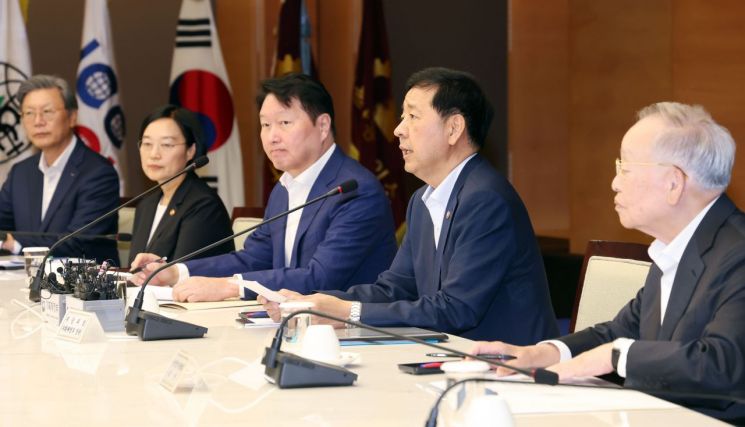 Deputy Prime Minister and Minister of Economy and Finance Koo Yoonchul is delivering a keynote speech at the first Growth Strategy TF meeting with heads of six economic organizations held at the Korea Chamber of Commerce and Industry in Seoul on the 5th. Photo by Yonhap News Agency
The government will pursue a major transformation in artificial intelligence with the goal of becoming the 'world's leading physical AI nation.' Minister Koo stated, "We will establish a cooperative system among companies, the government, and universities to commercialize core technologies such as AI manufacturing robots and AI autonomous driving," and added, "We will also make every effort to utilize data and foster AI talent."
Measures to ease the management burden on companies were also announced. Minister Koo said, "We will conduct a comprehensive review of Galapagos-style corporate regulations and rationalize economic criminal penalties to align with global standards." He explained, "We will convert criminal penalties, including for breach of trust, into monetary fines and other measures to reduce the criminal liability risks for CEOs, while ensuring that victims receive substantial compensation for damages."
The government plans to include these measures in the 'New Government Economic Growth Strategy' and the budget proposal to be announced later this month.
Choi Taewon, Chairman of the Korea Chamber of Commerce and Industry, also stated at the TF meeting, "It is a great relief that the uncertainty over tariffs has been resolved," and evaluated, "As the international order is changing, it is very timely for our government to focus on growth policies based on pragmatism."
He also suggested to the government, "A new approach is needed," and added, "Above all, if we want to achieve growth, the system must be designed to guarantee the freedom and creativity of corporate activities, which are the main drivers of growth." He emphasized that as companies grow, they should not be subject to discriminatory regulations.
Chairman Choi added that new methods of capital procurement should be considered for investments in the United States totaling $350 billion, including in AI and advanced industries.
© The Asia Business Daily(www.asiae.co.kr). All rights reserved.












