Changes in How the Young Generation Seeks Inner Comfort
Concerns About Jobs, Relationships, and Social Life
Turning to Tarot and Four Pillars of Destiny for Answers
69% of People in Their Twenties Say "No Religion"
On August 4, at a tarot shop in Gangbuk-gu, Seoul, Seongyeon Na (24) was receiving a Four Pillars of Destiny reading. After confirming Na's date of birth, the tarot consultant spread out the cards and said, "It seems you have many concerns about your career. Things will start to improve from September." Na commented, "I don't have a particular religion, but in anxious times like these, simply having someone listen to me brings comfort."
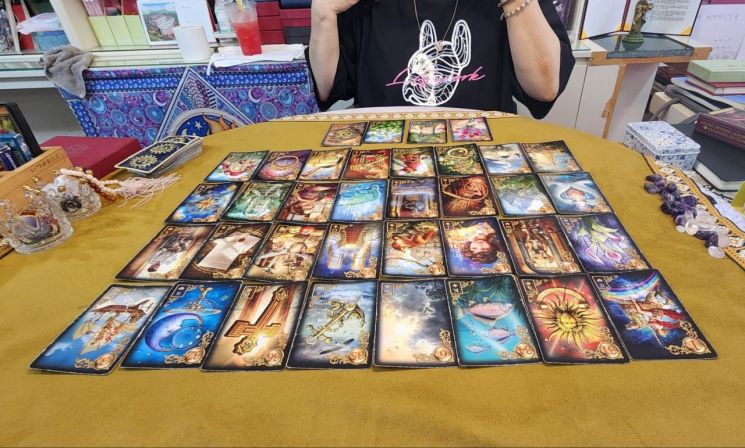 Ra Hee, who has been working as a tarot consultant in Jongno-gu for seven years, is demonstrating a Four Pillars of Destiny reading. Photo by Byun Seonjin
The way the younger generation seeks inner comfort is changing. While interest in divination methods such as tarot and Four Pillars of Destiny is growing, institutionalized religions are increasingly being neglected.
Ra Hee (61), who has been working as a tarot consultant in Jongno-gu for seven years, explained, "Seven out of ten clients are in their twenties or thirties. Most of them come with practical concerns about employment, relationships, and interpersonal issues." Lee, who operates a fortune-telling house in Dongdaemun-gu, said, "In the past, most visitors were in their forties or fifties, but now, many young people are coming."
Some people even consult ChatGPT for Four Pillars of Destiny readings. Shin (28), an office worker, said, "Since tarot shop fees are not cheap, I once entered my Four Pillars of Destiny information online and asked ChatGPT for an interpretation." On Instagram, there are around one million hashtags related to tarot and Four Pillars of Destiny. According to Playboard, a YouTube statistics website, there are 2,684 domestic channels related to fortune-telling.
As divination and Four Pillars of Destiny readings gain popularity among young people, it is estimated that the number of related practitioners has also surged. According to the Korea Research Institute for Vocational Education and Training, the number of private tarot-related certifications increased more than sixfold, from 76 in 2018 to 470 as of August this year. Last year, a total of 2,660 people took exams for tarot-related certifications.
In contrast, institutionalized religions are increasingly being shunned by the younger generation. According to the regular "Religious Perception Survey" conducted by Korea Research, the proportion of people in their twenties and thirties who responded that they "have no religion" rose from 65% and 59% in 2018 to 69% and 63% last year, respectively. This contrasts with the fact that only 30% of those aged 70 and older identified as having no religion.
Analysts say this phenomenon results from changes in how the younger generation seeks comfort and their overall attitude toward life. Many feel burdened by the structure of institutionalized religion, which requires regular attendance and religious devotion. Kwak Geumju, a professor of psychology at Seoul National University, explained, "Young people feel pressured by faith that requires belonging to a community or devotion to doctrine, but the inner desire for comfort still exists. The popularity of divination and fortune-telling does not mean belief itself has disappeared, but rather that it has become more personal and flexible."
© The Asia Business Daily(www.asiae.co.kr). All rights reserved.

















