Video Call at FKI Roundtable Reveals Direct U.S. Pressure for Tangible Investment
"Negative Impact on Automotive Tariffs Is Inevitable"
U.S. trade experts have emphasized that Korea's $350 billion (approximately 486 trillion won) investment in the United States must be realized as a prerequisite for the 15% mutual tariff agreement between Korea and the U.S. They strongly demanded Korea's fulfillment of its investment as a key condition for expanding domestic production and creating jobs in the U.S., which is being interpreted as a sign of increasing American pressure regarding investments.
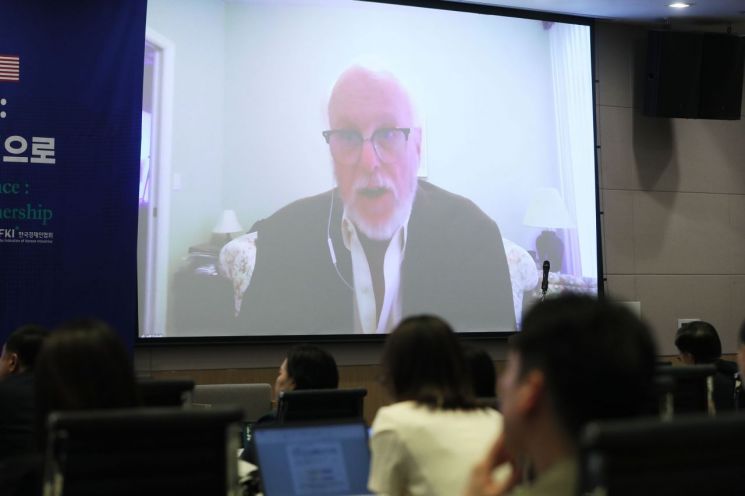 Jeffrey Short, Senior Fellow at the Peterson Institute for International Economics (PIIE), delivered a keynote speech via video conference at the roundtable titled "Evolving Korea-US Economic Alliance: Beyond Tariffs to Technology and Industrial Cooperation" held at the FKI Tower Conference Center on the 5th. Photo by Korea Economic Association
On August 5, Jeffrey Schott, Senior Fellow at the Peterson Institute for International Economics (PIIE), participated via video call in the roundtable discussion "The Evolving Korea-U.S. Economic Alliance: Beyond Tariffs to Technology and Industrial Cooperation," hosted by the Federation of Korean Industries at the FKI Tower Conference Center in Yeouido, Seoul. He stated, "We hope that this investment commitment will actually lead to expanded production in the U.S. and invigorate trade between the two countries." This remark reflects the U.S. perspective that the agreement should not remain a mere promise but must result in tangible outcomes.
Schott particularly highlighted the "Make American Shipbuilding Great Again (MASGA) Project," an agreement between Korea and the U.S. focusing on cooperation in the shipbuilding industry. He said, "From the U.S. perspective, this has provided an opportunity to bring in technological expertise from Korean shipbuilding," and added, "There is great anticipation regarding the establishment of a joint fund between Korea and the U.S. I believe this can further strengthen America's shipbuilding capabilities and even lead to defense industry cooperation." By emphasizing the importance of Korean investment in the U.S., including in shipbuilding, for restoring the competitiveness of American industries, the U.S. side made it clear that the agreement must result in actual investment implementation.
He also analyzed that Korea's automotive industry is likely to be significantly affected by the tariffs. Schott said, "Statistics show that last year, Korea posted a trade surplus of about $47 billion with the U.S., largely through automotive trade. This accounts for 70% of Korea's total trade surplus with the U.S.," and added, "Due to the impact of tariffs, Korea will have to compete on price with Japan, Europe, and Mexico going forward." He further advised, "Considering the current political situation in the U.S., Korea needs to strengthen its supply chains."
Patrick Cronin, Chair for Asia-Pacific Security at the Hudson Institute, who also participated, stressed, "With this large-scale investment commitment in key industries, Korea will play the role of a strong and capable U.S. ally in the future."
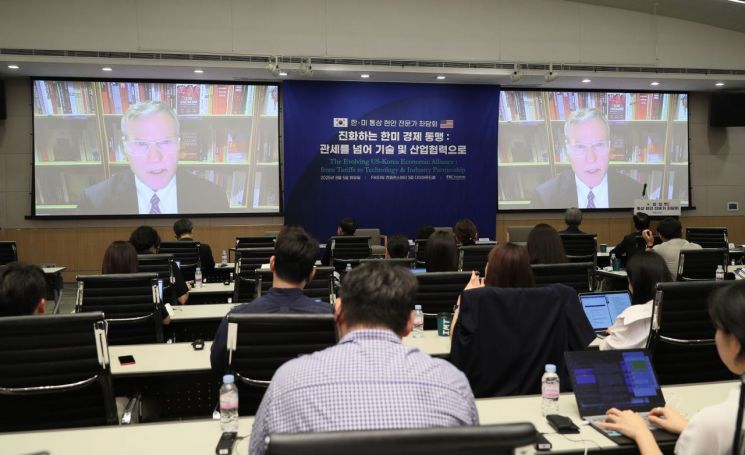 Jeffrey Short, Senior Fellow at the Peterson Institute for International Economics (PIIE), delivered a keynote speech via video conference at the roundtable titled "Evolving Korea-US Economic Alliance: Beyond Tariffs to Technology and Industrial Cooperation" held at the FKI Tower Conference Center on the 5th. Photo by Korea Economic Association
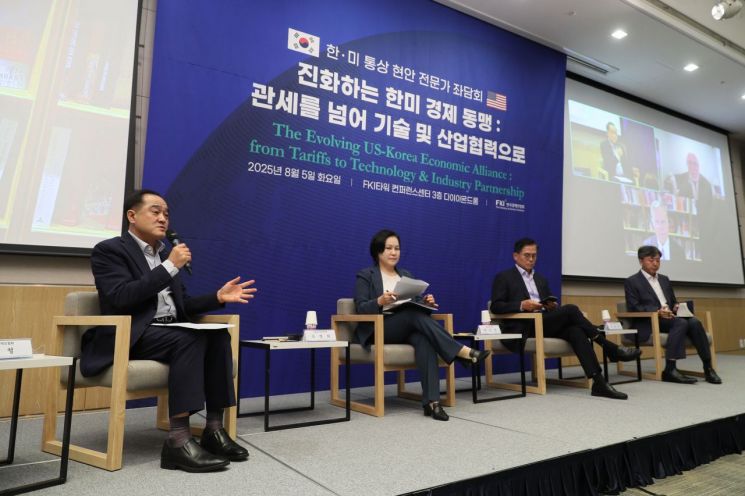 Jung Chul, president of the Korea Economic Research Institute, is speaking at the panel discussion titled "Evolving Korea-US Economic Alliance: Beyond Tariffs to Technology and Industrial Cooperation" held at the FKI Tower Conference Center on the 5th. Photo by Korea Economic Association
These remarks suggest that, following the conclusion of the Korea-U.S. tariff negotiations on July 31, the U.S. is likely to urge Korea to fulfill its investment commitments. The U.S. is urgently demanding Korean investment as a means to address its own economic challenges, such as recession and job shortages.
In contrast, Korean trade experts emphasized that, rather than focusing solely on investment in the U.S., efforts should be made in the upcoming detailed negotiations on tariffs to secure practical benefits for Korean companies.
Yoo Myunghee, former Minister for Trade and current professor at Seoul National University's Graduate School of International Studies, stated during the panel discussion, "Now is the time to devise strategies that can resolve practical issues for our companies while building a mutually beneficial cooperative structure with the U.S. in the detailed negotiations." She added, "As Korean companies are increasingly focusing on investments in the U.S., concerns are growing about the hollowing out of domestic industries. Therefore, it is more important than ever for the government to create an environment that can maintain the competitiveness of the manufacturing sector through active deregulation policies."
Lee Jaemin, former Chairman of the Korea Trade Commission and current Dean of the Seoul National University School of Law, who also participated as a panelist, said, "It is too early to assess the actual impact at this stage," but added, "The substantive negotiations are just beginning. In the interpretation and implementation of key issues, a meticulous and strategic response is needed to ensure our position is fully reflected." Choi Seokyoung, former Ambassador to the Geneva Mission and current advisor at Kwangjang Law Firm, also advised, "As additional discussions on security issues such as defense cost-sharing and the adjustment of U.S. Forces Korea's role are expected through future summits and documentation processes, strategic preparation is necessary. Since there are differences between Korea and the U.S. regarding the establishment of the $350 billion investment fund, the government must respond with clear principles and standards."
© The Asia Business Daily(www.asiae.co.kr). All rights reserved.
![Clutching a Stolen Dior Bag, Saying "I Hate Being Poor but Real"... The Grotesque Con of a "Human Knockoff" [Slate]](https://cwcontent.asiae.co.kr/asiaresize/183/2026021902243444107_1771435474.jpg)


















